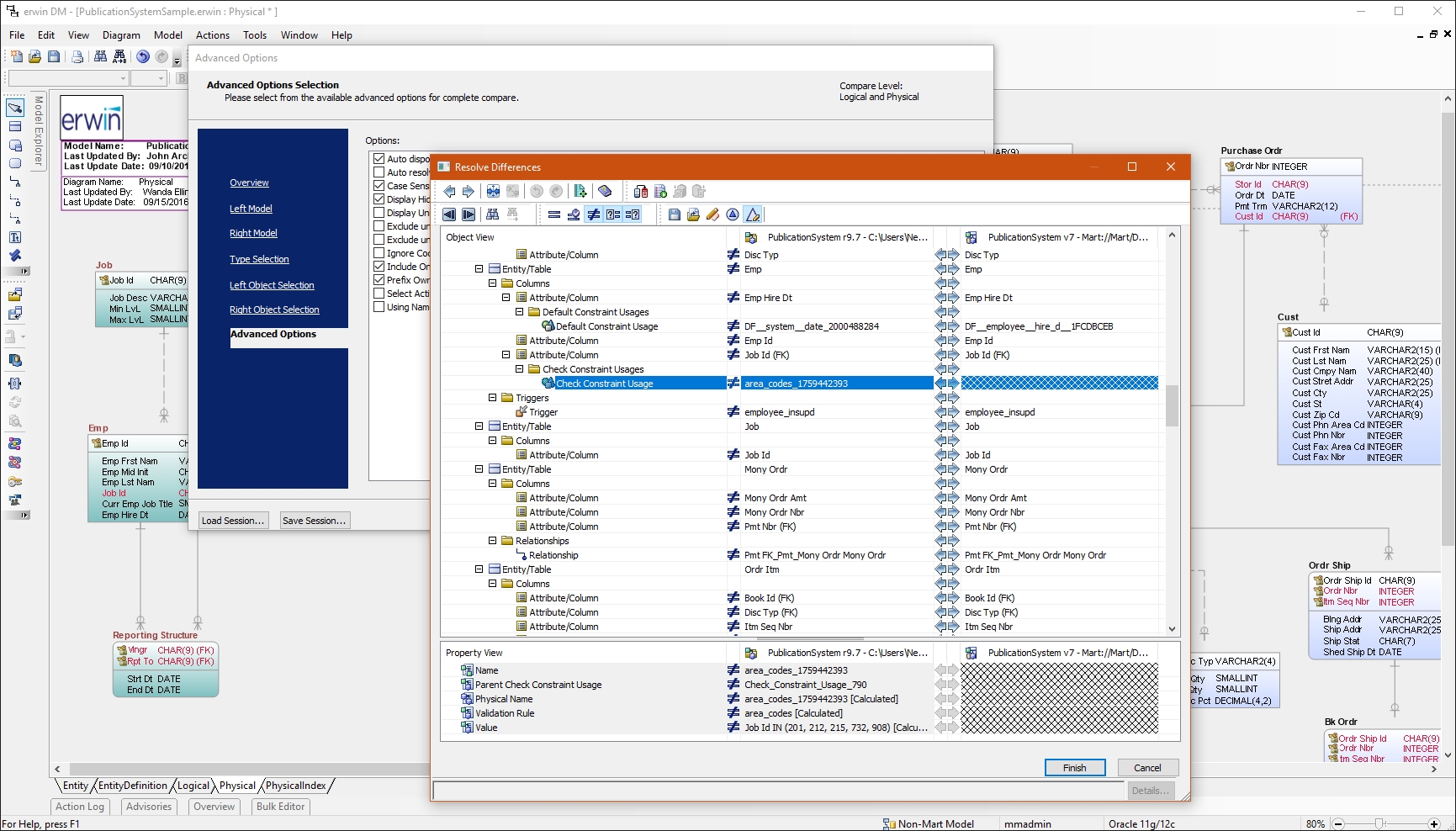
erwin Data Modeler by Quest is a data modeling tool used to find, visualize, design, deploy and standardize high-quality enterprise data assets. It can discover and document any data from anywhere for consistency, clarity and artifact reuse across large-scale data integration, master data management, metadata management, Big Data, business intelligence and analytics initiatives, accomplishing this whil esupporting data governance and intelligence efforts.
N/A
Informatica Cloud Data Quality
Score6.9 out of 10
N/A
The vendor states that Informatica Data Quality empowers companies to take a holistic approach to managing data quality across the entire organization, and that with Informatica Data Quality, users are able to ensure the success of data-driven digital transformation initiatives and projects across users, types, and scale, while also automating mission-critical tasks.
N/A
Pricing
erwin Data Modeler
Informatica Cloud Data Quality
Editions & Modules
No answers on this topic
No answers on this topic
Offerings
Pricing Offerings
erwin Data Modeler
Informatica Cloud Data Quality
Free Trial
Yes
No
Free/Freemium Version
No
No
Premium Consulting/Integration Services
Yes
No
Entry-level Setup Fee
Optional
No setup fee
Additional Details
—
—
More Pricing Information
Features
erwin Data Modeler
Informatica Cloud Data Quality
Data Quality
Comparison of Data Quality features of erwin Data Modeler and Informatica Cloud Data Quality
I have had a chance to use few other data modeling tools from Quest and Oracle, but I am most comfortable using erwin Data Modeler. They understand your data modeling needs and have designed the software to give you a feeling of completeness when you are designing a data model.
A de minimis incentive was given to thank the reviewer for their time. The incentive was not used to bias or drive a particular response, nor was the incentive contingent on a positive endorsement. More Info
For effective data collaboration, systematic verification of customer information, and address, among others, Informatica Data Quality is a fruitful application to consider. Besides, Informatica Data Quality controls quality through a cleansing process, giving the company a professional outline of candid data profiling and reputable analytics. Finally, Informatica Data Quality allows the simplistic navigation of content, with a dashboard that supports predictability.
A de minimis incentive was given to thank the reviewer for their time. The incentive was not used to bias or drive a particular response, nor was the incentive contingent on a positive endorsement. More Info
Reverse Engineering: I love the way we can import an SQL file containing schema meta data and generate ER diagram out of it. This is specifically useful if you are implementing erwin Data Modeler for an existing database.
Forward Engineering: We use this feature very frequently. Where we do database changes in our physical and logical data models and then generate deployment scripts for the changes made.
Physical vs Logical Models: I like to have my database model split into physical and logical models and at the same time still linked to each other. Any changes you make to logical model or physical model shows up in the other.
A de minimis incentive was given to thank the reviewer for their time. The incentive was not used to bias or drive a particular response, nor was the incentive contingent on a positive endorsement. More Info
The matching algorithms in IDQ are very powerful if you understand the different types that they offer (e.g., Hamming Distance, Jaro, Bigram, etc..). We had to play around with it to see which best suit our own needs of identifying and eliminating duplicate customers. Setting up the whole process (e.g., creating the KeyGenerator Transformation, setting up the matching threshold, etc..) can be somewhat time consuming and a challenge if you don't first standardize your data.
The integration with PowerCenter is great if you have both. You can either import your mappings directly to PowerCenter or to an XML file. The only downside is that some of the transformations are unique to IDQ, so you are not really able to edit them once in PowerCenter.
The standardizer transformation was key in helping us standardize our customer data (e.g., names, addresses, etc..). It was helpful due to having create a reference table containing the standardized value and the associated unstandardized values. What was great was that if you used Informatica Analyst, a business analyst could login and correct any of the values.
A de minimis incentive was given to thank the reviewer for their time. The incentive was not used to bias or drive a particular response, nor was the incentive contingent on a positive endorsement. More Info
As pointed out earlier, due all the robust features IDQ has, our use f the product is successful and stable. IDQ is being used in multiple sources (from CRM application and in batch mode). As this is an iterative process, we are looking to improve our system efficiency using IDQ.
I had a lot of experience using erwin Data Modeler for designing data models. I think it's pretty intuitive and easy to use. It has enough features to represent your database requirements in form of a model.
A de minimis incentive was given to thank the reviewer for their time. The incentive was not used to bias or drive a particular response, nor was the incentive contingent on a positive endorsement. More Info
A de minimis incentive was given to thank the reviewer for their time. The incentive was not used to bias or drive a particular response, nor was the incentive contingent on a positive endorsement. More Info
A de minimis incentive was given to thank the reviewer for their time. The incentive was not used to bias or drive a particular response, nor was the incentive contingent on a positive endorsement. More Info
A de minimis incentive was given to thank the reviewer for their time. The incentive was not used to bias or drive a particular response, nor was the incentive contingent on a positive endorsement. More Info
CA customer support and our account manager have been able to support us with any issues that we have had, from managing our serial keys to issues we logged tickets to resolve. There are aspects of key management that have made it difficult over the years but support usually has worked with us.
A de minimis incentive was given to thank the reviewer for their time. The incentive was not used to bias or drive a particular response, nor was the incentive contingent on a positive endorsement. More Info
Not listed, but I've only used alternatives built into something like the Squirrel SQL editor. That one is semi-functional but lacking many features and, in some instances, just plain wrong. The only pro there is that it's freely available and works over ODBC. I've tried some of the other free ones like Creately but didn't have much success.
A de minimis incentive was given to thank the reviewer for their time. The incentive was not used to bias or drive a particular response, nor was the incentive contingent on a positive endorsement. More Info
IDQ is used by a department at my organisation to ensure and enhance the data quality. The usage was started with address standardization and now it had been brought to altogether a next level of quality check where it fixes duplicates, junk characters, standardize the names, streets, product descriptions. In the past we had issues mainly with duplicate customers and products and this were affecting the sales projection and estimates.
A de minimis incentive was given to thank the reviewer for their time. The incentive was not used to bias or drive a particular response, nor was the incentive contingent on a positive endorsement. More Info
A de minimis incentive was given to thank the reviewer for their time. The incentive was not used to bias or drive a particular response, nor was the incentive contingent on a positive endorsement. More Info