F5 Big-IP Advanced WAF vs. HAProxy Community Edition vs. NGINX

Overview
ProductRatingMost Used ByProduct SummaryStarting Price
F5 Big-IP Advanced WAF
Score 9.4 out of 10
N/A
F5 Networks offers the Advanced Web Application Firewall (WAF) to provide bot defense, advanced application protection, anti-bot SDK, and other features.N/A
HAProxy Community Edition
Score 9.3 out of 10
N/A
HAProxy Community Edition is a free, open source reverse-proxy offering high availability, load balancing, and proxying for TCP and HTTP-based applications. It is presented as suited for very high traffic web sites.
$0
NGINX
Score 9.2 out of 10
Mid-Size Companies (51-1,000 employees)
NGINX, a business unit of F5 Networks, powers over 65% of the world's busiest websites and web applications. NGINX started out as an open source web server and reverse proxy, built to be faster and more efficient than Apache. Over the years, NGINX has built a suite of infrastructure software products o tackle some of the biggest challenges in managing high-transaction applications. NGINX offers a suite of products to form the core of what organizations need to create…N/A
Pricing
F5 Big-IP Advanced WAFHAProxy Community EditionNGINX
Editions & Modules
No answers on this topic
Offerings
Pricing Offerings
F5 Big-IP Advanced WAFHAProxy Community EditionNGINX
Free Trial
NoNoYes
Free/Freemium Version
NoYesYes
Premium Consulting/Integration Services
NoNoYes
Entry-level Setup FeeNo setup feeNo setup feeOptional
Additional Details
More Pricing Information
Community Pulse
F5 Big-IP Advanced WAFHAProxy Community EditionNGINX
Considered Multiple Products
F5 Big-IP Advanced WAF
Chose F5 Big-IP Advanced WAF
F5 APM beats them all, hands down for internally hosted applications.
HAProxy Community Edition
Chose HAProxy Community Edition
We chose HA Proxy because it is cheaper than a hardware balancer, it is an open-source solution with a large community behind it and with constant updates. It also allows custom scripts according to needs.HA Proxy is a solution used in many internet sites like GitHub, Reddit, …
NGINX
Chose NGINX
Nginx's cache mechanism is better than Apache and HAProxy. Also Nginx is very light weight and works for multiple sites with much less work. i.e. As front end proxy server configuration is very easy as compared to other applications. Apache sometimes crashes and is not able to …
Chose NGINX
NetApp, f1, etc., [I've] used them all. I find using commodity hardware across diverse endpoints running software solutions is cheaper while being more available than individual hardware solutions. and I find Nginx to be the best proxy solution that can do everything we need.
Chose NGINX
As I mentioned before, I'd chose Nginx over HAProxy any day. It's just simpler to use, has more features and less quirks.
Features
F5 Big-IP Advanced WAFHAProxy Community EditionNGINX
Application Servers
Comparison of Application Servers features of Product A and Product B
F5 Big-IP Advanced WAF
-
Ratings
HAProxy Community Edition
-
Ratings
NGINX
8.7
32 Ratings
9% above category average
IDE support00 Ratings00 Ratings7.617 Ratings
Security management00 Ratings00 Ratings8.627 Ratings
Administration and management00 Ratings00 Ratings8.827 Ratings
Application server performance00 Ratings00 Ratings9.327 Ratings
Installation00 Ratings00 Ratings8.929 Ratings
Open-source standards compliance00 Ratings00 Ratings9.025 Ratings
Best Alternatives
F5 Big-IP Advanced WAFHAProxy Community EditionNGINX
Small Businesses
Cloudflare
Cloudflare
Score 8.9 out of 10
NGINX
NGINX
Score 9.2 out of 10
Apache HTTP Server
Apache HTTP Server
Score 9.1 out of 10
Medium-sized Companies
Cloudflare
Cloudflare
Score 8.9 out of 10
NGINX
NGINX
Score 9.2 out of 10
Apache Tomcat
Apache Tomcat
Score 8.0 out of 10
Enterprises
NGINX
NGINX
Score 9.2 out of 10
NGINX
NGINX
Score 9.2 out of 10
Apache Tomcat
Apache Tomcat
Score 8.0 out of 10
All AlternativesView all alternativesView all alternativesView all alternatives
User Ratings
F5 Big-IP Advanced WAFHAProxy Community EditionNGINX
Likelihood to Recommend
9.2
(16 ratings)
9.0
(7 ratings)
8.9
(50 ratings)
Likelihood to Renew
9.1
(1 ratings)
-
(0 ratings)
9.1
(1 ratings)
Usability
8.4
(5 ratings)
9.1
(2 ratings)
8.3
(3 ratings)
Support Rating
-
(0 ratings)
9.7
(2 ratings)
8.1
(4 ratings)
User Testimonials
F5 Big-IP Advanced WAFHAProxy Community EditionNGINX
Likelihood to Recommend
F5
I believe that in industrial environments like ours where we have to have bare metal devices near the production environment combined with hybrid cloud, that is a good platform. That's a good use case. It optimizes traffic. It helps us stay more secure in our data centers. Now with regards to that are fully operating in the cloud, I'm not really sure if we would make the same decision considering the option that I said to have something that is self-provision to avoid too much management of virtual machines on the cloud. So that's an area of improvement.
Read full review
Open Source
It prevents a single server failure from being a downtime event by adding redundancy to every layer of your architecture. A load balancer facilitates redundancy for the backend layer (web/app servers), but for a true high availability setup, you need to have redundant load balancers as well. So it is well suited for all production related servers and less suited for individual servers that do not require redundancy.
Read full review
F5
Nginx is well-suited for any web server scenarios, such as web applications, backend or reverse proxy for both application and HTTP requests, and distribution. It is less appropriate for Windows-based applications that run directly on a Windows Server host. In any case, it is very easy to manage, through separate conf files for each application or site you want to host with it.
Read full review
Pros
F5
  • So the product definitely is helping us for sudden attacks through DDOS, some injection ingestion into UI URLs, and definitely it's capturing those and I definitely see that as an advantage for us. They can stop the hackers from using our endpoints.
Read full review
Open Source
  • Low-Cost Load Balancer
  • Intelligent Request Routing based on URL and/or URI
  • Extremely flexible load balancing and healthchecks, can do almost anything including HTTP, HTTPS, PostgreSQL, etc.
  • SSL Termination
Read full review
F5
  • Very low memory usage. Can handle many more connections than alternatives (like Apache HTTPD) due to low overhead. (event-based architecture).
  • Great at serving static content.
  • Scales very well. Easy to host multiple Nginx servers to promote high availability.
  • Open-Source (no cost)!
Read full review
Cons
F5
  • The UI for events. E.g., clicking the "Accept" button does nothing.
  • Traffic learning suggestions are often very incorrect. We were originally suggested to use "Automatic" learning, and had to completely scrap the policy due to the suggestions.
  • "All in one" dashboard for viewing application URL/parameter overrides per policy.
Read full review
Open Source
  • A few, rare times each year, HAProxy CPU utilization spikes to 100% and server has to be rebooted - this may be related to HAProxy OR it could be an external factor causing this.
Read full review
F5
  • Customer support can be strangely condescending, perhaps it's a language issue?
  • I find it a little weird how the release versions used for Nginx+ aren't the same as for open source version. It can be very confusing to determine the cross-compatibility of modules, etc., because of this.
  • It seems like some (most?) modules on their own site are ancient and no longer supported, so their documentation in this area needs work.
  • It's difficult to navigate between nginx.com commercial site and customer support. They need to be integrated together.
  • I'd love to see more work done on nginx+ monitoring without requiring logging every request. I understand that many statistics can only be derived from logs, but plenty should work without that. Logging is not an option in many environments.
Read full review
Likelihood to Renew
F5
We just love work with f5
Read full review
Open Source
No answers on this topic
F5
Great value for the product
Read full review
Usability
F5
Most* of it is very intuitive and easy to use. The "Help" section is fairly fantastic. See some of my other comments about things like the "Traffic Learning" section being wildly wrong sometimes, and also the event logs with UI buttons that don't do anything. Overall though, it's an excellent product.
Read full review
Open Source
It is very easy to use. I was able to find a lot of documents for it on the internet. Very good community support. There are lots of examples available to try. We mostly use a command-line user interface to interact with it. The CLI is also super easy to use and very easy to interact with
Read full review
F5
This tool is really easy to use and configure. Consumes very less system resources. It is highly modular and configurable. You can easily use it with other tools like certbot for SSLs. You can configure basic security with configuration and headers
Read full review
Support Rating
F5
Highly knowledgeable engineers who understand complex networking and application-delivery issues.


Strong escalation paths — once a case reaches senior engineers, resolutions are fast and accurate.


Comprehensive documentation and many self-service resources for troubleshooting.


Clear communication with well-structured updates throughout the ticket lifecycle.


Excellent for critical incidents, with reliable guidance during high-severity outages.


Deep product expertise across BIG-IP, ASM/Advanced WAF, GTM/DNS, and modern F5 services.
Read full review
Open Source
We haven't used customer support. We mostly used the community version. We build a multi-node HAProxy cluster with HA to the proxy itself using opensource plugins available. With the support available on the internet and the documents available we don't need to use much customer support.
Read full review
F5
Community support is great, and they've also had a presence at conferences. Overall, there is no shortage of documentation and community support. We're currently using it to serve up some WordPress sites, and configuring NGINX for this purpose is well documented.
Read full review
Alternatives Considered
F5
-Stable data path equals to less crashes -Almost all the features working as expected -Provides more granular controls in allowing false positives -Request evaluation is accurate -Irules feature is a plus
Read full review
Open Source
We chose HA Proxy because it is cheaper than a hardware balancer, it is an open-source solution with a large community behind it and with constant updates. It also allows custom scripts according to needs.HA Proxy is a solution used in many internet sites like GitHub, Reddit, Twitter, and Tuenti.
Read full review
F5
I have found that [NGINX] seems to perform better throughout the years with less issues although I've used Apache more. I would definitely recommend [NGINX] for any high volume site and I've seen this to usually be the case from most provided web hosts who will pick [NGINX] over alternatives
Read full review
Return on Investment
F5
  • In our case it has been great because the pricing is just right for all the features that we have on the platform and the flexibility. In fact, we acquired another license last year, so that's something that we're interested in. We are currently moving towards the cloud with our ERP systems and eliminating the IBM platform, so we would like to see that F5 virtual option available on Azure.
Read full review
Open Source
  • Significantly lower investment vs competitors. In the case of F5s we have Virtual Editions so we're paying for the hardware to run it on top of the several thousand dollar licenses that are required for each pair and we currently have a pair of F5s per client so there's a huge potential for cost savings there.
  • Requires our network engineers to learn a new skill or our Systems engineers to take on the responsibility of managing the load balancers. It's not a huge difference either way, but it does impact the way we have done business in the past.
Read full review
F5
  • By using Nginx, we can host multiple web services on a single server, keeping our infrastructure costs lower.
  • Nginx maintains our HTTPS connections, allowing us to keep our promise to our customers that their data is safe in transit.
  • Due to Nginx's extremely low failure rate, our web addresses always return something meaningful, even when individual services go down. In sense, this means we are "always online" and allows us to maintain brand and support our customers even in the face of catastrophe.
Read full review
ScreenShots

NGINX Screenshots

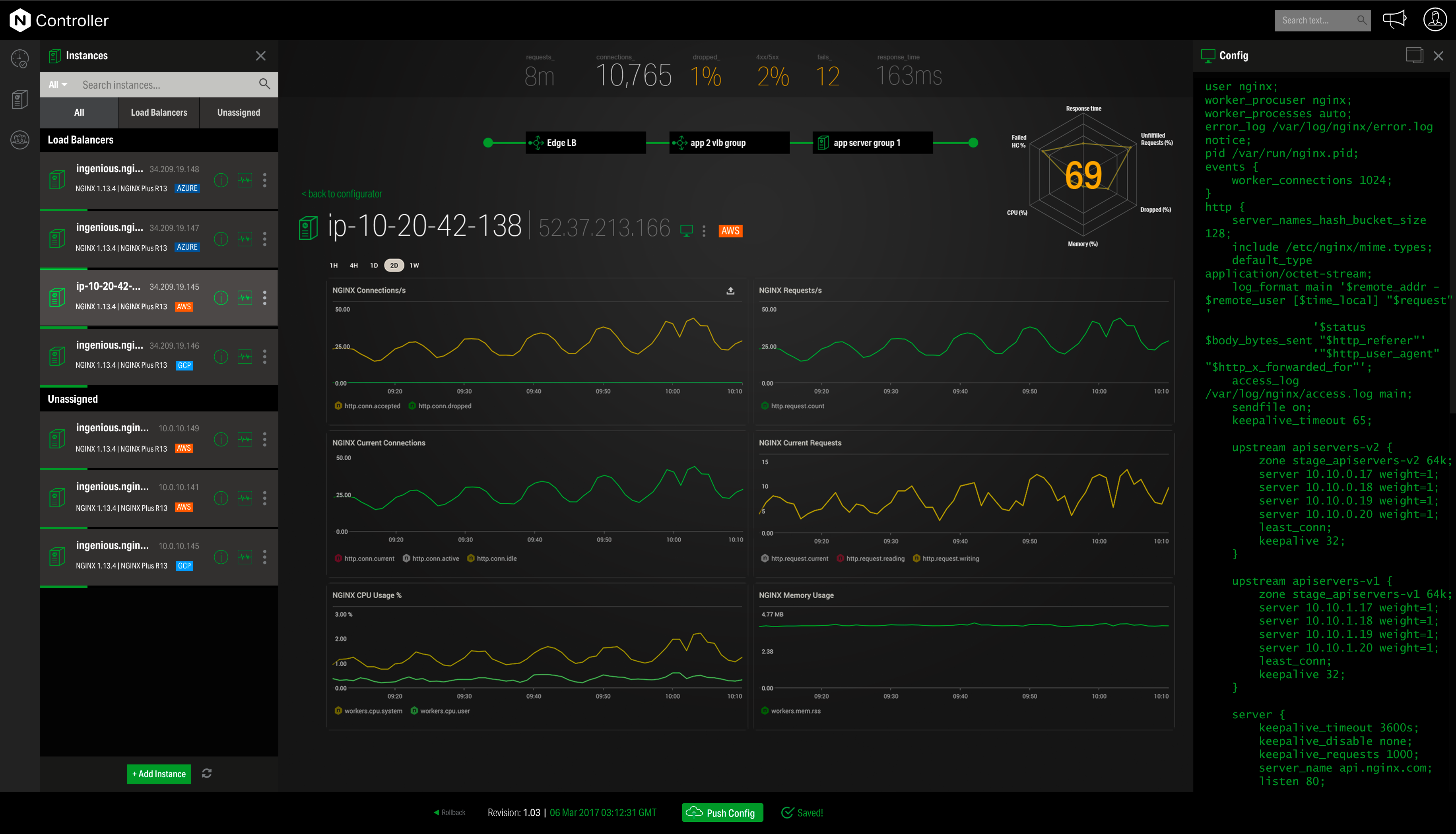
Screenshot of Overview of the NGINX Application PlatformScreenshot of NGINX Controller - MonitoringScreenshot of NGINX Controller - Configuration