Ibexa, headquartered in Oslo, helps B2B companies to stay relevant and succeed by transforming traditional sales strategies into frictionless buying experiences, with their eponymous digial experience platform (DXP).
$20,143.81
per year
Kibo eCommerce
Score6.1 out of 10
N/A
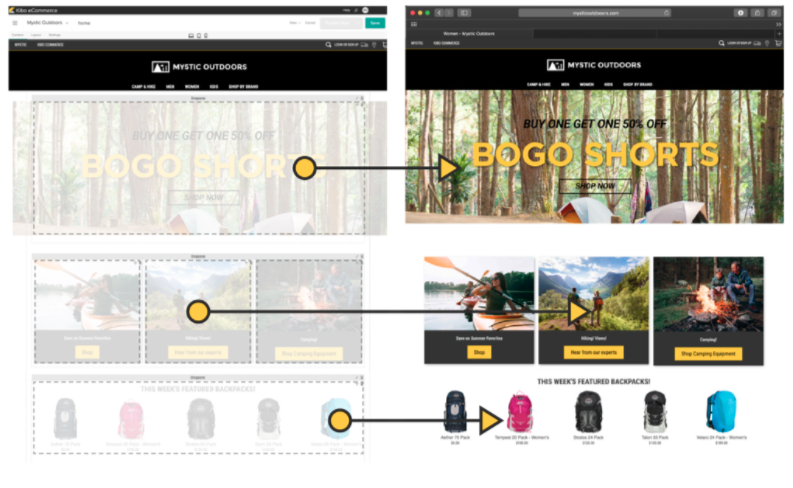
Kibo Software offers Kibo eCommerce (formerly Mozu), designed to support retailers with online offer creation and deployment, content publishing and landing pages, and many tools and widgets out of the box with a retail-oriented ecommerce solution.
Mozu was acquired by Kibo Software from Volusion in October 2016.
I always recommend Ibexa DXP to my fellows. The only scenario that I would not recommend it is if the site is either too small, too simple, or that they simply cannot afford to stand it up properly.
The platform has flexibility at its core and we have made full use of that capability. Even if Kibo [eCommerce] hasn't been ready to provide features and functions we need, we have the opportunity to build them ourselves. The platform started as Mozu and while it was relatively well-developed for DTC, it lacked a lot of basic B2B functionality. As a result, when we were ready to move into that arena, we built a lot for ourselves (including a multi-level account system and a tool to manage it). Keep in mind, too, that Kibo eCommerce is part of a larger suite of tools. The company has purchased a mobile Point-of-Sale system, Baynote, Certona, Monetate, and an OMS. If you need a full-scale solution, they can offer a lot. As I mentioned previously, their support and documentation need shoring up. They're not terrible, but they hinder (rather than help) when it comes to fulfilling the platform's promise of letting the customers be self-service in building out their capabilities.
A de minimis incentive was given to thank the reviewer for their time. The incentive was not used to bias or drive a particular response, nor was the incentive contingent on a positive endorsement. More Info
Content Taxonomy: Content is managed in a tree. Though taxonomy vs folksonomy is a near-religious debate among professionals, clients seeing the system for the first time just seem to "get it" more often.
Content Flexibility: Common content types such as blog posts and articles are available out of the box. However, customizing these and creating new content types is very easy.
Developer Friendly: Developers need only a little PHP experience to get started. Of course being an expert doesn't hurt and opens the door for the development of custom modules.
A de minimis incentive was given to thank the reviewer for their time. The incentive was not used to bias or drive a particular response, nor was the incentive contingent on a positive endorsement. More Info
A de minimis incentive was given to thank the reviewer for their time. The incentive was not used to bias or drive a particular response, nor was the incentive contingent on a positive endorsement. More Info
Prebuilt Integration - There is not currently a large number of preexisting integrations, but custom integrations are fairly quick
Time to Deploy - Don't get me wrong, We have deployed in the timeline we expected, but if you are trying to get something off the ground fast, Kibo might not be right for you. It is a robust platform that take some time to get up and running.
Complicated Shipping - if you have a complicated shipped process, you might want to look for a tool to help, Kibo does not have very robust out of the box shipping capabilities.
A de minimis incentive was given to thank the reviewer for their time. The incentive was not used to bias or drive a particular response, nor was the incentive contingent on a positive endorsement. More Info
It is quite easy to navigate through the backend and also, you can directly work in frontend view. Dynamic content can be created on the fly. Their Landing page features are awesome. You create a page by drag & drop.
They are directly reachable and help you to deal with other services, e.g. if would like to set up a CDN for China or if you would like to integrate a tool like HubSpot. If there is anything you are missing, they help you to find a workaround until they can deliver such items - like local language versions.
One positive note is that I have always been able to get someone on the phone in support whenever I have called, even at 1 AM. Getting someone on the phone is only half the battle though. In the first few months of using Mozu it often seemed that support didn’t know anymore about Mozu than we did. This has slowly started to change, but as a daily user you are likely to be on par with support in terms of knowing what to do when you encounter a problem. The support phone number is really most useful for having them put in a support ticket for you rather than typing it all out yourself and emailing it. It is very rare that the support reps are actually empowered to solve the problem at hand. Unless the issue you are having is user error, they will just take your information and pass it on the proper department. Your request or problem will then be ignored for months on end. Some day, it might actually get fixed but you are unlikely to be notified that this has happened. Most of these issues are assigned an internal ID that they use for tracking. Support is more than happy to pass this ID along, but it is useless. There is no way to actually see where the issue lies in the endless queue of similar issues.
A de minimis incentive was given to thank the reviewer for their time. The incentive was not used to bias or drive a particular response, nor was the incentive contingent on a positive endorsement. More Info
At the time of our implementation Mozu did not have any processes or procedures set up around going live. We basically were forced to just wing it and hope for the best
eZ Publish isn't as large in community size and number of installations as other content management systems. However, it's just as capable and met our needs:
Developers, system administrators, and project manager can all speak the same language during the development and maintenance cycles of a site.
End-user training is very straight-forward.
Vendor support is available.
Client IT departments can access if need (developers/designers/sysadmins).
The community is there (forums) and there are solid contributions (extensions) from both the vendor and the community.
A de minimis incentive was given to thank the reviewer for their time. The incentive was not used to bias or drive a particular response, nor was the incentive contingent on a positive endorsement. More Info
We had a custom, in-house ecommerce website before moving to Kibo. It was brittle, slow, and wasn't going to scale nearly well enough or fast enough to keep up with our requirements
A de minimis incentive was given to thank the reviewer for their time. The incentive was not used to bias or drive a particular response, nor was the incentive contingent on a positive endorsement. More Info
We’ve priced other enterprise products and found Ibexa DXP to be a bit more expensive. However, not enough to dissuade us from staying with the product.
The partner ecosystem is small. However, we've worked with two Ibexa partners over the last 10 years. They were very skilled. They were great companies. We've interviewed other Ibexa partners in North America. We found them all to be professional with solid resumes.
Common knowledge: By making eZ a core offering, developers, system administrators, and project managers were able to communicate with each other effectively.
Training: Due to its content taxonomy, end-user training often went well.
Support: In our case, we had Gold support from eZ Publish which saved time and helped with customizations.
A de minimis incentive was given to thank the reviewer for their time. The incentive was not used to bias or drive a particular response, nor was the incentive contingent on a positive endorsement. More Info