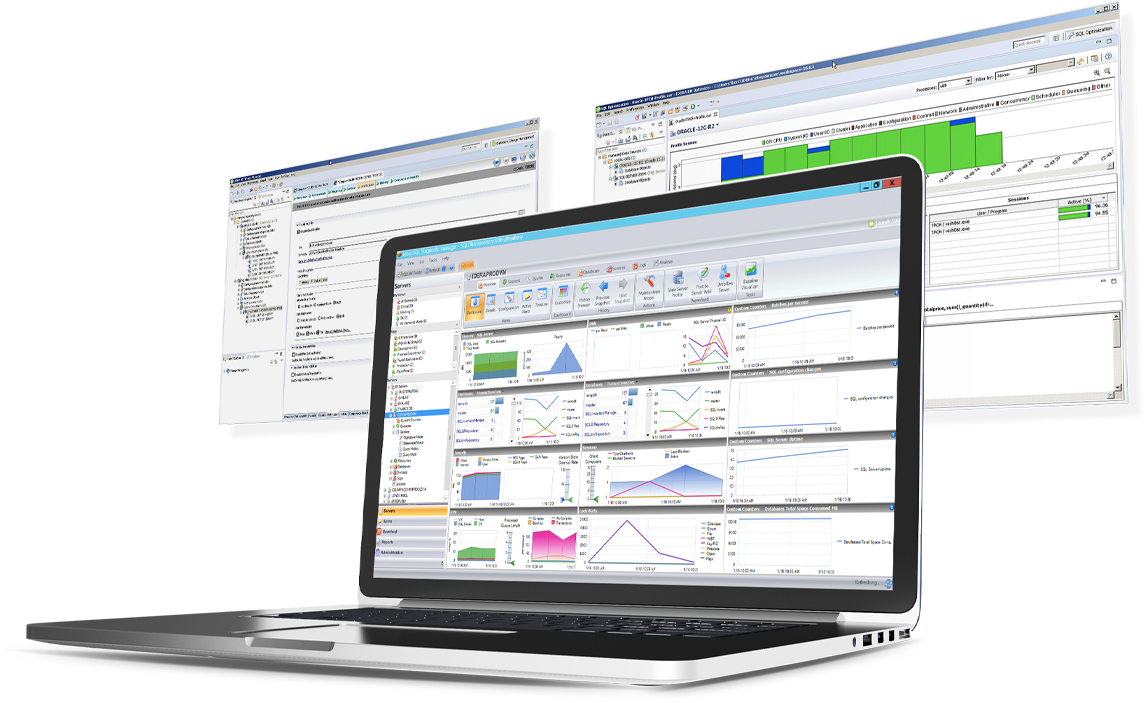
SQL Diagnostic Manager for Microsoft SQL Server helps database administrators to find and fix Microsoft SQL Server performance problems in physical, virtual, and cloud environments. Unlike its competition, it provides effective scalability, advanced SQL query analysis and optimization, prescriptive analysis with corrective SQL scripts, powerful automated alert responses, broad PowerShell integration, complete customization, and extensive support for current and legacy Microsoft SQL Server and…
$1,996
per instance with first year maintenance included
MariaDB Platform
Score9.1 out of 10
N/A
MariaDB is an open-source relational database made by the original developers of MySQL, supported by the MariaDB Foundation and a community of developers. The community states recent additional capabilities as including clustering with Galera Cluster 4, compatibility with Oracle Database, and Temporal Data Tables, allowing one to query the data as it stood at any point in the past.
A de minimis incentive was given to thank the reviewer for their time. The incentive was not used to bias or drive a particular response, nor was the incentive contingent on a positive endorsement. More Info
SQL Server [Business Intelligence] Manager is useful for tracking performance across SSIS, SSRS and SSA and have the data represented in dashboards. It helps improve performance and helps end users. However, several features are redundant for smaller organization that can use the tools that comes with existing Microsoft products. These features also takes time to learn and use.
A de minimis incentive was given to thank the reviewer for their time. The incentive was not used to bias or drive a particular response, nor was the incentive contingent on a positive endorsement. More Info
A de minimis incentive was given to thank the reviewer for their time. The incentive was not used to bias or drive a particular response, nor was the incentive contingent on a positive endorsement. More Info
SQLdm does a good job of providing information at a high level, but also allows me to drill down to specific queries and events if needed. I don't always need to sift through tons of details to get the information I need. It also gives a very wide range of information from SQL specific metrics, to OS metrics, to VM metrics, all the way up to host server metrics.
I like how the alert and notification system can be customized. For example, if you know a certain server regularly has long-running queries, you can adjust the alert to not fire unless a query has been running for 30 minutes while the rest of the servers fire after 30 seconds. That is very helpful in not being bombarded at dinner with alerts from a server similar to, "I've been at 90% cpu for 26 milliseconds!!!!!!!...and now it's back down to 30%" Good information to know, but not something you need to literally lose sleep over.
I like how you can configure different servers to be monitored differently. For example, you can have a group of servers called DEVELOPMENT that you can turn on heavier monitoring on so you can test how changes in applications might affect the SQL environment, but in the PRODUCTION group, you may only want to enable the heavier analysis and logging when performance issues are actively being reported.
A de minimis incentive was given to thank the reviewer for their time. The incentive was not used to bias or drive a particular response, nor was the incentive contingent on a positive endorsement. More Info
Simpler learning curve. MariaDB is a cleaner, simpler system that is (IMO) easier to learn and easier to manage effectively than many other database systems.
Lower hardware requirements. After migrating to MariaDB from another database software system, we find that our hardware needs have substantially decreased.
MariaDB support is very responsive. It's like they actually care. On the few occasions we've run into technical issues, support has always come through with what we needed. Once it was showing me a relatively new feature the server supported that I wasn't aware of, that, once I was able to properly make use of it helped me resolve a serious production performance issue.
Architectural flexibility. As an example, the ready availability of synchronous (Galera) versus asynchronous replication schemes without being locked into one of the other by enormous technical complexity or punitive licensing, allows the customer to find what really works best for their needs.
A de minimis incentive was given to thank the reviewer for their time. The incentive was not used to bias or drive a particular response, nor was the incentive contingent on a positive endorsement. More Info
Windows client has some issues. When you have small time intervals for your data collection, it can cause the client to become unresponsive and require you to restart it.
It takes more time to get the web client running than it does to get the windows client running.
The visualizations have been the same for the last eight years--could use a little bit of a refresh.
A de minimis incentive was given to thank the reviewer for their time. The incentive was not used to bias or drive a particular response, nor was the incentive contingent on a positive endorsement. More Info
Driver Support - Some third party applications use database drivers that cause unexplained slowness with MariaDB. This can be worked around by using the MySQL drivers, but it's not clear what causes the problem in the first place.
Support - While online communities are helpful in diagnosing problems, there isn't as much professional documentation/support available for MariaDB as some of the other major database options.
Data Visualization - It would be helpful if there were more built in options for analyzing statistics and generating reports.
A de minimis incentive was given to thank the reviewer for their time. The incentive was not used to bias or drive a particular response, nor was the incentive contingent on a positive endorsement. More Info
MariaDB is very usable and stable to be used in production settings as an alternative to MySQL. The shortcomings of SQL are present but well understood in the community, and if the decision were to be made again, I would choose MariaDB over MySQL on future projects.
A de minimis incentive was given to thank the reviewer for their time. The incentive was not used to bias or drive a particular response, nor was the incentive contingent on a positive endorsement. More Info
We have launched several inquiries to MariaDB support and they have always responded very quickly and have not been tutoring for the duration of the incident/problem.
Likewise, they want to hold constant meetings with the client to get their opinion as well as how they can help.
I see a very human support and concerned about the customer.
A de minimis incentive was given to thank the reviewer for their time. The incentive was not used to bias or drive a particular response, nor was the incentive contingent on a positive endorsement. More Info
IDERA SQL Diagnostic Manager for SQL, Redgate SQL, and MonitorLogicMonitor are similar products to each other. We decided on IDERA SQL Diagnostic Manager for SQL because our experience with locating heavy queries has been very good and it provides real-time monitoring of all servers and databases. It also allows you to have a large volume of historical data which allows you to analyze trends in the databases.
A de minimis incentive was given to thank the reviewer for their time. The incentive was not used to bias or drive a particular response, nor was the incentive contingent on a positive endorsement. More Info
MariaDB stacks up the the competition just fine. Due to is ture open source nature we do not have to worry about licencing and spending money on nothing. Moreover, MariaDB does everything that we need to get done. We can run data that is a million rows or many smaller projects on the same environment with little overhead. One of the best features that MariaDB has is the ability of backup or dump data to standard text sql statements. That was one of the reasons why we choose MariaDb because it makes backups or transferring data a snap
A de minimis incentive was given to thank the reviewer for their time. The incentive was not used to bias or drive a particular response, nor was the incentive contingent on a positive endorsement. More Info
A de minimis incentive was given to thank the reviewer for their time. The incentive was not used to bias or drive a particular response, nor was the incentive contingent on a positive endorsement. More Info
A de minimis incentive was given to thank the reviewer for their time. The incentive was not used to bias or drive a particular response, nor was the incentive contingent on a positive endorsement. More Info