Miro is the AI Innovation Workspace that brings teams and AI together to plan, co-create, and build the next big thing, faster. With the canvas as the prompt, Miro's collaborative AI workflows keep teams in the flow of work, scale shifts in ways of working, and drive organization-wide transformation.
$10
per month per user
Slickplan
Score 0.0 out of 10
N/A
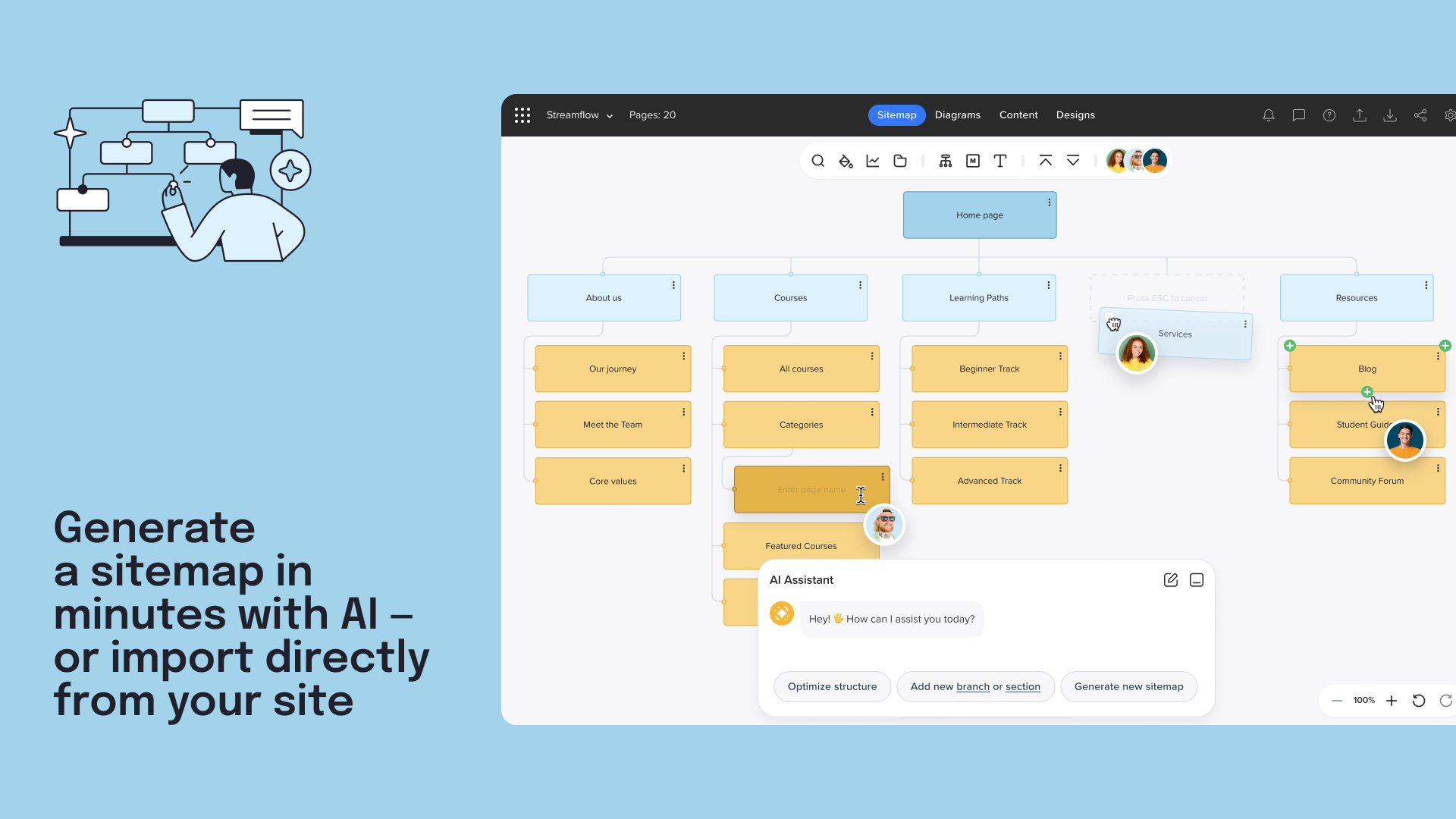
Slickplan helps teams and agencies bring order to complex website planning projects – from initial ideas and concepts to production-ready deliverables. Rather than bouncing between docs, spreadsheets and disconnected tools, Slickplan provides a centralized space to structure site architecture, map user flows, plan and create content as well as review designs together. The application's goal is to help users achieve faster launches, fewer revisions, smoother handoffs to…
$11.99
per month
Pricing
Miro
Slickplan
Editions & Modules
1. Free - To discover what Miro can do. Always free
$0
2. Starter - Unlimited and private boards with essential features
$8
per month (billed annually) per user
3. Business - Scales collaboration with advanced features and security
$16
per month (billed annually) per user
4. Enterprise - For work across the entire organization, with support, security and control, to scale
contact sales
annual billing per user
Basic – For simple projects or occasional planning needs
$11.99
per month
Pro – Best for growing teams that need complete workflows
$34.99
per month
Team – Ideal for larger teams collaborating across multiple projects
$69.99
per month
Agency – Built for enterprise clients with large, complex portfolios
$114.99
per month
Offerings
Pricing Offerings
Miro
Slickplan
Free Trial
Yes
Yes
Free/Freemium Version
Yes
Yes
Premium Consulting/Integration Services
No
No
Entry-level Setup Fee
Optional
No setup fee
Additional Details
Monthly billing also available at $10 per month for the Starter plan, or $20 for the Business plan.
I first used Miro in a service design module at university, where we used it for personas, customer journey mapping, and more. I've since used it in marketing for SWOT analysis, RACI models, project planning, and more. I've yet to use it in a wider team setting, but from my experience, some team activities, even a SWOT analysis, for instance, where it is brainstorming-based, are better done in a physical space and then brought onto a digital tool, rather than done purely digitally.
Makes internal coordination between admin team and tutors extremely painless. It's like a single place where everyone can drop ideas, get updates and notes without loss of context which usually happens in long email threads.
Versioning and board history are handled very well, which drastically reduces the workload. They help me track how a policy or math guideline has evolved, and also make it easy to revert changes if something doesn't work.
Comments stick exactly where they are meant to, making internal reviews much clearer. Admins don't have to guess which note refers to which rule or section.
Exports are clean, so even non-Miro teammates get it instantly.
As a designer, I miss some more creative features. I can't even get really into designing small things (like paths). Many of my colleagues have already switched to the Figma board because it is possible there.
Things often get lost in the workflow, especially in teams. Working on the same file often leads to misunderstandings and can be frustrating. For example, if text is accidentally deleted and cannot be recovered, or if images become distorted.
The scale on the board is missing, which often leads to size differences.
Miro saves my day. I would spend at least 4x more time on documenting my projects and work without this tool. It support my day to day role and helps me be successful while saving my capacity. It is not only very easy to start working on it without additional training required, but also adapts to any use case that I might need to implement
It's very easy to use, while having endless features. When I start a new board, I know that there's almost nothing that I cannot put on it, whether these are builtin tools, like documents and diagrams, or whether these are 3rd party services that can be imported onto the board. Using Miro is very easy. When I'm onboarding a new user, I focus on what can be done and not on how, as everything is very intuitive.
I have not encountered events where Miro is not available. It is quite nice and reliable to be fair, even on my freemium version (startup) I don't have reliability issues. It does have sometimes where the screen refresh or "freezes" or "consumes a lot of data" and we have to rewind windows and the likes, this instances are very less
I took the loading quickly to be related to availability which I commented on before, so ditto with those comment on load time here. Although to reemphasize, Miro doesn't crash or just refuse to load like some other programs. The weak point of Miro for me is integration of files like Word, Excel, or PowerPoint (especially the later two). When you embed these, it gets slow, and complicated to bring them up while you're in the application.
We have never reached out to or contacted support because Miro's platform has been incredibly intuitive and user-friendly. The comprehensive resources available, such as tutorials, documentation, and community forums, have provided all the guidance we needed. The seamless integration with our existing tools and the reliability of the platform have ensured that we rarely encounter issues that require external assistance. This self-sufficiency has allowed us to focus more on our projects and collaboration without interruptions. Overall, our experience with Miro has been smooth and efficient, eliminating the need for additional support
There was a series of webinars which Miro hosted with our organization that went over the basics, then progressively became more advanced with additional sections. The instructors were knowledgeable, and provided examples throughout the sessions, as well as answered peoples' questions. There was ample time and experience on the calls to cover a range of topics. The instructors were also very friendly and sociable, as well as honest. Of course Miro isn't a "God-tool" that does absolutely everything, but the instructors were aware and emphasized the strengths where Miro had them and sincerely accepted feedback.
Easy to learn, Miro has a series of videos on YouTube that effectively taught this program to my team members and me. The program is drag-and-drop and works excellently. People pick up on how to use it efficiently, and it's great for organizing ideas more freely. This product is more challenging for some older audiences who are not accustomed to using a touchpad, but for most, it was very easy to use.
Both FigJam and ClickUp have similar features where we can do collective brainstorming and idea mapping. We have gone back to Miro from both of those platforms because of the intuitive nature and usability of the Miro interface. Surprisingly, we do still pay for ClickUp and Figma. Miro has not been able to replace either of these for us because we use them for different use cases. Our team expressed the most comfort and ease of use with Miro versus these two platforms, so we gladly have decided to stay.
Maybe is possible now so... Could be useful to manage in some way source code for the projects? not to edit so when we make solutions with different components in MIro, maybe each component could redirect to the source code of this component
Miro allows me to plan work for the future without having to reference tedious spreadsheets. This gives me better insight into workload forecasting.
Just today, I was able to quickly put together a Miro to show a team member who was confused the workflow for a problem. The easy 'on-the-fly' tools let me create something quickly in real time.
Flowcharts often get a bad rap because people think they are too complicated, but Miro lets me get more work done quickly than just using a doc or sheet.