OpenText™ ALM/Quality Center, formerly from Micro Focus, serves as the single pane of glass for software quality management. It helps users to govern application lifecycle management activities and implement rigorous, auditable lifecycle processes.
N/A
Ranorex
Score8 out of 10
N/A
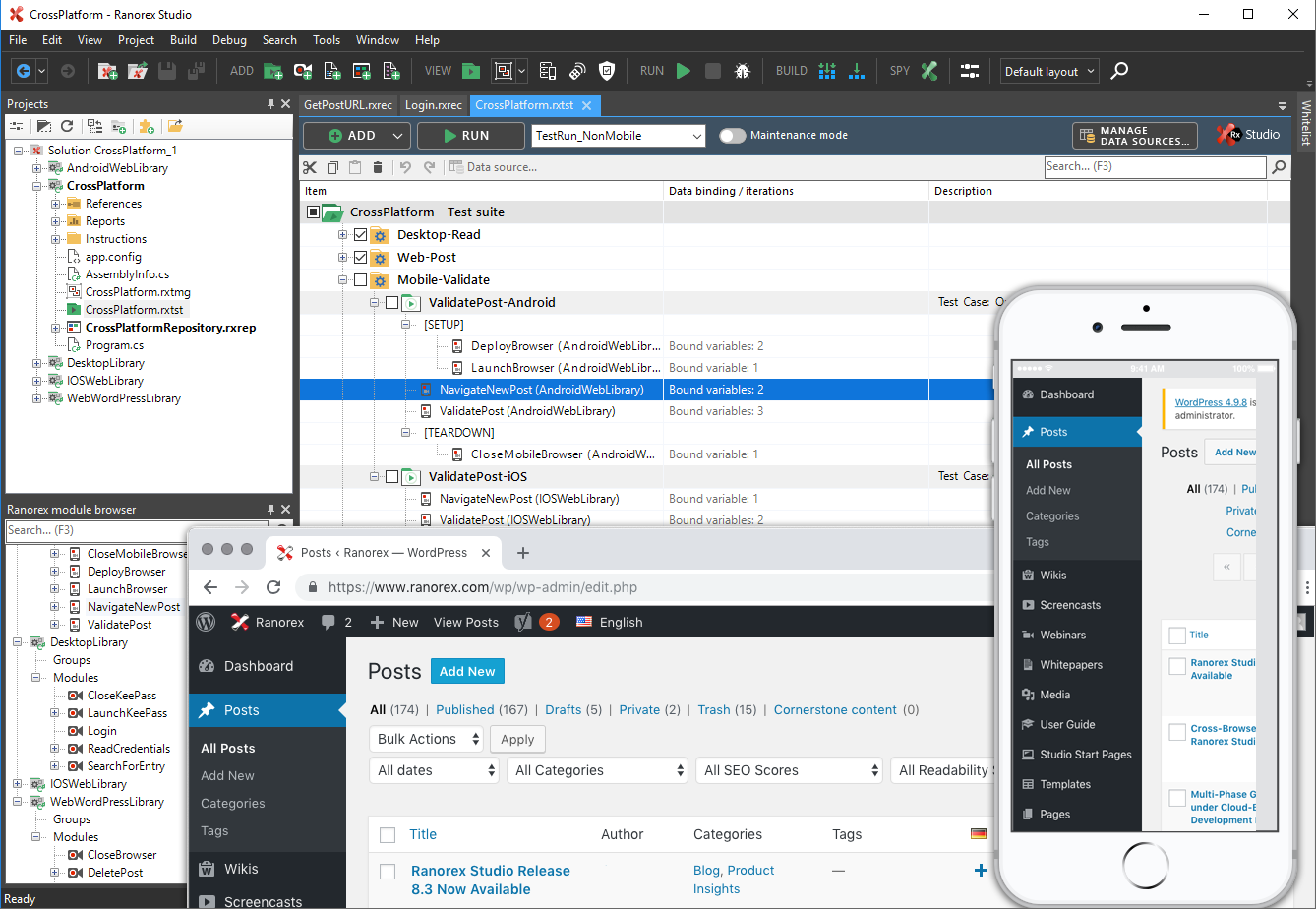
Over 14,000+ users worldwide automate tests with Ranorex Studio, which promises to enable rapid delivery of high-quality desktop, mobile, and web applications. The vendor says that with over 10 years in test automation, Ranorex Studio supports automating functional UI tests for even the most challenging technologies, from legacy applications to the latest web and mobile platforms. Ranorex Studio is an all-in-one tool that empowers everyone on the team. Key benefits and…
$890
per additional endpoint
Pricing
OpenText ALM/Quality Center
Ranorex
Editions & Modules
No answers on this topic
Runtime Floating Licnse
$890
per additional endpoint
Premium Node-Locked License
$2,990
per installation
Premium Floating License
$4,990
per concurrent user
Offerings
Pricing Offerings
OpenText ALM/Quality Center
Ranorex
Free Trial
No
Yes
Free/Freemium Version
No
No
Premium Consulting/Integration Services
No
Yes
Entry-level Setup Fee
No setup fee
Optional
Additional Details
—
All licenses are perpetual and include 12 months of maintenance and email support. A runtime floating license requires at least one premium license for test creation. Please contact our sales team for information about possible volume discounts and options for enterprise support. Consulting, integration and training services are available from our partners worldwide.
For an organisation that has completely adopted SAFe structure including naming terminology, it is less appropriate and apart from that. It can suit any organisation out there, and it can solve all your problems one way or another by customising it. It is a robust and highly scalable solution to support all the business needs. It improves a lot of productivity and visibility.
A de minimis incentive was given to thank the reviewer for their time. The incentive was not used to bias or drive a particular response, nor was the incentive contingent on a positive endorsement. More Info
Personally I rate it a 10 from my own experience, but from a company perspective, I would drop that to perhaps an 8. This is because while I have fun while finding it extremely easy to use and comprehensive enough, there have been times that relative to the project currently in works, Ranorex has not performed due to its shortcomings. If asked though I would certainly fully recommend Ranorex to a potential user, especially to someone less skilled in this field.
A de minimis incentive was given to thank the reviewer for their time. The incentive was not used to bias or drive a particular response, nor was the incentive contingent on a positive endorsement. More Info
If you have a mix of automation & manual test suites, HPALM is the best tool to manage that. It definitely integrates very well with HP automation tools like HP Unified Functional Testing and HP LoadRunner. Automated Suites can be executed, reports can be maintained automatically. It also classifies which test suites are manual & which are automated & managers can see the progress happening in moving from manual to automated suites. In HPA ALM all the functional test suites, performance test suites, security suites can be defined, managed & tracked in one place.
It is a wonderful tool for test management. Whether you want to create test cases, or import it, from execution to snapshot capturing, it supports all activities very well. The linking of defects to test runs is excellent. Any changes in mandatory fields or status of the defect triggers an e-mail and sent automatically to the user that the defect is assigned to.
It also supports devops implementation by interacting with development tool sets such as Jenkins & GIT. It also bring in team collaboration by supporting collaboration tools like Slack and Hubot.
This tool can integrate to any environment, any source control management tool bringing in changes and creates that trace-ability and links between source control changes to requirements to tests across the sdlc life-cycle.
A de minimis incentive was given to thank the reviewer for their time. The incentive was not used to bias or drive a particular response, nor was the incentive contingent on a positive endorsement. More Info
The requirements module is not as user friendly as other applications, such as Blue Bird. Managing requirements is usually done in another tool. However, having the requirements in ALM is important to ensure traceability to tests and defects.
Reporting across multiple ALM repositories is not supported within the tool. Only graphs are included within ALM functionality. Due to size considerations, one or two projects is not a good solution. Alternatively, we have started leveraging the template functionality within ALM and are integrating with a third party reporting tool to work around this issue.
NET (not Octane) requires a package for deployment to machines without administrative rights. Every time there is a change, a new package must be created, which increases the time to deploy. It also forces us to wait until multiple patches have been provided before updating production.
A de minimis incentive was given to thank the reviewer for their time. The incentive was not used to bias or drive a particular response, nor was the incentive contingent on a positive endorsement. More Info
Language support is limited, c# and Vb.net only if i remember correctly compared to other tools which allow many more. This addition would certainly be appreciated if added on in a company like mine with a variety of differently skilled individuals
Paid license. This is not always preferred. A free version without a limited trial but maybe limited features would be appreciated.
A de minimis incentive was given to thank the reviewer for their time. The incentive was not used to bias or drive a particular response, nor was the incentive contingent on a positive endorsement. More Info
A de minimis incentive was given to thank the reviewer for their time. The incentive was not used to bias or drive a particular response, nor was the incentive contingent on a positive endorsement. More Info
Because it lets me track the test cases with detailed scenarios and is clearly separated in folders. Also the defect filter helps me filter only the ones that have been assigned to a particular area of interest. The availability of reports lets me see the essentials fields which I might be missing the data on and helps me to work on these instead of having to go through everything.
A de minimis incentive was given to thank the reviewer for their time. The incentive was not used to bias or drive a particular response, nor was the incentive contingent on a positive endorsement. More Info
It is a great tool, however, it got this rating because there is a lot of learning that takes a lot longer than other tools. There are no mobile versions of ALM even with just a project summary view. I believe ALM is well capable of integration with other analytics tools that can help business solutions prediction based on current and past project data. This is Data held in ALM but with no other use apart from human reading and project progress. ALM looks like a steady platform that I believe can handle more dynamic functionality. You could add an internal communication platform that is not a third party. Limit that communication tool to specific project members.
A de minimis incentive was given to thank the reviewer for their time. The incentive was not used to bias or drive a particular response, nor was the incentive contingent on a positive endorsement. More Info
I suppose my experience is sort of mixed. Help documents are substantially helpful. I personally have not got the quickest responses from Ranorex support but at the same time, they are pretty good with updating their users frequently with info about their product/s and features. The community is really where I find support and I suppose that could look to be an extension of the product itself.
A de minimis incentive was given to thank the reviewer for their time. The incentive was not used to bias or drive a particular response, nor was the incentive contingent on a positive endorsement. More Info
We have other tools in our organization like Atlassian JIRA and Microsoft Team Foundation Server, which are very capable tools but very narrow in their approach and feature set and does not come even close to the some of the core capabilities of HP ALM. HP ALM is the "System of Record" in our organization. It gives visibility for an artifact throughout the delivery chain, which cut downs unnecessary bottlenecks and noise during releases.
A de minimis incentive was given to thank the reviewer for their time. The incentive was not used to bias or drive a particular response, nor was the incentive contingent on a positive endorsement. More Info
A de minimis incentive was given to thank the reviewer for their time. The incentive was not used to bias or drive a particular response, nor was the incentive contingent on a positive endorsement. More Info
A de minimis incentive was given to thank the reviewer for their time. The incentive was not used to bias or drive a particular response, nor was the incentive contingent on a positive endorsement. More Info