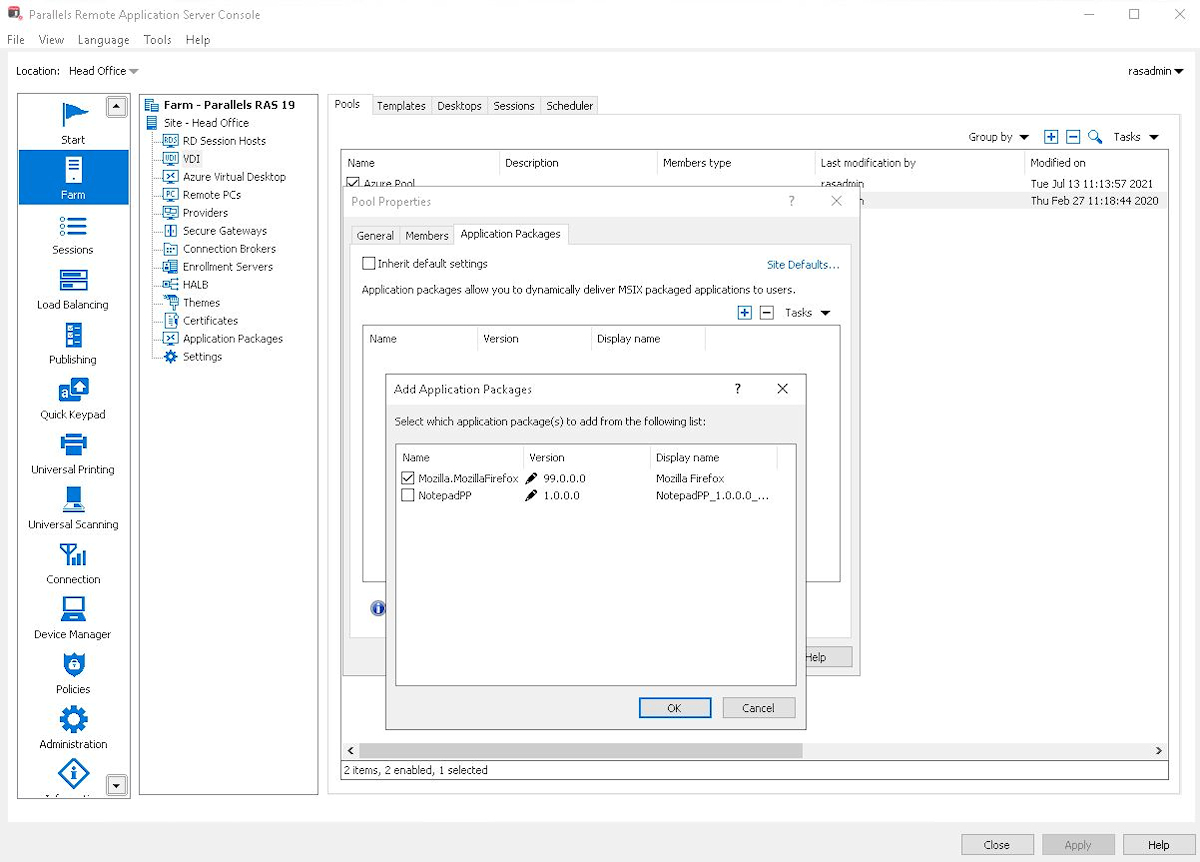
Parallels Remote Application Server (Parallels RAS, formerly 2X RAS), is application virtualization technology, billed as a solution to extend the life of legacy OS (like Windows XP) with its virtual desktop for any device.
Maltese company 2X Software developed the technology, but was acquired by Parallels (in Seattle, WA) in February, 2015 to extend their cross-platform support solutions.
$120
per year per user
SANsymphony
Score 8.0 out of 10
N/A
DataCore SANsymphony software-defined storage aims to deliver flexibility, scalability, and cost-efficiency in a HCI platform. Powered by a block-level storage virtualization technology, SANsymphony is designed to provide flexibility to control how data is stored, protected, and accessed. The vendor states users can ensure business continuity with just 2 nodes, easily scaling out to 64 nodes, and achieve productivity for performance-demanding workloads by improving I/O processing and reducing…
N/A
Pricing
Parallels Remote Application Server (Parallels RAS)
Parallels Remote Application Server (Parallels RAS)
SANsymphony
Likelihood to Recommend
Parallels
Scenarios where time is a factor in having a solution in place and up and running safely and securely. Where there are older devices that ordinarily wouldn't be up to the task of running modern apps and services. Where users need to work away from the network, and security is a concern.
Now that you have virtualized your server's CPU and memory resources, you should look to do the same for your storage. Separation of hardware and software has many added benefits not only for CPUs and memory but for storage as well. Without this solution, we would not have been able to afford black-box type SANs at every location. This allowed us to virtualize over 90% of the server environment saving costs and power consumption/cooling and provides all the features costly black-box SANs, including true-HA (which most SAN vendors don't have). Migration from variant SAN storage and using mixed back-end storage solutions is as easier than ever before because the storage being virtualized.
The printing driver is quite excellent, both in the Parallels Client and on the HTML5 client.
Setup is incredibly easy; the default setup is very functional, and adding features is a breeze.
Speed is very acceptable in general for end-users, the clients adapt quite well to the amount of bandwidth available, and features are available to adjust further.
Parallels Remote Application Server (Parallels RAS) continually improves the product but has broken some features recently. For example the web management portal lost the ability to manage user sessions after a major update. That issue was fixed in a later release
Multi-monitor support beyond 4 monitors (It does handle up to 4 -1080 monitors well)
More options around connection security and MFA. current options are sufficient but limited
We've noticed some performance issues with Windows Server 2019 and 2022. I'd like to see more robust support for remote applications running from those platforms.
We have been using Parallels since it was called 2X - it is a major part of how we do business. It is fairly simple to use and maintain - staff like it, we like it. It is a product that makes a promise - and it keeps it. As Parallels evolves, and clean bandwidth becomes more readily available everywhere - it just makes sense to continue to use Parallels in our environment
Parallels RAS was easy to setup, with great admin guides and resources. We especially liked the included Visio templates which made diagramming much easier. The reference deployment diagrams also simplified our deployment process. Our end users love Parallels RAS. Apps launch faster than Citrix, and the Parallels RAS client is far more reliable than Workspace.
If there are any issues with Parallels - they are usually more about the server operating systems than Parallels itself. It would be rare for us to have any reason to take Parallels offline - we schedule a reboot on the servers at 3am to keep the O/S itself fresh, but again - it is not a Parallels issue. If individual users have any issues we ask them to completely log out of parallels - which ends their session - and then back in - and that typically resolves the issue right away.
I am giving Parallels 9/10 on this one because the only application that sometimes seems slow or has issues - is Microsoft Outlook. It is sometimes the result of a pop-up that may not show up in the published application (vs full desktop). Other than that - pages load very quickly - and it does not seem to slow down other applications that are running at the same time. Most of our users run Outlook, softphone and Teams locally - and published applications for everything else. When they do that - it is very solid.
Good support in place if required, very helpful when it comes to upgrades or any issues faced. The support team is knowledgeable, friendly, and quick to respond to issues The company also provides a range of online resources, including a knowledge base, documentation, and forums, which can be helpful before raising a ticket
In the 3 years I have been running this, I have contacted support around 4 or 5 times and that was for minor questions with exception of one time when I was performing an update on the system. And in that one time, they were very timely in assisting me with correcting the problem. Top notch customer support!
Overall, it was pretty simple compared to most other projects. Again, we had a strong familarity with the product so there was not much of a learning curve. Our 'biggest' issue is the end-user understanding of a 'local' application and a published application. For example - Online meetings need to run locally for camera/video to work smoothly so opening a link to a meeting from a published application continues to be an occasional issue.
Parallels Remote Application Server (Parallels RAS) provides the finest end user experience while being cost-effective and reducing administrative and support man hours. Parallels Remote Application Server (Parallels RAS) is platform agnostic; it works with various kinds of devices (computers, phones, tablets) and several operating systems (Windows, Linux, Apple, etc.), allowing users to access it on gadgets of their choice.
DataCore is far easier to manage as well as deal with when it comes to hardware (as DataCore works with any hardware). It also seems way more affordable.
We added our Integrated Services Staff to parallels, with filtered, published applications - in a single afternoon. We added licensing and installed the desktop client software on multiple platforms both in the office and at remote sites all on the same day - and got remote users that had never used the product up and running - very quickly.
Our customers have had dramatic cost decreases due to no longer needing IT departments to work with our software.
We've been able to charge more for our hosting services due to our customers saving money in the long run. Parallels Remote Application Server has more than paid for itself, and the increased income has gone right back into the business.
Both our customers and our company have benefited from this transition.
More uptime - Typical SANs have redundant controllers, redundant power supply's and can make the drives redundant by leveraging RAID-0, 5, 6, and 10. The claim to be HA but they are not. That is because if I spay water all over them or catch the SAN on fire, the storage will go down. With DataCore's solution we have identical systems (maybe even at different datacenters connected with long-haul-fiber) including duplicate storage. So one side of the solution can totally be taken offline by water, fire, etc. and the other side will remain up providing true-HA storage. Because of this, we can upgrade the SANs during the day and still keep storage services running (zero-downtime).
Lower Costs - Ability to use 3rd party hardware which lowers the costs, not only for the initial investment but as storage capacity grows.
All the features one can want - High Availability, Thin Provisioning, Asynchronous and Synchronous mirroring/replication, snap-shotting, continues data protection, deduplication, storage reporting, trending with graphs, centralized console for easier management and many more.