
Parallels Remote Application Server (Parallels RAS) vs. VMware Cloud Foundation
Parallels Remote Application Server (Parallels RAS) vs. VMware Cloud Foundation
| Product | Rating | Most Used By | Product Summary | Starting Price |
|---|---|---|---|---|
 Parallels RAS | N/A | Parallels Remote Application Server (Parallels RAS, formerly 2X RAS), is application virtualization technology, billed as a solution to extend the life of legacy OS (like Windows XP) with its virtual desktop for any device. Maltese company 2X Software developed the technology, but was acquired by Parallels (in Seattle, WA) in February, 2015 to extend their cross-platform support solutions. | $120 per year per user | |
 VMware Cloud Foundation | N/A | VMware Cloud Foundation is a hybrid cloud platform for managing VMs and orchestrating containers, built on full-stack hyperconverged infrastructure (HCI) technology. With a single architecture that is desribed by the vendor as easy to deploy, VMware Cloud Foundation aims to enable consistent, secure infrastructure and operations across private and public cloud. | N/A |
| Parallels Remote Application Server (Parallels RAS) | VMware Cloud Foundation | |||||||||||||||
|---|---|---|---|---|---|---|---|---|---|---|---|---|---|---|---|---|
| Editions & Modules | No answers on this topic | No answers on this topic | ||||||||||||||
| Offerings |
| |||||||||||||||
| Entry-level Setup Fee | No setup fee | No setup fee | ||||||||||||||
| Additional Details | — | — | ||||||||||||||
| More Pricing Information | ||||||||||||||||
| Parallels Remote Application Server (Parallels RAS) | VMware Cloud Foundation |
|---|
| Parallels Remote Application Server (Parallels RAS) | VMware Cloud Foundation | |
|---|---|---|
| Small Businesses | VMware Fusion Score 7.0 out of 10 |  StarWind HCA Score 9.2 out of 10 |
| Medium-sized Companies | VMware Fusion Score 7.0 out of 10 | StarWind HCA Score 9.2 out of 10 |
| Enterprises | VMware Fusion Score 7.0 out of 10 |  Nutanix Cloud Infrastructure Score 8.9 out of 10 |
| All Alternatives | View all alternatives | View all alternatives |
| Parallels Remote Application Server (Parallels RAS) | VMware Cloud Foundation | |
|---|---|---|
| Likelihood to Recommend | 9.7 (152 ratings) | 7.0 (1 ratings) |
| Likelihood to Renew | 8.5 (22 ratings) | - (0 ratings) |
| Usability | 8.4 (31 ratings) | - (0 ratings) |
| Availability | 9.1 (4 ratings) | - (0 ratings) |
| Performance | 4.5 (4 ratings) | - (0 ratings) |
| Support Rating | 7.8 (129 ratings) | - (0 ratings) |
| Online Training | 7.3 (2 ratings) | - (0 ratings) |
| Implementation Rating | 7.4 (12 ratings) | - (0 ratings) |
| Configurability | 7.3 (4 ratings) | - (0 ratings) |
| Ease of integration | 4.5 (3 ratings) | - (0 ratings) |
| Product Scalability | 7.3 (3 ratings) | - (0 ratings) |
| Vendor post-sale | 9.1 (4 ratings) | - (0 ratings) |
| Vendor pre-sale | 9.1 (4 ratings) | - (0 ratings) |
| Parallels Remote Application Server (Parallels RAS) | VMware Cloud Foundation | |
|---|---|---|
| Likelihood to Recommend |  Parallels
|  VMware by Broadcom
 Sudipta Banerjee Product Manager |
| Pros | Parallels
| VMware by Broadcom
Sudipta Banerjee Product Manager |
| Cons | Parallels
| VMware by Broadcom
Sudipta Banerjee Product Manager |
| Likelihood to Renew | Parallels
 iain Stephen Information Systems Manager | VMware by Broadcom No answers on this topic |
| Usability | Parallels
| VMware by Broadcom No answers on this topic |
| Reliability and Availability | Parallels
iain Stephen Information Systems Manager | VMware by Broadcom No answers on this topic |
| Performance | Parallels
iain Stephen Information Systems Manager | VMware by Broadcom No answers on this topic |
| Support Rating | Parallels
| VMware by Broadcom No answers on this topic |
| Online Training | Parallels
 Craig Cormier IT Manager | VMware by Broadcom No answers on this topic |
| Implementation Rating | Parallels
iain Stephen Information Systems Manager | VMware by Broadcom No answers on this topic |
| Alternatives Considered | Parallels
| VMware by Broadcom
Sudipta Banerjee Product Manager |
| Scalability | Parallels
iain Stephen Information Systems Manager | VMware by Broadcom No answers on this topic |
| Return on Investment | Parallels
| VMware by Broadcom
Sudipta Banerjee Product Manager |
| ScreenShots | Parallels RAS Screenshots  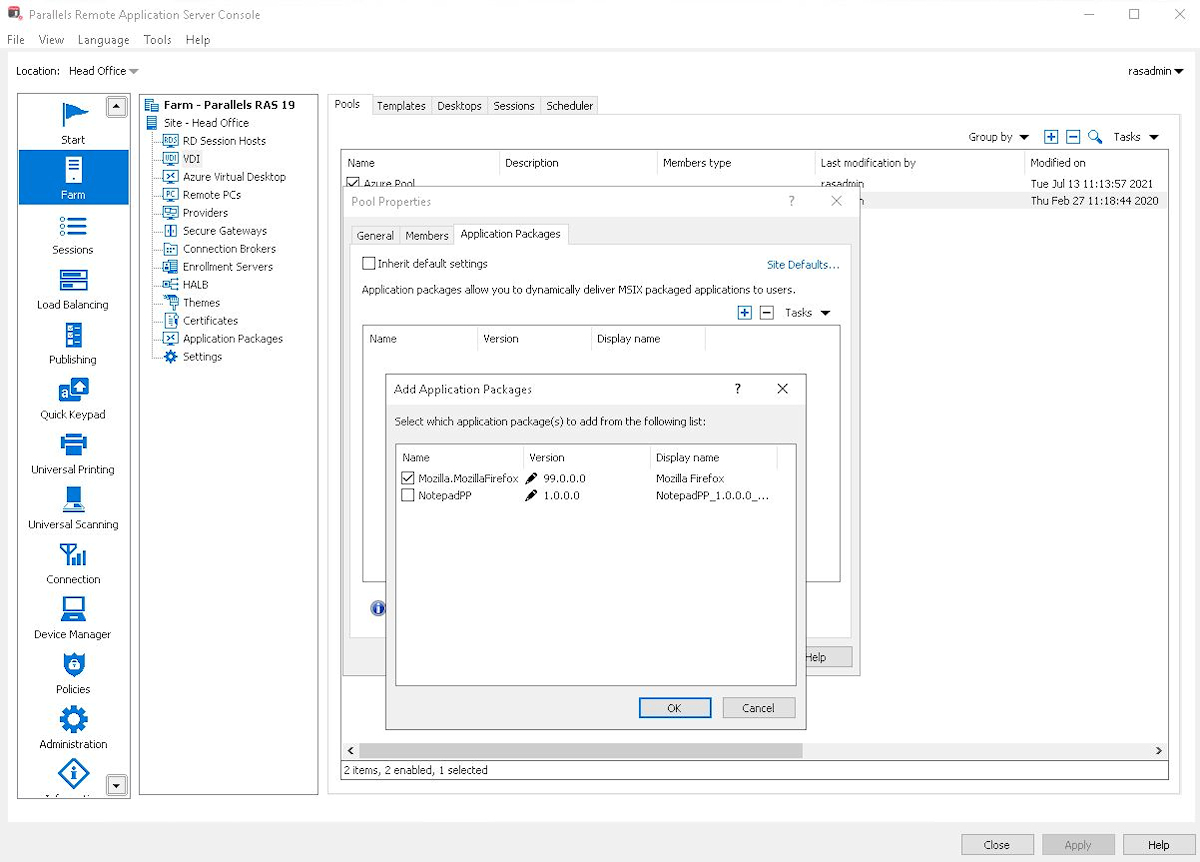    |