Proxmox Virtual Environment is an open source server virtualization management solution based on QEMU/KVM and LXC. Users can manage virtual machines, containers, highly available clusters, storage and networks via a web interface or CLI. Proxmox VE code is licensed under the GNU Affero General Public License, version 3. The project is developed and maintained by Proxmox Server Solutions GmbH.
$7.50
per month
Stackby
Score8.8 out of 10
N/A
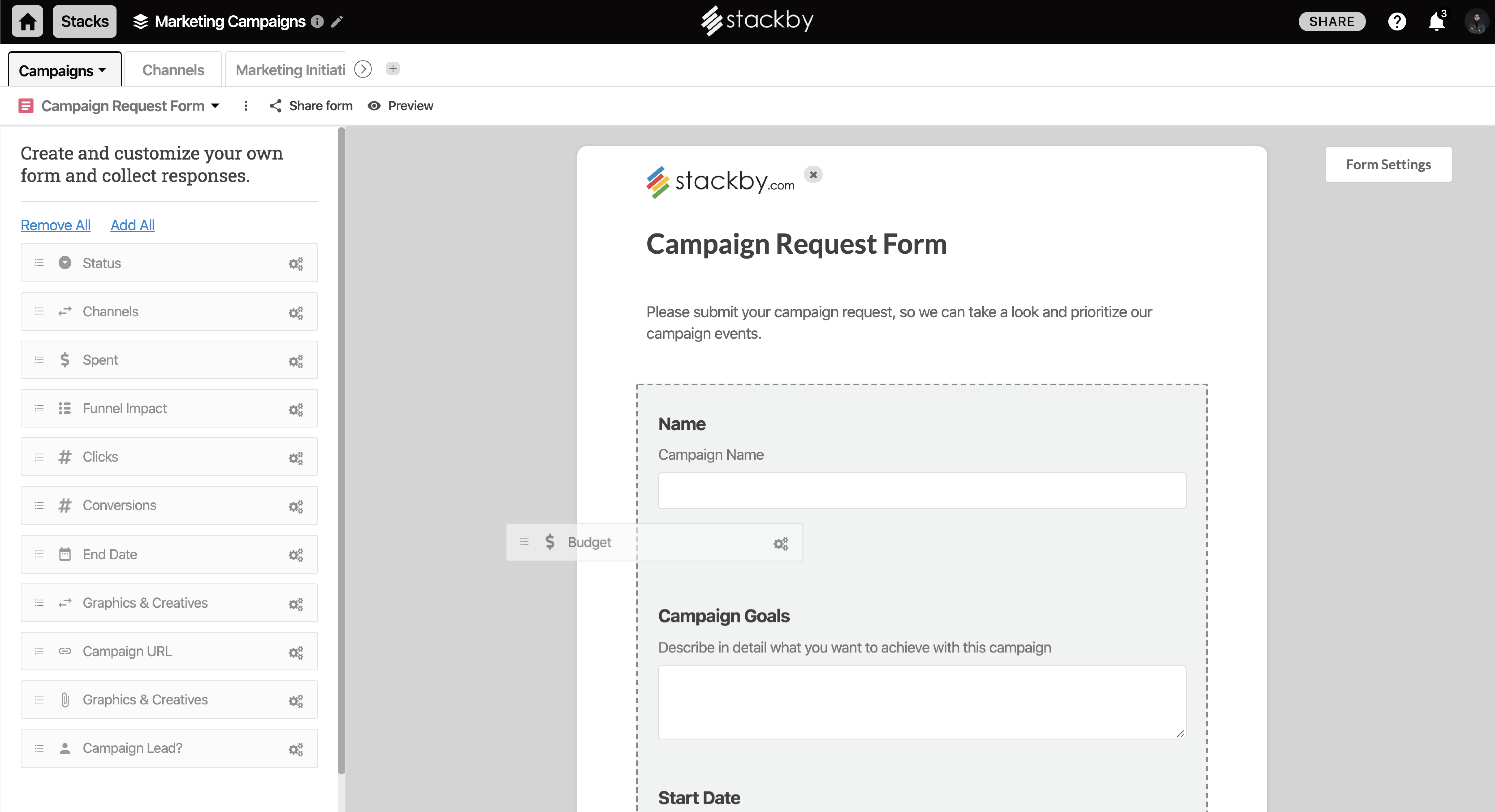
Stackby is designed to bring together the simplicity of spreadsheets, the functionality of databases and integrations with best business APIs to let anyone build their own tools, the way they want. No coding needed. Users can build a database from scratch, import data from pre-existing sources like spreadsheets or Google Sheets, or choose from over 100 pre-built templates across multiple categories. Stackby offers over 25 unique column types like text,…
$5
per month per user
Pricing
Proxmox VE
Stackby
Editions & Modules
Community
€ 90
year & CPU socket
Basic
€ 280
year & CPU socket
Standard
€ 420
year & CPU socket
Premium
€ 840
year & CPU socket
Personal
$6
per month per user
Economy
$10
per month per user
Business
$20
per month per user
Business Plus
$35
per month per user
Enterprise
Custom
Offerings
Pricing Offerings
Proxmox VE
Stackby
Free Trial
No
Yes
Free/Freemium Version
Yes
Yes
Premium Consulting/Integration Services
No
No
Entry-level Setup Fee
No setup fee
No setup fee
Additional Details
Proxmox Virtual Environment's source code is published under the free software license GNU AGPL, v3 and thus is freely available for download, use and share. A Proxmox VE Subscription is an additional service program that helps IT professionals and businesses keep Proxmox VE deployments up-to-date. A subscription provides access to the stable Proxmox VE Enterprise Repository delivering software updates and security enhancements, technical help and support.
We used Proxmox to implement private cloud services, for clusters of a small number of servers, from 3 to 11 with and without high availability. Allways with ZFS file systems, and we used to install the root pool in SSDs mirrored and use other pools with RAID 10 in groups of four, for the virtual machines and containers, for the backups and snapshots, we used magnetic disks with RAID 10, in groups of four. Do not use an even number of servers because does not facilitates the implementation of High Availability, because the corosync service must have an odd number of servers to detect a failed server for the quorum system. We used a variety of servers, from clone PCs with AMD Ryzen with 6 cores and 12 threads with 64 GB of RAM no ECC, to high end servers with 64 cores and 128 threads per cpu and 2 cpus per server, with AMD EPYC Rome or Milan, 2 terabytes of RAM ECC.
A de minimis incentive was given to thank the reviewer for their time. The incentive was not used to bias or drive a particular response, nor was the incentive contingent on a positive endorsement. More Info
Based on my experience, I can provide specific scenarios where Stackby is well suited and others where it may be less appropriate: Project Management: Stackby is an excellent choice for project management scenarios. Its ability to create custom databases, track tasks, assign responsibilities, and collaborate in real-time makes it highly effective for managing and monitoring project progress. CRM and Sales: Stackby is well suited for managing customer relationships and sales processes. Its customizable database structure allows for organizing customer information, tracking leads, managing deals, and generating reports. The ability to integrate with other tools further enhances its usefulness in CRM and sales workflows. Content Planning: Stackby is a great fit for content planning scenarios. Users can create databases to manage editorial calendars, track content ideas, assign tasks to team members, and monitor content performance. Collaboration features facilitate seamless content collaboration and ensure timely publishing.
The web UI does not work as well on mobile devices. It is useable, but a mobile optimised / responsive UI would be nice to have. There is a mobile app, so that may alleviate this issue, but I have not yet tried it.
Support in the community forums could be better. There are paid support plans, but new users trying out the software will not have access to this. Answers to questions can sometimes be terse, and I can imagine this may put some people off.
The wiki is a bit hit and miss with certain topics. I've often seen outdated or missing information, and the whole thing looks like it could do with some polish. I'd love to see it opened up for the community to add to.
A de minimis incentive was given to thank the reviewer for their time. The incentive was not used to bias or drive a particular response, nor was the incentive contingent on a positive endorsement. More Info
Implement the same views available on desktop into the mobile app
Internal automations (like Airtable)
Ability to implement and display info as a dashboard (like Airtable)
Polish up the formatting of formulas, inputting them causes user frustration due to the formula input cursor jumping around
Better intelligence and ease of inputting data in bulk i.e have the fields automatically identify what data is being input and format appropriately (like Airtable does)
Proxmox VE provides the most capable, yet stable virtualization platform in the market today. Licensing options are also competitive and cost-effective for support, and support is extremely fast and knowledgable of getting issues resolved as quickly and soundly as possible.
A de minimis incentive was given to thank the reviewer for their time. The incentive was not used to bias or drive a particular response, nor was the incentive contingent on a positive endorsement. More Info
The interface is easy to use for most of it, but still lacks screens for some configurations. Also, a few of the screens are not as intuitive as they could be. This is specially true with disk and network configuration, where some graphic/visual representations of the configurations would be very useful
A de minimis incentive was given to thank the reviewer for their time. The incentive was not used to bias or drive a particular response, nor was the incentive contingent on a positive endorsement. More Info
Stackby is overall pretty easy to use, especially if you're used to something like Airtable or SmartSuite. Some of the pages seem like near exact clones (though they put their own creative spin on things). I'd prefer a slighty fresher interface (like SmartSuite), but I'm willing to sacrifice that for the better price and great customer service.
Proxmox VE's ha-cluster functionality is very much improved, though does have a not-very-often occurrence of failure. In a 2-node cluster of Proxmox VE, HA can fail causing an instance that is supposed to migrate between the two nodes stop and fail until manually recovered through the command-line tools provided. Other than this, the HA clustering capability of Proxmox VE has proven to be reliable in 3 or more clustered environments with much less chance of these failures to occur.
A de minimis incentive was given to thank the reviewer for their time. The incentive was not used to bias or drive a particular response, nor was the incentive contingent on a positive endorsement. More Info
Proxmox VE's interfacing is always fast to load, both the Web interface and the command-line tool interfaces. Reporting is practically real time almost all the time, and you can see everything in mere seconds, easily able to identify if something is wrong or it everything is in tip-top shape as always desired
A de minimis incentive was given to thank the reviewer for their time. The incentive was not used to bias or drive a particular response, nor was the incentive contingent on a positive endorsement. More Info
A de minimis incentive was given to thank the reviewer for their time. The incentive was not used to bias or drive a particular response, nor was the incentive contingent on a positive endorsement. More Info
A de minimis incentive was given to thank the reviewer for their time. The incentive was not used to bias or drive a particular response, nor was the incentive contingent on a positive endorsement. More Info
Proxmox VE is cheaper than VMware, especially upscaling an HA architecture. Compared with other free or less expensive solutions, Proxmox VE is high compatible with more types of hardware solutions and more VM types. From my point of view, Proxmox VE has no competitor at the same price level, it offers the most complete and production-ready HA solution.
A de minimis incentive was given to thank the reviewer for their time. The incentive was not used to bias or drive a particular response, nor was the incentive contingent on a positive endorsement. More Info
I have also tried Ora.Pm. Infinity has better graphical interface, but nowhere near as many features and the UI isn't as effective (i.e, moving around with keys). Grist has a much more technical interface and it comes from being more of a database/interactive spreadsheet vs Stackby. Grist has much more functionality in terms of formulas, but is much harder to learn to use and less other functionalities. Ora.PM is more of a test at a task management app, and doesn't compare - Stackby is much better.
Proxmox VE provides everything you need to quickly add new storage mediums, network and local, as well as networking interfaces, such as using Linux standard bridges and now Open-vSwitch bridges which can be even more scalable than before. Proxmox VE 4.0 dropped support for OpenVZ in favor of the more well supported and native LXC and made an upgrade path to it very simple.
A de minimis incentive was given to thank the reviewer for their time. The incentive was not used to bias or drive a particular response, nor was the incentive contingent on a positive endorsement. More Info
A de minimis incentive was given to thank the reviewer for their time. The incentive was not used to bias or drive a particular response, nor was the incentive contingent on a positive endorsement. More Info