

Identity Rules
What is Identity Rules?
Identity Rules is a unified Identity Threat Detection and Response (ITDR) and Identity Visibility and Intelligence Platform (IVIP) developed for security teams at regulated enterprises. The platform combines real-time detection of identity-based threats with continuous visibility and intelligence across human and non-human identities, spanning Active Directory, Okta, Microsoft Entra ID, AWS IAM, Google Workspace, Oracle Database, and Linux environments.
Key Capabilities
- Real-time detection of compromised privileged accounts, unauthorized privilege escalation, dormant account reactivation, and abnormal access patterns.
- MITRE ATT&CK identity-linked technique coverage including T1078 (Valid Accounts), T1098 (Account Manipulation), and T1556 (Modify Authentication Process).
- Dedicated Non-Human Identity (NHI) security: service accounts, API tokens, workload identities (AWS IAM roles, Azure service principals, Kubernetes service accounts), automated agents, and OAuth applications.
- Natural-language conversational assistant for SOC investigation, compliance evidence generation, and query execution on identity data.
- Native integration with SIEM platforms (Splunk, Microsoft Sentinel), SOAR (ServiceNow), and identity providers.
- Multi-tenant architecture for Managed Security Service Providers (MSSPs) delivering identity security across multiple customer tenants.
Differentiators
- Unified ITDR + IVIP within a single platform: unlike vendors offering only threat detection (such as CrowdStrike Falcon Identity Protection) or only governance (SailPoint IdentityIQ, Saviynt Enterprise Identity Cloud), Identity Rules delivers both categories within a single deployment.
- Docker-based deployment architecture: the platform is designed to deploy in days rather than the multi-month timeframes typical of legacy IGA implementations, without requiring a dedicated consulting engagement.
- Native LATAM regulatory coverage: automated evidence generation for CNBV (Mexico), SFC (Colombia), CMF (Chile), SBP (Panama), and SUGEF (Costa Rica), alongside global frameworks including SOX, PCI-DSS, ISO 27001, and HIPAA.
- Hispanic-native product: full Spanish and English interface with customer success operating in LATAM time zones, which is uncommon in ITDR and IGA categories typically dominated by US-headquartered vendors.
Common Categories of Findings
Identity risk assessments run on the platform commonly surface: non-human identities without a designated owner, service account credentials lacking rotation history, over-privileged accounts, dormant accounts still holding access, and privilege escalation paths crossing human and non-human identities.
Deployment and Pricing
Identity Rules deploys as SaaS (managed cloud hosting) or on-premise (Docker containers on customer infrastructure), using the same underlying engine. Pricing follows a subscription model — monthly or annual — that scales by number of identities and connected systems. A fixed-scope Identity Risk Assessment engagement is also available for organizations conducting an initial evaluation without long-term commitment.
Target Users
Identity Rules is used by CISOs, IAM leaders, SOC managers, and compliance teams at mid-market and enterprise organizations (500 to 10,000+ employees) in regulated industries: banking and financial services, insurance, telecommunications, government, healthcare, and technology. Primary geographic markets are Mexico, Colombia, Chile, Panama, and Costa Rica, expanding into the United States and Spain.
Categories & Use Cases
Videos
Screenshots


1 / 7
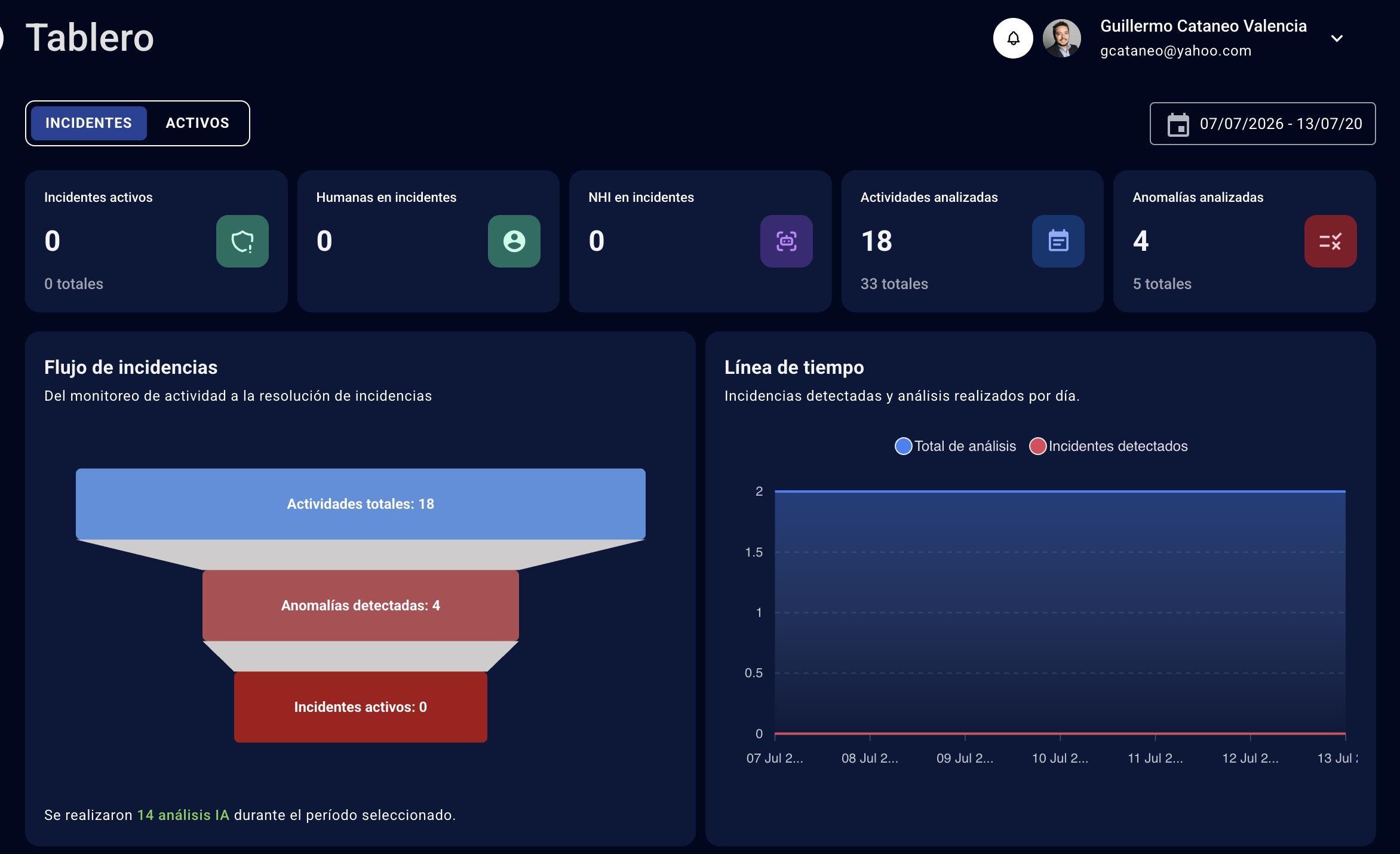
Screenshot of Executive dashboard showing the identity activity funnel — from monitored activities (18) to anomalies detected (4) to active incidents (0) — for a selected date range. Adjacent timeline visualizes incident detection and total AI-driven analysis events per day, with headline KPIs for active incidents, human vs. non-human identities involved, activities analyzed, and anomalies analyzed.
Technical Details
| Deployment Types | On-Premise, SaaS |
|---|---|
| Operating Systems | Windows, Linux, Mac |
| Mobile Application | No |
| Supported Countries | Latam, USA, Canada |
| Supported Languages | English, Spanish |
FAQs
What are Identity Rules's top competitors?
CrowdStrike Falcon Identity Protection are common alternatives for Identity Rules.