Adobe Captivate is an elearning authoring and course design tool (or LCMS). It supports mobile HTML5 content. Captivate’s users are commonly midsized businesses to enterprises. Adobe Captivate includes some prebuilt assets as well as customizable workflows.
$33.99
per month
MadCap Xyleme
Score 6.0 out of 10
N/A
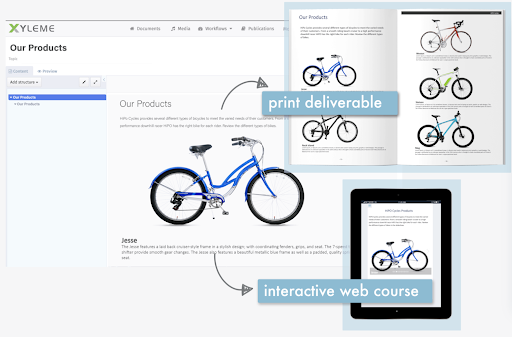
Xyleme is a robust Component and Learning Content Management Solution dedicated to providing users with an easy and safe way to create and disseminate learning materials and other business-related content. It comes equipped with several features that focus on creating a central, single source of truth for an organization’s content.
N/A
Pricing
Adobe Captivate
MadCap Xyleme
Editions & Modules
Subscription
$33.99
per month
Student & Teacher Edition
$399
one-time fee
Upgrade
$499
one-time fee
Pereptual License
1,299
one-time fee
No answers on this topic
Offerings
Pricing Offerings
Adobe Captivate
MadCap Xyleme
Free Trial
Yes
No
Free/Freemium Version
No
No
Premium Consulting/Integration Services
No
No
Entry-level Setup Fee
No setup fee
No setup fee
Additional Details
—
—
More Pricing Information
Community Pulse
Adobe Captivate
MadCap Xyleme
Features
Adobe Captivate
MadCap Xyleme
Learning Management
Comparison of Learning Management features of Product A and Product B
Adobe Captivate
9.1
31 Ratings
6% above category average
MadCap Xyleme
-
Ratings
Course authoring
8.030 Ratings
00 Ratings
Course catalog or library
9.018 Ratings
00 Ratings
Player/Portal
8.024 Ratings
00 Ratings
Learning content
9.024 Ratings
00 Ratings
Progress tracking & certifications
9.026 Ratings
00 Ratings
Learning reporting & analytics
9.019 Ratings
00 Ratings
Social learning
10.014 Ratings
00 Ratings
Gamification
8.02 Ratings
00 Ratings
eLearning Content
Comparison of eLearning Content features of Product A and Product B
Captivate is well suited for instruction designers who want to build attractive, personalized, interactive, energetic lessons. It's also a good choice for someone who wants to build something innovative because Captivate gives the developer so much control over so many aspects.
But if someone wanted something built quickly, generically and didn't care about holding the viewer's attention, then Captivate might be an expensive tool. That person might be more satisfied with a cheaper and easier to learn authoring tool.
Building and keeping up to date modular content (blocks).
Maintaining and updating large content library where meaning team members might be working on the same content but using the content in different context (e.g. learning and internal comms).
Creating learning content by new/recently onboarded team members.
Create simple learning courses with some level of interactively, medium interactivity (tabs, image maps, slider reveal images), create different types of knowledge checks/assessments from multiple choice to drag and drop activities); embed videos and other HTML elements .
Integrate with LMS, apply SCORM rules etc
Better to use in combination with other media creation tools like Vyond, Storyline. Some things can get tricky (compatibility).
Less appropriate: 1. If you need to build highly interactive learning experience 2. When you don't have a team member you can dedicate specifically to customize templates in Xyleme for your organizational needs (looks, functionality etc.) or and to train team members on this software. You'd need someone on your team to collaborate with Xyleme closely to customize functions for your organization's needs. 3. When #2 and you want a modern/in trend looking output and not willing to compromise on what it looks and feels.
Quickly adding in graphics, text, and interactive buttons.
Has extensive variables and branching for additional customization, beyond the competition.
Has 360 degree capability which competitors don't offer (I have not used this feature).
High degree of customization and personalization.
True responsive screen display on all devices, viewable as you are creating the training. This is different than some competitors - some just shrink the screen, but Adobe Captivate allows actually removing or moving or changing items at different screen sizes.
If you like Flash, it has Flash output, although it's going away in 2020. Personally, I think this is an outdated technology.
Many advanced capabilities. I chose this product due to the capabilities.
Comes with assets, templates, people, head shots, and full body—excellent.
Adobe Captivate is the authoring tool. It integrates with Adobe Captivate Prime - which I highly recommend if you want to truly take advantage of all of its features in reporting, administration, compliance, and social learning. (I didn't use Prime because you essentially need 100+ students to affordably use Prime.) If you look at my chart of what Captivate is capable of, I can't say that Captivate has a lot of the reporting features because they are part of Prime/SCORM, although, with Captivate's customization, you might be able to do most of them if you are up to it, but I did not.
Clunky interface, it takes a lot of extra clicks to get places compared to other Adobe apps and competitor's eLearning software.
Would be nice if it was part of creative cloud, or at least in the group of apps you can add through Creative Cloud.
More regular and meaningful updates. Compared to flagship apps like Photoshop, Illustrator, etc. Captivate is like the read headed step child. Competitors excel at providing regular updates with clear change documentation. How are we still using Captivate 2019 in 2022?
The interface feels like it is still stuck in the 90s, would be nice if it was more modern and better in-line with flagship adobe offerings.
Variables and associated menus are a nuisance to work with vs some of the clever drop down and content-sensitive options in Articulate Storyline.
several features advertised as device agnostic or mobile friendly do not work properly on mobile
finicky in many ways, sometimes you need to tinker with details for to long to make things work properly
many UI solutions/elements that are not intuitive at all (even using the tool almost every day you need to make effort to remember how things are done)
We have hundreds of courses that were created in Adobe Captivate. It will take us a while to convert to Articulate. We'll need a license for another year and/or until Adobe comes out with a true update to the software.
Adobe Captivate does take some getting used to. There are features that are much more convoluted than they need to be, but overall it is a great product with a some excellent features. Being in a pretty small market, Adobe Captivate and Articulate Storyline dominate the space. They are not the same software, but allow for eLearning authoring. Each has their benefit and their downside, but, for me, Adobe Captivate edges out Storyline.
It is difficult to get in touch with Adobe Captivate support. With a seemingly limited number of resources, mostly outsourced, getting in contact with someone to help troubleshoot an issue is challenging. Typically wait times are long, and the desired path to resolution is to use an existing knowledge base or a self-help guide. It is certainly not a user-friendly experience.
I'm only aware of the problems Adobe Captivate had with SumTotal LMS and Upside LMS, requiring extensive contact with both internal and external support staff to fix the problems. We had no problems at all with Articulate.
I think that Articulate360 is more user-friendly and has a cleaner, more updated look. If you can edit a PDF, then you can use Articulate 360. Adobe Captivate may be more challenging for the designer, but it has more features. We chose Adobe Captivate because we want the option to create interactive learning environments. Adobe Captivate plays well with the other Adobe design products including Photoshop, Illustrator, and Premier. Additionally, Adoe Captivate is highly compatible with Cornerstone, our preferred Learning Management Systems.
Adobe Captivate has allowed our instructors to engage students in ways we never have before.
Instructors who have used Adobe Captivate in our organization have reported higher levels of engagement with their courses and their students, theoretically leading to improved assessment of student performance.