The world of work is constantly changing. Agile work processes in particular are becoming increasingly popular. Even large companies are trying to introduce agile working methods. For many, the Scaled Agile Framework (SAFe) is the right solution for their agile teams. However, implementing SAFe with all its features such as providing reports, visualizing dependencies and automated documentation is not always easy in reality. Many companies spend a lot of time and money searching for the right…
N/A
Asana
Score8.5 out of 10
N/A
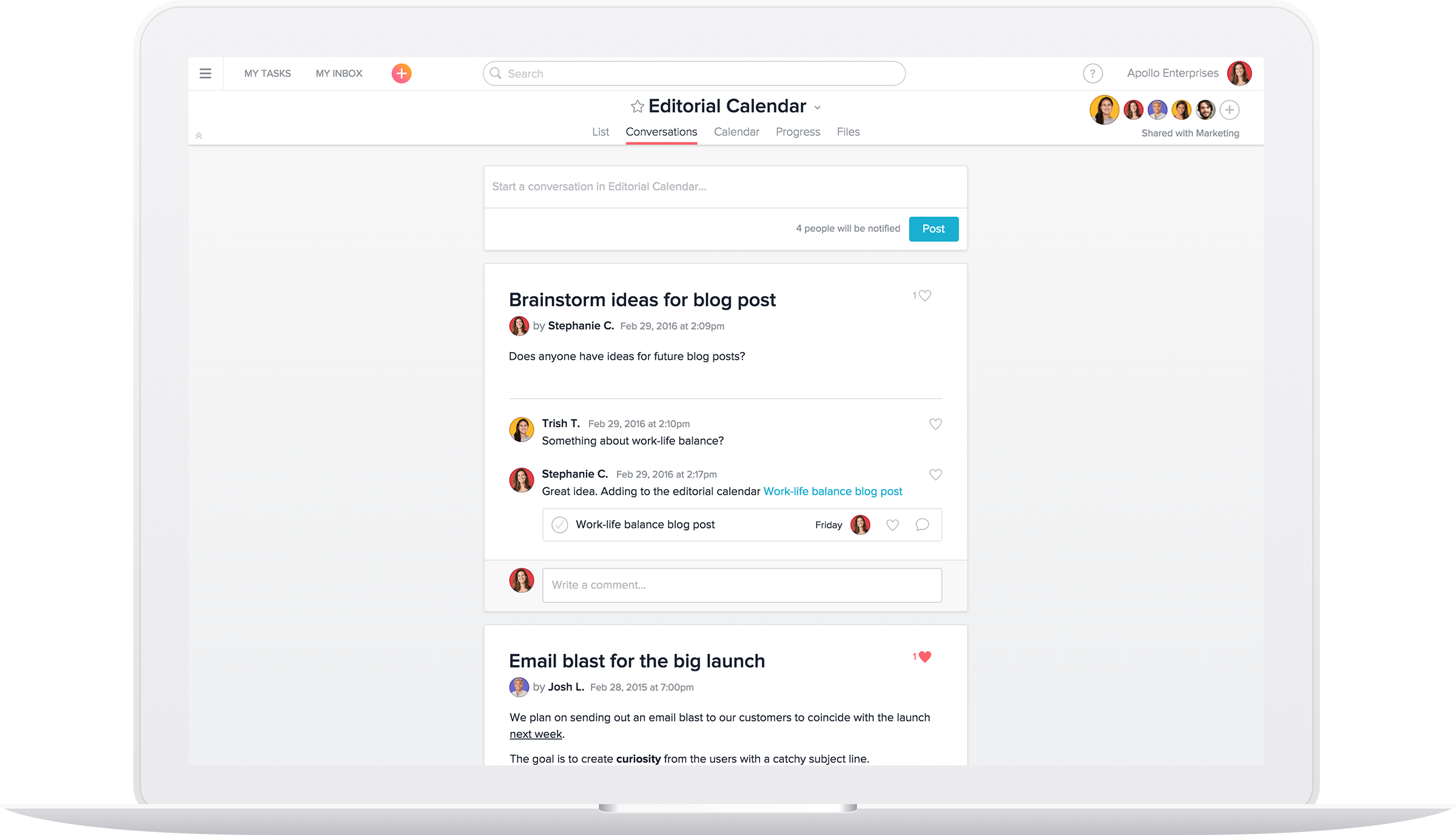
Asana is a web and mobile project management app. With tasks, projects, conversations, and dashboards, Asana lets an entire team know who's doing what by when, enabling workload balancing. Users can also add integrations for GANTT charts, time tracking and more.
Agile Hive is used for our value train within a SAFe setup. Every quarter we organize a so-called Product Increment (PI) Planning, where we plan all Features and Enablers in Agile Hive. Based on the priority of the Product Manager all teams plan their Features and Enablers accordingly to the sprints that are determined by the Release Train Engineer and set up in Agile Hive. The teams then create User Stories and estimate them and based on their sprint velocity (defined in Agile Hive) Product Owners can see how many Features and Enablers are realistic in one quarter (Product Increment). Further, dependencies across teams can be defined and made visible in Agile Hive, so that the plan is feasible. Without Agile Hive it would be hard or impossible to plan across several teams within a value train and to manage all dependencies. Additionally, with Agile Hive the plan is more realistic, so what can be achieved within one quarter in product development.
A de minimis incentive was given to thank the reviewer for their time. The incentive was not used to bias or drive a particular response, nor was the incentive contingent on a positive endorsement. More Info
The usability of Asana is broad since it's available in a variety of platforms that are widely used nowadays. I think that it would be great for people who are constantly on the move and switching devices, since it has allowed me to work from my phone, too. I also think that Asana has proven itself to handle a large quantity of work
Through it, we were able to communicate and cooperate with the rest of the team to complete the work in the required manner and at the appropriate time.
A de minimis incentive was given to thank the reviewer for their time. The incentive was not used to bias or drive a particular response, nor was the incentive contingent on a positive endorsement. More Info
A de minimis incentive was given to thank the reviewer for their time. The incentive was not used to bias or drive a particular response, nor was the incentive contingent on a positive endorsement. More Info
A de minimis incentive was given to thank the reviewer for their time. The incentive was not used to bias or drive a particular response, nor was the incentive contingent on a positive endorsement. More Info
It has in general a good usability, but there are some downsides, the big picture view of the entire product increment is too static, so there is no zoom in or zoom out. Mostly throughout planning it is necessary to zoom in to a sprint level and manage the user stories there. Also, the pig picture view has some limitations, because you cannot read the entire user story name (boxes are too small).
A de minimis incentive was given to thank the reviewer for their time. The incentive was not used to bias or drive a particular response, nor was the incentive contingent on a positive endorsement. More Info
It is very user-friendly. Takes a new employee an hour to start figuring out how the system works. That's an important factor. You don't want to encounter the issue where employees need a week to understand how the system works. For example, JIRA, I tried using it for a week and I still don't understand the complicated layout. Asana has a simple interface. Once you see it, you get it type of program.
A de minimis incentive was given to thank the reviewer for their time. The incentive was not used to bias or drive a particular response, nor was the incentive contingent on a positive endorsement. More Info
I haven't had to use their support so I can't rate it. The fact that I haven't needed them reflects the ease of use of the product. I would recommend that any new users schedule a complete demo of the product to ensure that they are using it to it's fullest (there's a lot of useful features).
A de minimis incentive was given to thank the reviewer for their time. The incentive was not used to bias or drive a particular response, nor was the incentive contingent on a positive endorsement. More Info
With Jira Software alone it is also possible to plan a SAFe product increment planning, but it would be nearly impossible to see the overall big picture of all product teams involved in a release train. So, the planning on sprint level for one team would be more efficient, but the planning for a whole quarter with all dependencies across teams would be not feasible to present. Therefore, Agile SAFe enables value trains an efficient way to plan a product increment.
A de minimis incentive was given to thank the reviewer for their time. The incentive was not used to bias or drive a particular response, nor was the incentive contingent on a positive endorsement. More Info
Asana is a top-tier project management software that helps us organize and track projects from start to finish. It allows us to apply tasks/to-dos to multiple projects without duplication, divide complex projects into smaller tasks, and track project progress. It also helps us organize work on Kanban boards or linear lists. It stands out from the crowd in a big way compared to the competition.
A de minimis incentive was given to thank the reviewer for their time. The incentive was not used to bias or drive a particular response, nor was the incentive contingent on a positive endorsement. More Info