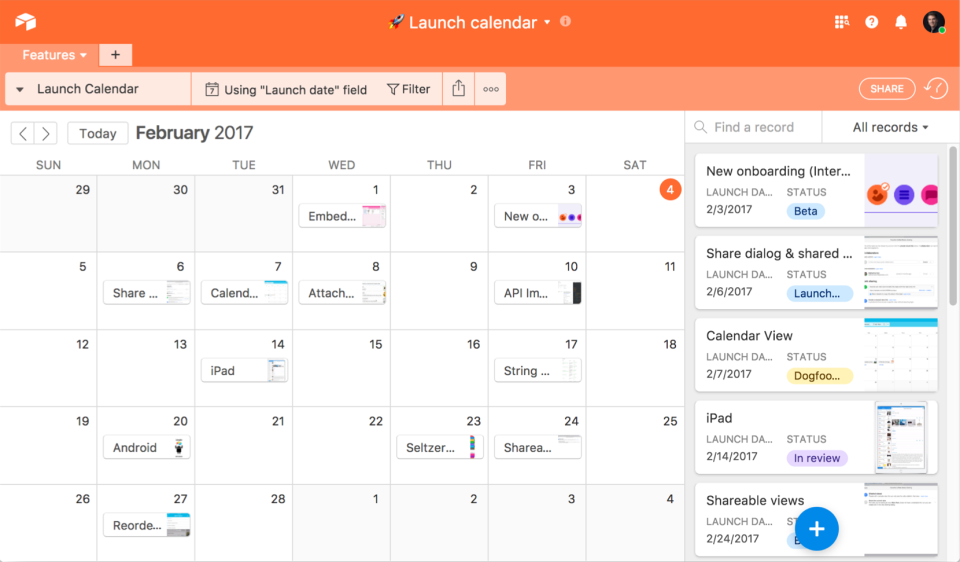
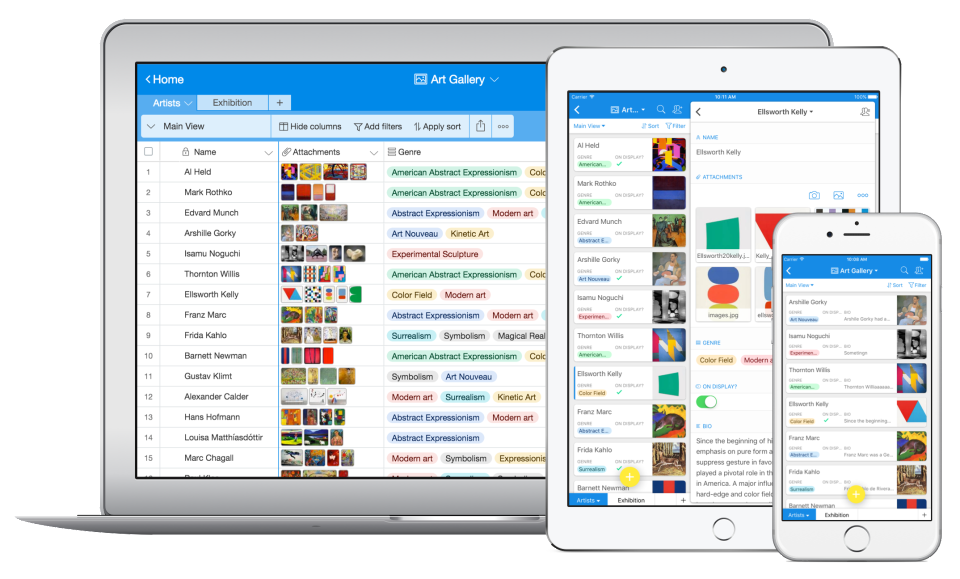
Airtable is a project management and collaboration platform designed to enable content pipelines, product management, events planning, user research, and more. It combines spreadsheet,database, calendar, and kanban functionality within one platform.
$24
per month per seat
Ninox
Score 10.0 out of 10
N/A
Ninox is a codeless app building platform available via the cloud or on-premise for Mac, from Ninox Software headquartered in Berlin.
$10
per month
React (React.js)
Score 8.8 out of 10
N/A
React or React.js is a JavaScript library for building user interfaces. React enables users to create interactive UIs.
$0
Pricing
Airtable
Ninox
React (React.js)
Editions & Modules
Team
$24
per month per user
Business
$54
per month per user
Enterprise
Custom Pricing
Ninox Cloud
$10
per user, per month
Mac
£34.99
one-time purchase
Ninox Cloud - Enterprise
Contact Sales
No answers on this topic
Offerings
Pricing Offerings
Airtable
Ninox
React (React.js)
Free Trial
Yes
Yes
No
Free/Freemium Version
Yes
No
Yes
Premium Consulting/Integration Services
No
No
No
Entry-level Setup Fee
No setup fee
No setup fee
No setup fee
Additional Details
—
—
—
More Pricing Information
Community Pulse
Airtable
Ninox
React (React.js)
Features
Airtable
Ninox
React (React.js)
Project Management
Comparison of Project Management features of Product A and Product B
Airtable is an ideal platform for small and growing businesses to keep track of just about EVERYTHING they need to keep things running smoothly. It's a great way to keep tasks organized, and keep everyone on the same page with progress on all things. Our company finds the kanban particularly useful, as products go through a lifecycle from ideation to retirement, it's good to keep a database of what is in production, what's working, and what we've tried before. I can see the platform being challenging with much larger businesses, but for the small to medium businesses I've used the platform with, it is ideal.
React is a JavaScript user interface construction library that works well for:
Developing web apps with dynamic and complicated user interfaces.
creating reusable UI elements that may be used in other applications.
creating single-page applications with dynamic content updates that don't require a page reload.
The Virtual DOM's effective updating mechanism allows it to handle large volumes of data updates.
React, on the other hand, might be less suitable for:
Websites that are simple, stagnant, and have no interaction. Other libraries or simple HTML, CSS, and JavaScript may be a better fit in such circumstances.
Web sockets may be a better choice for applications that need real-time updates, such as chat or gaming apps.
When creating mobile apps, React Native is a better option.
Server side rendering only, as React is designed to run on the client side.
Airtable has capabilities commonly found in spreadsheet applications, but also has some of the features found in databases.
The ability to filter fields. I set up a filter on the status field, so when a project is marked, complete, on hold, or canceled, that record is hidden from my current projects table view. If it is marked complete, the record is moved to the completed projects table view. In this way I can easily access a record of past projects
Being able to duplicate tables and create alternate views
Collapse and expand records. When I collapse the rows, I can easily scan current projects, next steps, project status, and due dates. When I expand the row, or field, I can see more detailed information about that field or record very easily. I can also expand or open the entire record. This is is helpful, when I am entering a lot of information to multiple fields in that record.
React is fantastic for building performant user interfaces. Our web app is snappy and great for our customers.
React has the philosophy of doing one thing and doing it well which is the view layer of the application. This makes it incredibly intuitive and flexible for developers to use.
React has lead the way in being able to write modular and structured code. It is a drastic improvement since the days of spaghetti jQuery code.
React has an unmatched community. The amount of tools and libraries available is fantastic, and there plenty of solutions available online for common problems.
Debugging React is challenging. Bugs in react code generate stack traces internal to React and it is often totally unclear how it relates to the code you actually wrote.
Relating your React elements to corresponding DOM elements is difficult. The intentional separation of virtual and actual DOM also makes it difficult to map the elements to the structures in the DOM. This is partially ameliorated by the use of the React dev tool, which provides a DOM-like view of the React elements, but the tool still does not provide a direct correspondence with the DOM that is often necessary to figure out why something isn't right.
Because JSX is React-specific and not a language feature, a special compilation process is necessary to convert JSX code to normal JS. Coming from a C++ background, compiling things doesn't bother me, but many JS developers are used to a less structured development.
We will 10/10 renew the use of Airtable because it has brought great value to our team. Not only is Airtable affordable, but it's also user-friendly and helps our team be efficient. We no longer need to rely on Excel spreadsheets being passed from person to person via email. Furthermore, we aren't dealing with corrupt Excel spreadsheets and the need to salvage data when a file is accidentally altered.
IMO the usability of this product is its greatest asset. The UI is clean and the menus are intuitive to the point where I'd feel confident having a non-spreadsheety colleague take on building an Airtable for the first time with next to no training. I can't say that about every table-like software product that I've used such as Notion.
React is just a bit of a different animal. I was avoiding it for the longest time. I thought for sure I would land on Vue or something else with a more approachable and familiar appearance. But after taking an online course in React, I started realize what people were raving about (and complaining about) and decided to implement it at our office for one of our products.
I have rarely experience downtime, compared to other tools, and given how much time we spend on the tool. Even if there were to be, their updates on it are very timely, and our support team are able to provide any questions regarding
I never had any issues with load time, even with the integrations that we use today (google sheets) However, I'm curious if adding additional layers of integrations would slow down performance. We do carry quite a bit of data in Airtable, but, again, no impact on overall performance
Airtable has great support. They have a variety of support features to answer any questions. They have great self teaching instructions for templates and product tours. They also have support for teams and project management. They also have a fantastic customer help line. They are able and willing to answer customer questions and never have customers waiting long
Since it's open-source and very popular, the community support for React and related tools and libraries is excellent. There are a lot of people using the same tools, and so issues tend to get fixed quickly and "recipes" are easy to come by. And since it's backed by Facebook, they have a dedicated engineering team working on the progression of React.
Recorded trainings were provided by the Airtable team. Great as an evergreen resources to new team members and for anyone that wants to refresh their Airtable knowledge
Training all users was an important part of the implementation, which did take considerable time and effort. At first glance without training, the content calendar can be overwhelming because of the amount of data. The features within Airtable seem to be endless but our team was able to identify the most important to be successful.
Airtable was a really good fit for this specific use case as it provided a huge number of collaboration features in an intuitive and pleasant-to-use interface. The free tier worked initially with our work, and the upgrade pathway was fair and made sense for us.
While this is a widely contested debate with various blog posts and benchmarks all over the place, its really a personal choice to determine what works for the team. Coming from a Angular 1.x background, I decided to try a new framework when Angular 2.x was announced and at that time React is gaining popularity and Vue hasn't taken off yet. Compared to Angular 1.x and Vue (hybrid of React and Angular) that split the logic from the html templates, I loved the way React breaks code into components using the jsx syntax. In my mind, this allows for cleaner components and easier maintenance
There are TONS of opportunity to scale, but I think it's a matter if you have the time and resources to do so because the initial setup can be fairly time consuming and prioritized dedication
Through this platform, I always have the idea bout which of my team member is working on which particular part of the project, I can easily track their progress, and also I can easily correct them where it is required by adding sticky notes, by sending the attachments and URLs.