Amazon Lightsail is a virtual private server (VPS) designed to present an easy-to-use cloud platform that offers everything needed to build an application or website, plus a cost-effective, monthly plan.
$3.50
per month
AWS CloudFormation
Score 8.7 out of 10
N/A
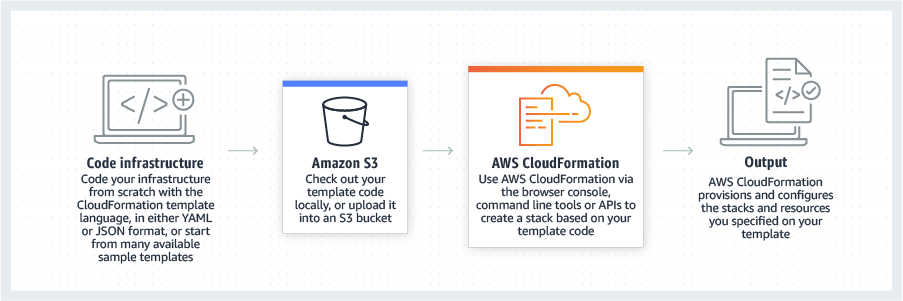
AWS CloudFormation gives developers and systems administrators a way to create and manage a collection of related AWS resources, provisioning and updating them in a predictable fashion. Use AWS CloudFormation’s sample templates or create templates to describe the AWS resources, and any associated dependencies or runtime parameters, required to run an application. Users don’t need to figure out the order for provisioning AWS services or the subtleties of making those dependencies work.…
$0
Bluehost
Score 5.7 out of 10
N/A
Bluehost, headquartered in Orem, Utah, offers website hosting. Bluehost also offers managed WordPress hosting, with optional SEO and marketing tools for WordPress plans.
$19.95
per month for 36 month term
Pricing
Amazon Lightsail
AWS CloudFormation
Bluehost
Editions & Modules
512 MB Linux
$3.50
per month
1 GB Linux
$5.00
per month
2 GB Linux
$10.00
per month
Free Tier - 1,000 Handler Operations per Month per Account
$0.00
Handler Operation
$0.0009
per handler operation
Shared WordPress Hosting
$3.95-$16.99
per month
Shared Web Hosting
$3.95-$26.99
per month for 36 month term
eCommerce - WooCommerce Hosting
$15.95-$49.95
per month, 1 month to 36 month terms available
Managed WordPress (beta)
$19.95
per month for 36 month term
VPS Hosting
$19.99 - $119.99
per month
Blue Sky Live WordPress Support
$29.00-$149.00
per month
Dedicated Hosting
$79.99-$209.99
per month
Offerings
Pricing Offerings
Amazon Lightsail
AWS CloudFormation
Bluehost
Free Trial
No
Yes
No
Free/Freemium Version
No
Yes
No
Premium Consulting/Integration Services
No
Yes
No
Entry-level Setup Fee
No setup fee
No setup fee
No setup fee
Additional Details
—
There is no additional charge for using AWS CloudFormation with resource providers in the following namespaces: AWS::*, Alexa::*, and Custom::*. In this case you pay for AWS resources (such as Amazon EC2 instances, Elastic Load Balancing load balancers, etc.) created using AWS CloudFormation as if you created them manually. You only pay for what you use, as you use it; there are no minimum fees and no required upfront commitments.
When you use resource providers with AWS CloudFormation outside the namespaces mentioned above, you incur charges per handler operation. Handler operations are create, update, delete, read, or list actions on a resource.
—
More Pricing Information
Community Pulse
Amazon Lightsail
AWS CloudFormation
Bluehost
Features
Amazon Lightsail
AWS CloudFormation
Bluehost
Infrastructure-as-a-Service (IaaS)
Comparison of Infrastructure-as-a-Service (IaaS) features of Product A and Product B
Amazon Lightsail
8.8
6 Ratings
7% above category average
AWS CloudFormation
-
Ratings
Bluehost
-
Ratings
Service-level Agreement (SLA) uptime
10.06 Ratings
00 Ratings
00 Ratings
Dynamic scaling
5.05 Ratings
00 Ratings
00 Ratings
Elastic load balancing
9.34 Ratings
00 Ratings
00 Ratings
Pre-configured templates
8.06 Ratings
00 Ratings
00 Ratings
Monitoring tools
8.06 Ratings
00 Ratings
00 Ratings
Pre-defined machine images
8.95 Ratings
00 Ratings
00 Ratings
Operating system support
10.06 Ratings
00 Ratings
00 Ratings
Security controls
10.06 Ratings
00 Ratings
00 Ratings
Automation
10.05 Ratings
00 Ratings
00 Ratings
Configuration Management
Comparison of Configuration Management features of Product A and Product B
We utilized Amazon Lightsail to get a web application proof of concept up and running. It's easy to set up, requires minimal configuration, and lets us to concentrate on the coding. It's designed to help you get started fast and easily, but it's not designed for corporate applications or workloads.
I still give it an 8 because it's one of those tools that just quietly does the heavy lifting for you but it can really test your patience when it breaks esp with deep nested stacks. It's perfect for projects where we need clean consistent environments every time. It's less ideal for quick experimental setups like new EC2 configs or Lambda permission tweaks.
Bluehost is a decent all-around choice for web hosting with professional web development and domain management features that are particularly ideal for WordPress websites and blogs. They have a good reputation within the industry as a company that invests heavily in new technology and platform innovation. Bluehost has made a lot of improvements to customize their back-end administration (AMP & control panel) by working to improve the usability and design of the browser interface. Bluehost is primarily focused on customers who use WordPress and we would recommend either their hybrid cloud or managed WordPress platform, which provides everything that you need to build and maintain a popular website. All in all, Bluehost is a well-established brand that continually improves its hosting products, regularly upgrades their data center hardware, and is generally considered a leader in the development of new cloud hosting platform services.
Customer service/tech support is simply top-notch. Being able to pick up the phone, get help, and not get charged for it is rare in the tech-support world.
Their Dashboard/C-panel has a wide selection of popular tools and options to make website design and all that goes with it very easy. Lots of choices; they are more than a simple hosting service.
Keeping their tools up-to-date. I never have to worry about upgrades or having the latest features; it just happens automatically!
My overall experience with Amazon Lightsail is very good, and the online community of Lightsail users is very large and its helps to resolve any kind of issue i faced on my server. I also like the integration of other AWS services with Amazon Lightsail like we can export our Lightsail instance into ec2 server using snapshots.
It's easy enough to get a shared template & apply it. You don't even have to download-then-upload or copy-and-paste, a publicly-accessible url works.
Diving deeper, it has enough powerful capabilities to make the life of a platform / DevOps engineer bearable.
However, you need equally deep knowledge to troubleshoot issues, when they inevitably pop up. This is the same for all IaC technologies, as they are additional abstraction layers on top of the native API provided by the cloud providers.
I use Wordpress for my website on Bluehost, so I already know how it works and happy with it. I gave it this rating as I love the fact that If you do plan on creating multiple websites on Bluehost you'll be able to create specific login access for each website sites making it less likely to enter into the wrong website accounts. Which makes it even easier to manage client websites if you plan to create and host websites on behalf of your clients.
They are quick, easily reached, and can usually solve problems on the first try. However I noticed I had to go to customer support more often than with other providers, whether that was things breaking more often or if their customer support couldn't fix things on the first try. But in most scenarios, they are fine.
Amazon Lightsail is a great platform. Before we started using it, we were using AWS EC2 instances as our primary servers after being dissatisfied with other providers. After Amazon Lightsail's introduction, we were able to reduce our operating costs, improve our quality assurance tasks, and provide much more efficient and better apps with our microservices architecture.
Cloning a virtual machine creates a virtual machine that is cloning a virtual machine creates a virtual machine that is a copy of the original. The new virtual machine is configured with the same virtual hardware, installed software, and other properties that were configured for the original virtual machine. For information about persistent memory and PMem storage, see the vSphere Cloning a virtual machine creates a virtual machine that is a copy of the original. The new virtual machine is configured with the same virtual hardware, installed software, and other properties that were configured for the original virtual machine. For information. Management guide.For information copy of the original. The new virtual Cloning virtual machine creates a virtual machine that is a copy of the original. The new virtual machine is configured with the same virtual hardware, installed software, and other properties that were configured for the original virtual machine. For information about persistent memory and PMem storage, see the vSphere Resource Management Guide. For information is configured with the same virtual hardware, installed software, and other properties that were configured for the original virtual machine. For information about persistent memory and PMem storage, see the vSphere Resource Management Guide. For information
Bluehost did not stack up against HostGator; in fact, HostGator was where we ended up migrating after we realized Bluehost was not for us. Bluehost is not geared toward businesses, especially ones like ours that have a very customized site. HostGator allowed us the customization that we needed, and their prices were terrific.
The website is slow. The speed is not reliable. Sometimes, sites would go down without warning. You would have to get a VPS to get consistent speed. If you have small website as a hobby, then Bluehost will be sufficient. Otherwise, I recommend looking for something more fast. Storage is good, but speed is lacking