Amazon SageMaker enables developers and data scientists to quickly and easily build, train, and deploy machine learning models at any scale. Amazon SageMaker removes all the barriers that typically slow down developers who want to use machine learning.
N/A
OpenText Magellan
Score 9.0 out of 10
N/A
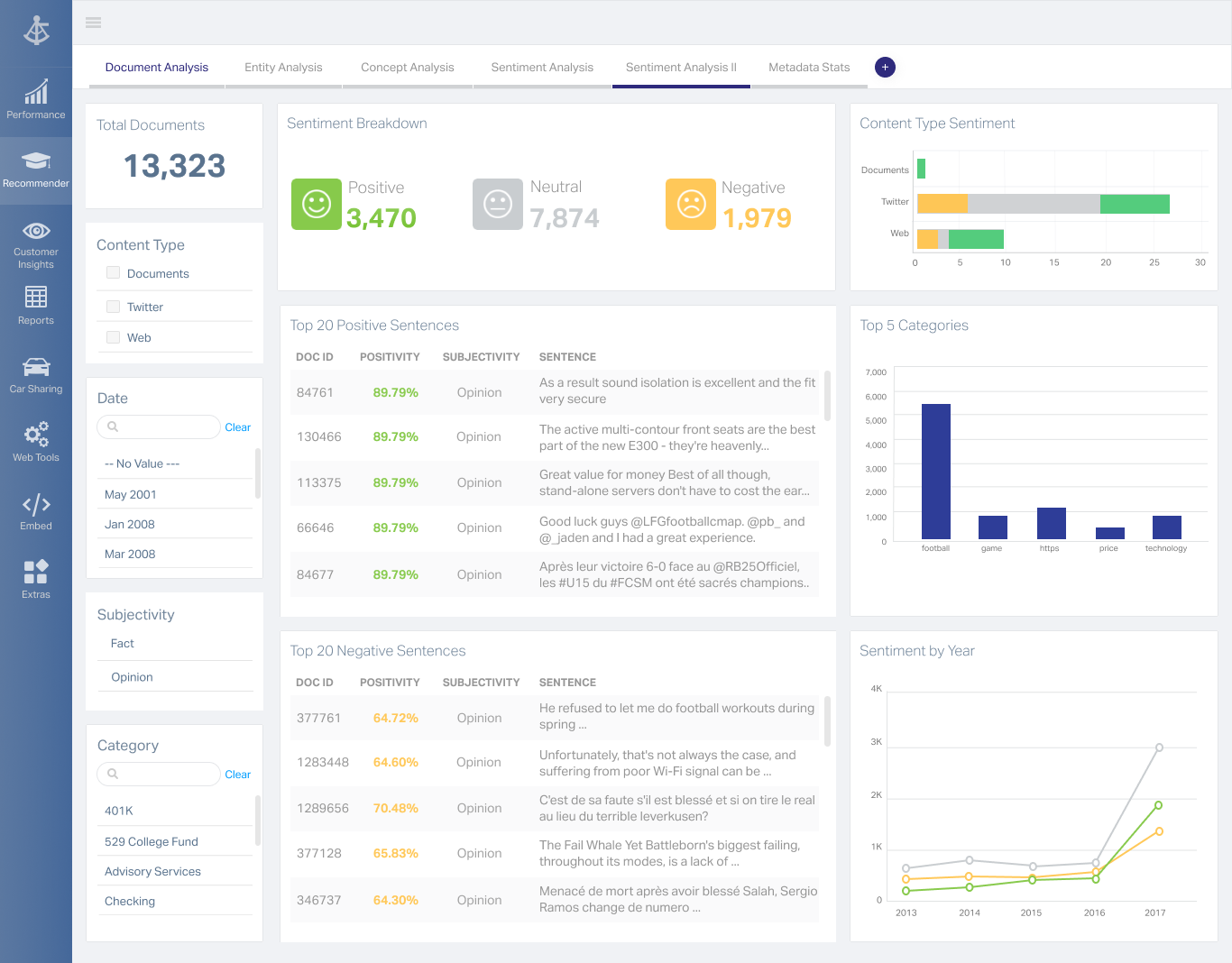
OpenText Magellan Analytics Suite leverages a comprehensive set of data analytics software to identify patterns, relationships and trends through data visualizations and interactive dashboards.
N/A
TensorFlow
Score 7.7 out of 10
N/A
TensorFlow is an open-source machine learning software library for numerical computation using data flow graphs. It was originally developed by Google.
N/A
Pricing
Amazon SageMaker
OpenText Magellan
TensorFlow
Editions & Modules
No answers on this topic
No answers on this topic
No answers on this topic
Offerings
Pricing Offerings
Amazon SageMaker
OpenText Magellan
TensorFlow
Free Trial
No
No
No
Free/Freemium Version
No
No
No
Premium Consulting/Integration Services
No
No
No
Entry-level Setup Fee
No setup fee
No setup fee
No setup fee
Additional Details
—
—
—
More Pricing Information
Community Pulse
Amazon SageMaker
OpenText Magellan
TensorFlow
Features
Amazon SageMaker
OpenText Magellan
TensorFlow
BI Standard Reporting
Comparison of BI Standard Reporting features of Product A and Product B
Amazon SageMaker
-
Ratings
OpenText Magellan
7.0
2 Ratings
16% below category average
TensorFlow
-
Ratings
Customizable dashboards
00 Ratings
7.02 Ratings
00 Ratings
Report Formatting Templates
00 Ratings
7.01 Ratings
00 Ratings
Ad-hoc Reporting
Comparison of Ad-hoc Reporting features of Product A and Product B
Amazon SageMaker
-
Ratings
OpenText Magellan
8.3
3 Ratings
3% above category average
TensorFlow
-
Ratings
Drill-down analysis
00 Ratings
8.03 Ratings
00 Ratings
Formatting capabilities
00 Ratings
8.03 Ratings
00 Ratings
Integration with R or other statistical packages
00 Ratings
9.01 Ratings
00 Ratings
Report sharing and collaboration
00 Ratings
8.02 Ratings
00 Ratings
Report Output and Scheduling
Comparison of Report Output and Scheduling features of Product A and Product B
Amazon SageMaker
-
Ratings
OpenText Magellan
8.3
2 Ratings
1% above category average
TensorFlow
-
Ratings
Publish to Web
00 Ratings
8.02 Ratings
00 Ratings
Publish to PDF
00 Ratings
8.02 Ratings
00 Ratings
Report Versioning
00 Ratings
9.02 Ratings
00 Ratings
Report Delivery Scheduling
00 Ratings
8.02 Ratings
00 Ratings
Data Discovery and Visualization
Comparison of Data Discovery and Visualization features of Product A and Product B
It allows for one-click processes and for things to be auto checked before they are moved through the process but through the system. It also makes training easy. I am able to train users on the basic fundamentals of the tool and how it is used very easily as it is fully managed on its own which is incredible.
If you do not have a large budget and are a large organization, I would steer clear of Actuate. If you are looking to do very complex washboarding, I would not use them. Your developers have to be very skilled to work with this. Plan to bring in consultants if necessary to help your process. Adhoc reporting is weak. If your pricing is user based and you expand, this could be very expensive.
TensorFlow is great for most deep learning purposes. This is especially true in two domains: 1. Computer vision: image classification, object detection and image generation via generative adversarial networks 2. Natural language processing: text classification and generation. The good community support often means that a lot of off-the-shelf models can be used to prove a concept or test an idea quickly. That, and Google's promotion of Colab means that ideas can be shared quite freely. Training, visualizing and debugging models is very easy in TensorFlow, compared to other platforms (especially the good old Caffe days). In terms of productionizing, it's a bit of a mixed bag. In our case, most of our feature building is performed via Apache Spark. This means having to convert Parquet (columnar optimized) files to a TensorFlow friendly format i.e., protobufs. The lack of good JVM bindings mean that our projects end up being a mix of Python and Scala. This makes it hard to reuse some of the tooling and support we wrote in Scala. This is where MXNet shines better (though its Scala API could do with more work).
It's very good for the hardcore programmer, but a little bit complex for a data scientist or new hire who does not have a strong programming background.
Most of the popular library and ML frameworks are there, but we still have to depend on them for new releases.
Theano is perhaps a bit faster and eats up less memory than TensorFlow on a given GPU, perhaps due to element-wise ops. Tensorflow wins for multi-GPU and “compilation” time.
I am no longer working for the company that was using Actuate but I believe they would continue to use it because the stitching costs would be to high. It would require a complete rewrite of the reports and the never version of Actuate (BIRT) even required an almost complete report rewrite
It is quite intuitive to use. It is fit specifically for doing sentiment, emotion, and intention analysis as well as text classification and text summarization. I would have given 10 if it is fit for the purpose of doing image processing and analysis as well. There is a huge market to analyze video and image data.
Community support for TensorFlow is great. There's a huge community that truly loves the platform and there are many examples of development in TensorFlow. Often, when a new good technique is published, there will be a TensorFlow implementation not long after. This makes it quick to ally the latest techniques from academia straight to production-grade systems. Tooling around TensorFlow is also good. TensorBoard has been such a useful tool, I can't imagine how hard it would be to debug a deep neural network gone wrong without TensorBoard.
Amazon SageMaker took the heavy lifting out of building and creating models. It allowed for our organization to use our current system for integration and essentially added on a feature to help all levels of Data scientists and IT professionals in our department and company as a whole. The training was simple as well.
It is vastly superior to these in many ways, for complex reporting it is a much more sophisticated solution. Visualizations are very good. Javascript extensibility is very powerful, others don't support this or as well. Pentaho and MS are both OLAP oriented. Pentaho is moving more toward big data, which was not our primary focus. Others are stuck in the Crystal Reports Band metaphor.
Keras is built on top of TensorFlow, but it is much simpler to use and more Python style friendly, so if you don't want to focus on too many details or control and not focus on some advanced features, Keras is one of the best options, but as far as if you want to dig into more, for sure TensorFlow is the right choice
Actuate can handle 50 to 60 sub reports inside a report very well.
Dynamically creating the datasource, chart, graph, reports are the main advantages. We can do any level of drilling, and can create a performance matrix dashboard efficiently.