Overview
ProductRatingMost Used ByProduct SummaryStarting Price
Anaconda
Score 8.7 out of 10
N/A
Anaconda is an enterprise Python platform that provides access to open-source Python and R packages used in AI, data science, and machine learning. These enterprise-grade solutions are used by corporate, research, and academic institutions for competitive advantage and research.
$0
per month
JMP
Score 9.7 out of 10
N/A
JMP® is statistical analysis software with capabilities that span from data access to advanced statistical techniques, with click of a button sharing. The software is interactive and visual, and statistically deep enough to allow users to see and explore data.
$1,320
per year per user
Posit
Score 10.0 out of 10
N/A
Posit, formerly RStudio, is a modular data science platform, combining open source and commercial products.N/A
Pricing
AnacondaJMPPosit
Editions & Modules
Free Tier
$0
per month
Starter Tier
$15
per month per user
Business
$50
per month per user
Custom
Contact Sales
JMP
$1320
per year per user
No answers on this topic
Offerings
Pricing Offerings
AnacondaJMPPosit
Free Trial
NoYesYes
Free/Freemium Version
YesNoYes
Premium Consulting/Integration Services
NoNoNo
Entry-level Setup FeeNo setup feeNo setup feeOptional
Additional DetailsUsers within organizations with 200+ employees/contractors (including Affiliates) require a paid Business license. Academic and non-profit research institutions may qualify for exemptions.Bulk discounts available.
More Pricing Information
Community Pulse
AnacondaJMPPosit
Considered Multiple Products
Anaconda
Chose Anaconda
I am using both; when it comes to application deployment on the server, I use Docker, and sometimes, I use Docker with conda image for deployment when it comes to ML/DL apps.
Chose Anaconda
There are several reasons why Anaconda is better to use for me including that it is much easier to use than Baycharm. Also, the user interface is not as complicated as that of Baycharm. Even Anaconda does not slow down my device, using PaySharm slowed down my device in an …
Chose Anaconda
It provides several IDEs like Spyder and Jupiter that would be enough for me to write my Python script. You can easily install it on a Windows or Linux computer and supports many libraries.
Chose Anaconda
In Anaconda, [it is easy] to find and install the required libraries. Here, we can work on multiple projects with different sets of the environment. [It is] easy to create the notebook for developing the ML model and deployment. Right now, it is the best data science version …
Chose Anaconda
I have used many other tools for coding purposes.
But for python programming, the best fit tool is Anaconda.
Memory management is best in Anaconda.
Chose Anaconda
One of the main competitors to Anaconda can be Google products such as Colab. Colab gives you the flexibility to handle large datasets gives it an edge over Anaconda. But again, the ease of access and usability of Anaconda stacks up against Colab. Besides, Anaconda relies more …
Chose Anaconda
It is almost dishonest to compare Anaconda with PyCharm as they do different things in their basic forms unless you spend a lot of time configuring plugins on your PyCharm environment. Anaconda has a lot of things ready and you just need to install your libs and dependencies.
Chose Anaconda
This is an open source tool and used very easily. All the notebooks are under one navigator solved the whole problem.
Chose Anaconda
Anaconda has features which overpowers it over the other analytical tools I have used. Also it provides multiple ways to reach to the solution, depending on the developers expertise. When I was a beginner at using Anaconda, since it is open source and the community using …
Chose Anaconda
Free ware, better design ease of use
Chose Anaconda
On top of all the software that I have used, Anaconda is the best because in Anaconda we have built-in packages that provide no headache to install packages and we can design a separate environment for different projects. Anaconda has versions made for special use cases. …
Chose Anaconda
Some analyzed tools, such as Pycharm and Spyder, are simpler to use but still do not have all the libraries needed for those starting out in data science--or in institutions that need to grow in that direction. Anaconda is more robust but stable, more complete, and the …
Chose Anaconda
If the project is not large scale then Jupiter notebooks or Visual Studio Code serve well. If you don't have any dependency on Python versions, these IDEs can be well suited for fast development and deployment.
Chose Anaconda
Anaconda includes many standard data science packages where as the regular python installation does not.
Depending on use case, some may feel Anaconda may be "bloated"
For ease Anaconda is better, for minimizing extraneous package installation, the regular python installer is …
Chose Anaconda
I know that Pycharm is a IDE and Anaconda is a distribution. However I use Anaconda largely due to Jupyter Notebook, which more or less does the same job as Pycharm. 1 year ago I decided to use Anaconda (Jupiyer Notebook) as it is easier to use it as a beginner(at least my …
Chose Anaconda
Anaconda has 64-bit support in the community edition, and package management is more in line with the way we think.
Chose Anaconda
I have not used another program like Anaconda before.
Chose Anaconda
MATLAB is more of a pay-as-you-go alternative, which not only does not use Python but is also more bloated and costly. MATLAB takes longer to install, setup, and configure for new users who may require specific packages - such as the Classification Learner (machine learning), …
Chose Anaconda
Compare Anaconda to Unix coding system. You can use PIP to install and create requirement.txt to replace environment.yml to avoid using Anaconda. However, Anaconda is such an excellent tool to maintain your environment and check the version of your package and update the …
Chose Anaconda
Anaconda is very strong in the environment and version control that make data science work much easier. The only thing that might be comparable to Anaconda would be using Kubernetes to control Docker. Another potential improvement would be replacing spyder with PyCharm and Atom …
Chose Anaconda
I like SpyDER, which comes with Anaconda better for its intuitive layout and variable explorer options.
Chose Anaconda
Anaconda gives freedom to do anything with its packages, compared to other non-programming language-based softwares. It is almost possible to do anything with Anaconda. Anaconda brings ease of integrity because it is possible to integrate anything with a Python Py script, …
Chose Anaconda
Suitable for Python development where there’s internal supporting for Python; otherwise, other platform offers similar capabilities with lower cost.
Chose Anaconda
I prefer Anaconda due to the control I have at every level over the data and the visualizations. Power BI does a better job at guessing what graphics to use, but these usually aren't the most helpful. Anaconda and the slew of Python extensions that add incredible functionality, …
Chose Anaconda
Other systems might be easier to set-up but Anaconda is a fairly flexible analytics toolkit. It can be configured in a way that truly matches the way in which your business or analytics department works. Built on top of lots of open source projects so things aren't siloed and …
JMP
Chose JMP
MS Excel with AnalysisToolPak provides a home-grown solution, but requires a high degree of upkeep and is difficult to hand off. Minitab is the closes competitor, but JMP is better suited to the production environment, roughly equivalent in price, and has superior support.
Chose JMP
Much better than Excel for deep data dives, but also much steeper learning curve. And the cost is significantly higher - Excel is provided by default, but we have to request a JMP license each year.
Chose JMP
It is great because it has UI menus but it costs money whereas the other programs are free. That makes it ideal for beginners but I think that RStudio and Python are going to make someone a lot more marketable for future opportunities since most companies won't pay for the …
Chose JMP
JMP Statistical Discovery Software was already being used at my company. Other statistical software tools such as dataConductor have an easier-to-use interface and do not require learning a scripting language to generate large quantities of data plots.
Chose JMP
JMP is superior to the MS Excel product in its graphical presentation and graphical exploration platforms. It has minor deficiencies in the lack of a 'goal seek' formula (although one can sort of get to this using the simulation platforms in some of the higher level ML …
Chose JMP
Compared to other, similar programs, JMP is outstanding in ease of use and ability to be used by almost anyone across an organization. It is more fluid, user friendly, and, most importantly, requires no coding experience. The only two areas where it is not as good as …
Chose JMP
JMP is more user-friendly, in my opinion, as it doesn't require any coding or searching for hours into cryptic folders for the analysis you want to perform. It is also very good for recording large data sets. Moreover, it is compatible with Microsoft Excel.
Chose JMP
For me, JMP is the best and easy way to run regressions. I wouldn't use it for other more advanced models. I decided to use it because we got it for free since we are technically an academic institution.
Chose JMP
I have only used STATA as a statistical package, and they are completely different tools. JMP has a much better layout and ease of use, but may not be as powerful as STATA for advanced processes. Overall speed and ease of use makes it like a combination of ms excel and stata …
Chose JMP
For what it does, it has better value and is easier to train other users to use.
Chose JMP
We actually use both JMP and IBM SPSS, but I think JMP's complexity lends itself to more in-depth statistical analyses. SPSS is designed for that as well, but we tend to use it more for quicker analyses, and we have found that JMP is far more powerful.
Chose JMP
Minitab, MODE. JMP is more user-friendly, interactive, and visual, with larger variety of analysis and tools. DOE platform itself is superior to any other software, instead of fitting the problem to classical design, the design is fitted to any problem and constraints.
Chose JMP
MS Excel is good for manipulating data and providing flexible data arrays, but has serious deficiencies in its graphical displays and analytic capabilities. This is where JMP has its greatest advantages...see some of my previous comments, but I see these software applications …
Chose JMP
Compared to:
MSExcel - Useful from engineering data analysis perspective
Matlab - cost/ expensive licensing
Chose JMP
I choose JMP because I can accomplish various analyses in one place (no need to move my data around). JMP also can handle huge data sets.
Chose JMP
I much prefer the ability to code my programs which is the main method used in both SAS and R. These software choices allow for quicker, more efficient, and more advanced analysis techniques. The one area that JMP is above these is in graphics and visual displays of data. JMP …
Chose JMP
Well, JMP is excellent for statistical analysis. So, this product it is well used for statistical analysis and data analytics.
Chose JMP
As I stated before, you can use Excel to do many similar things to JMP; you can even use SAS to create graphs without having to do any sort of exporting. If you use SAS, however, you know these graphs are hideous, and sometimes using an Excel graphs makes you look like you are …
Chose JMP
JMP is fast and powerful but little costly than others. But good return for money.
Chose JMP
Preference to JMP is driven more by my personal affinity for SAS and its application capabilities.
Chose JMP
I heard good things from colleagues who have used JMP. We did not get too far down the SPSS route before we decided to go with JMP because of price and perceived benefit from my colleague's advice.
Chose JMP
JMP simply excels against its competitors and the best way we know that is from our clients who have switched from other products. They recognize that their analytical capabilities are much higher with JMP then with whatever tools they used in the past. The ability to integrate …
Chose JMP
JMP is more powerful in terms of data graphing, correlation analysis, profiler capability, and DOE functionality.
Posit
Chose Posit
SPSS is good for folks who are not as familiar with statistics, and for those who are older or more technologically-experienced and may be overwhelmed by Posit's products. It's also really great for teaching students and getting them exposed. However, because Posit is free, …
Chose Posit
Posit is far better than Jupyter Notebook and Minitab in this regard that Posit is actually capable of doing all kind of analytical stuffs like data pre-processing, wrangling, validation and visualization. On the other hand, Jupyter Notebook can be used for python programming …
Chose Posit
Posit is way way way more reliable than Excel for anything more involved than a quick spreadsheet. Faster speeds, greater charting abilities, flexible functionality and more efficient memory usage. Python is still my go-to for anything that needs integration, but Posit beats …
Chose Posit
I've used ArcGIS and ESRI for similar analysis and while both have their advantages, RStudio is much better suited for running advanced statistics and processing large volumes of data. It can also produce quality maps, however, for visually attractive maps and graphs, ArcGIS is …
Chose Posit
RStudio is better than python for visualizations but it is less common to use it in many organizations. Excel and PowerBI are better for visualization but, they can only be used for simple models. I would choose R Studio for statistical analysis, ML, or DL because the language …
Chose Posit
RStudio works really well compared to competitors such as Jupyter Notebook where there is no environment to visualize variables. RStudio on the other hand is much easier to use and provides the right set of environments for users.
Chose Posit
inter-departmental collaboration - my first choice would be TIBCO Spotfire natural language processing and knowledge graphs - my first choice would be Python information security & visualizations (including d3.js libraries) - my first choice is RStudio
Chose Posit
RStudio is more than a home for a dashboard. It is a content management system for data science. It hosts models, APIs, runs scripts, AND hosts dashboards.
Chose Posit
RStudio stacks up pretty well against its competition. For me, it is really up to personal preference and what you are used to when deciding between the competitions. I like that Python packages have the most external resources, so it's easier to troubleshoot. But RStudio does …
Chose Posit
The most similar products to RStudio that I have used include IBM SPSS and Tableau Prep. In my experience, SPSS is more intuitive and has less of a learning curve; I used it extensively in my undergraduate career in Statistics and Cognitive Science research. While RStudio has …
Chose Posit
RStudio stacks up pretty well against Anaconda. However, Anaconda might be the first choice for someone who likes Python for their analytics and machine learning needs. In the past, I have found it seamless to connect Jupyter Notebook (in Anaconda suite) to integrate with other …
Chose Posit
RStudio was provided as the most customizable. It was also strictly the most feature-rich as far as enabling our organization to script, run, and make use of R open-source packages in our data analysis workstreams. It also provided some support for python, which was useful …
Chose Posit
Personally, I would prefer SPSS over RStudio and SAS, but the cost for licenses for SPSS deters me from continuing to go with IBM's statistics software. RStudio has the advantage in that it is low cost and there are a lot of available resources on YouTube available for users …
Chose Posit
Using [RStudio] requires greater knowledge of statistics and code than SPSS, which has a more simple "point and click" interface. [RStudio] is similar to SAS in its user interface and [requires] the user to write their own queries. [RStudio]'s main advantage is an open-source …
Chose Posit
I tried Stata because it's a standard tool for economists but it doesn't have the flexibility and breadth of R and RStudio. I didn't try other IDEs for R.
Chose Posit
RStudio is free and so that is the main reason that I use it. I like that it is open source and so there are lots of support on the internet. I tried SAS JMP and Python in a text editor but RStudio was better than either of those options for cost and code flexibility …
Chose Posit
RStudio is as good as any software available in the market and is better off than some as it is free. Since it is open source it is improving day by day. I would prefer RStudio over any other tool any day. I would recommend every data analyst to give RStudio a try.
Chose Posit
Much better GUI and customizability than BlueSky. I am able to do a variety of tasks at a much quicker pace.
Chose Posit
I understand the Jupyter notebook is supposed to be good like RStudio, and I've been exposed to it a little bit. But my experience using it has been very little.
Chose Posit
Amazon Quicksight, Power bi, SAS EG, Tableau, Salesforce (TREVI) - Victoria, SharePoint.
Chose Posit
I prefer SPSS to RStudio, but RStudio is very cheap in comparison to the cost of SPSS. IBM's SPSS does a better job holding the hands of users, but it does come at a very expensive license cost. RStudio is a little bit more difficult to use but is cheap.
Chose Posit
These all work synergistically and fulfill slightly different roles. In general this is determined by complexity of task and the degree of training and expertise of the end user. RStudio works well for organisations looking to move into doing more complex analytics. In general …
Chose Posit
There are loads of people in the BI (Business Intelligence) space, of course... but I wouldn't touch any of them because none of them offer anything like the R and Python support that RStudio does. RStudio publishes open-source, they're a public benefit corporation, and they …
Features
AnacondaJMPPosit
Platform Connectivity
Comparison of Platform Connectivity features of Product A and Product B
Anaconda
9.3
Ratings
11% above category average
JMP
-
Ratings
Posit
9.3
Ratings
11% above category average
Connect to Multiple Data Sources9.80 Ratings00 Ratings8.00 Ratings
Extend Existing Data Sources8.00 Ratings00 Ratings10.00 Ratings
Automatic Data Format Detection9.70 Ratings00 Ratings10.00 Ratings
MDM Integration9.60 Ratings00 Ratings00 Ratings
Data Exploration
Comparison of Data Exploration features of Product A and Product B
Anaconda
8.5
Ratings
1% above category average
JMP
-
Ratings
Posit
9.0
Ratings
6% above category average
Visualization9.00 Ratings00 Ratings8.00 Ratings
Interactive Data Analysis8.00 Ratings00 Ratings10.00 Ratings
Data Preparation
Comparison of Data Preparation features of Product A and Product B
Anaconda
9.0
Ratings
10% above category average
JMP
-
Ratings
Posit
10.0
Ratings
20% above category average
Interactive Data Cleaning and Enrichment8.80 Ratings00 Ratings10.00 Ratings
Data Transformations8.00 Ratings00 Ratings10.00 Ratings
Data Encryption9.70 Ratings00 Ratings00 Ratings
Built-in Processors9.60 Ratings00 Ratings00 Ratings
Platform Data Modeling
Comparison of Platform Data Modeling features of Product A and Product B
Anaconda
9.2
Ratings
9% above category average
JMP
-
Ratings
Posit
10.0
Ratings
17% above category average
Multiple Model Development Languages and Tools9.00 Ratings00 Ratings10.00 Ratings
Automated Machine Learning8.90 Ratings00 Ratings00 Ratings
Single platform for multiple model development10.00 Ratings00 Ratings10.00 Ratings
Self-Service Model Delivery9.00 Ratings00 Ratings10.00 Ratings
Model Deployment
Comparison of Model Deployment features of Product A and Product B
Anaconda
9.5
Ratings
11% above category average
JMP
-
Ratings
Posit
9.9
Ratings
15% above category average
Flexible Model Publishing Options10.00 Ratings00 Ratings10.00 Ratings
Security, Governance, and Cost Controls9.00 Ratings00 Ratings9.90 Ratings
Best Alternatives
AnacondaJMPPosit
Small Businesses
Jupyter Notebook
Jupyter Notebook
Score 8.4 out of 10
IBM SPSS Statistics
IBM SPSS Statistics
Score 8.3 out of 10
Jupyter Notebook
Jupyter Notebook
Score 8.4 out of 10
Medium-sized Companies
Posit
Posit
Score 10.0 out of 10
Alteryx Platform
Alteryx Platform
Score 9.0 out of 10
Mathematica
Mathematica
Score 7.0 out of 10
Enterprises
Posit
Posit
Score 10.0 out of 10
Alteryx Platform
Alteryx Platform
Score 9.0 out of 10
Dataiku
Dataiku
Score 8.5 out of 10
All AlternativesView all alternativesView all alternativesView all alternatives
User Ratings
AnacondaJMPPosit
Likelihood to Recommend
10.0
(0 ratings)
9.7
(0 ratings)
10.0
(0 ratings)
Likelihood to Renew
7.0
(0 ratings)
10.0
(0 ratings)
9.7
(0 ratings)
Usability
9.0
(0 ratings)
8.7
(0 ratings)
8.0
(0 ratings)
Availability
-
(0 ratings)
10.0
(0 ratings)
9.4
(0 ratings)
Performance
-
(0 ratings)
10.0
(0 ratings)
-
(0 ratings)
Support Rating
8.9
(0 ratings)
9.2
(0 ratings)
8.9
(0 ratings)
Online Training
-
(0 ratings)
7.9
(0 ratings)
-
(0 ratings)
Implementation Rating
-
(0 ratings)
9.6
(0 ratings)
9.3
(0 ratings)
Configurability
-
(0 ratings)
-
(0 ratings)
10.0
(0 ratings)
Product Scalability
-
(0 ratings)
10.0
(0 ratings)
8.2
(0 ratings)
User Testimonials
AnacondaJMPPosit
Likelihood to Recommend
I have asked all my juniors to work with Anaconda and Pycharm only, as this is the best combination for now. Coming to use cases: 1. When you have multiple applications using multiple Python variants, it is a really good tool instead of Venv (I never like it). 2. If you have to work on multiple tools and you are someone who needs to work on data analytics, development, and machine learning, this is good. 3. If you have to work with both R and Python, then also this is a good tool, and it provides support for both.
Read full review
Many organizations have seen their analytical capabilities, and the results from them, plateau. Of these, we've observed, that most of them didn't appreciate that they could do (even) better. These companies should definitely consider JMP. Any company that is research-based can benefit from accelerating their research, learning more in less time, effort and cost, with JMP's tools. Basically, any organization that is hungry enough for improvement to seek out better ways is suitable for JMP. Those who are happy with their current performance are not likely to consider the changes, though they were not major impediments by our clients, required.
Read full review
In my humble opinion, if you are working on something related to Statistics, RStudio is your go-to tool. But if you are looking for something in Machine Learning, look out for Python. The beauty is that there are packages now by which you can write Python/SQL in R. Cross-platform functionality like such makes RStudio way ahead of its competition. A couple of chinks in RStudio armor are very small and can be considered as nagging just for the sake of argument. Other than completely based on programming language, I couldn't find significant drawbacks to using RStudio. It is one of the best free software available in the market at present.
Read full review
Pros
  • Installing packages is very easy with Anaconda. Anaconda comes with 'anaconda navigator', a terminal-like utility from which you can easily install R packages and python libraries.
  • Launching R and python IDEs as well as Jupyter notebooks from anaconda navigator is simple, and Anaconda makes it very easy to keep these packages up-to-date.
  • I really like the fact that if you don't want to install the full version of Anaconda, you can opt to install a lightweight version (called Miniconda) that includes less python libraries and only core conda. I've installed it when I didn't want to take up as much disk space as Anaconda requires, but it works just the same.
Read full review
  • Graphs are more detail-oriented and contain statistical inferences.
  • Everything is drag and drop. Pretty much easy to use and handle and also to learn.
  • Importing and exporting the results are easy and they can be attached with any other tool for processing.
Read full review
  • RStudio does an excellent job providing a clean user interface for R or Shiny applications
  • RStudio integrates natively with version control software
  • Users can program with either R or Python
  • RStudio has a command line built in, eliminating the need for a separate program for a REPL
Read full review
Cons
  • More graphics need in Spyder book. If you work for couple of years then you will be bored with the graphics.
  • Extra tools are required for making it secure. We uses extra tools for adding Username /Password to Jupyter.
  • R Studio Hangs a lot when open from Anaconda Navigator.
Read full review
  • Loading a large amount of data is very tedious as it takes a lot of time and it crashes very frequently.
  • I dislike the limited options they have in terms of statistical models or analysis tools.
  • Variable value designation is a big problem in JMP, the software fails to recognize the type of data when it comes to the numeric value.
Read full review
  • Ability to scale across the company is limited based on the users license, cannot share a dashboard to the general view of the company.
  • Ability to retain session - not simple method to customize view per user (e.g., once session is ended, the users will return next time to the baseline view).
  • Ability to enable communication between multiple users - leave notes, tag other users, or share specific view.
Read full review
Likelihood to Renew
It's really good at data processing, but needs to grow more in publishing in a way that a non-programmer can interact with. It also introduces confusion for programmers that are familiar with normal Python processes which are slightly different in Anaconda such as virtualenvs.
Read full review
I've mentioned this earlier, but the licensing agreements are very prohibitive. I work with a company where my role has become less and less doing my own analytics and more and more trying to help other people in that role. As we are bringing more people "up to speed" it's hard to justify licenses for 2-3 people when they aren't full time, Six Sigma black belts just looking at stats all day. A floating license option would make this a no-brainer, since these people could continue their other work and add JMP usage as they grow their skills, but this is not something JMP/SAS has offered.
Read full review
There is no other platform that meets our needs. Even if it was terrible we would still use it but fortunately for us it is a very solid project with a great support team. I hope in the future to expand our use and get more licences as well as upgrade to RStudio workbench but for now we are very happy.
Read full review
Usability
I am giving this rating because I have been using this tool since 2017, and I was in college at that time. Initially, I hesitated to use it as I was not very aware of the workings of Python and how difficult it is to manage its dependency from project to project. Anaconda really helped me with that. The first machine-learning model that I deployed on the Live server was with Anaconda only. It was so managed that I only installed libraries from the requirement.txt file, and it started working. There was no need to manually install cuda or tensor flow as it was a very difficult job at that time. Graphical data modeling also provides tools for it, and they can be easily saved to the system and used anywhere.
Read full review
The GUI interface makes it easier to generate plots and find statistics without having to write code. The JSL scripting is a bit of a steep learning curve but does give you more ability to customize your analysis. Overall, I would recommend JMP as a good product for overall usability.
Read full review
For someone who learns how to use the software and picks up on the "language" of R, it's very easy to use. For beginners, it can be hard and might require a course, as well as the appropriate statistical training to understand what packages to use and when
Read full review
Reliability and Availability
No answers on this topic
RStudio is very available and cheap to use. It needs to be updated every once in a while, but the updates tend to be quick and they do not hinder my ability to make progress. I have not experienced any RStudio outages, and I have used the application quite a bit for a variety of statistical analyses
Read full review
Support Rating
Anaconda provides fast support, and a large number of users moderate its online community. This enables any questions you may have to be answered in a timely fashion, regardless of the topic. The fact that it is based in a Python environment only adds to the size of the online community.
Read full review
The helpful tips are great for new users. I am always able to find solutions to a tool I am working with through the hep section. And my area has a users group that meets each quarter to share ideas and view upcoming JMP revisions.
Read full review
Since R is trendy among statisticians, you can find lots of help from the data science/ stats communities. If you need help with anything related to RStudio or R, google it or search on StackOverflow, you might easily find the solution that you are looking for.
Read full review
Online Training
No answers on this topic
I have not used your online training. I use JMP manuals and SAS direct help.
Read full review
No answers on this topic
Implementation Rating
No answers on this topic
We did it at the individual level: anyone willing to code in R can use it. No real deployment involved.
Read full review
Alternatives Considered
One of the main competitors to Anaconda can be Google products such as Colab. Colab gives you the flexibility to handle large datasets gives it an edge over Anaconda. But again, the ease of access and usability of Anaconda stacks up against Colab. Besides, Anaconda relies more on your machine which makes it safe to use.
Read full review
We actually use both JMP and IBM SPSS, but I think JMP's complexity lends itself to more in-depth statistical analyses. SPSS is designed for that as well, but we tend to use it more for quicker analyses, and we have found that JMP is far more powerful.
Read full review
RStudio was provided as the most customizable. It was also strictly the most feature-rich as far as enabling our organization to script, run, and make use of R open-source packages in our data analysis workstreams. It also provided some support for python, which was useful when we had R heavy code with some python threaded in. Overall we picked Rstudio for the features it provided for our data analysis needs and the ability to interface with our existing resources.
Read full review
Scalability
No answers on this topic
I think that RStudio scales pretty well based on the size of the datasets I'm using. It has multithreading capabilities unlike some other statistical analysis programs which is very useful in cutting down on time. The format of RStudio's syntax also makes it very easy to replicate regardless off the scale of the analysis and data set
Read full review
Return on Investment
  • Positive impact - Multiple options for data presenting , visualizing and sharing. (Eg: R-Markdown).
  • Positive impact - Ease of access to build complex machine learning models. (I work in NLP, it has multiple built in models to analyze the various contexts).
  • Positive impact - Conda package let's to deal with external packages which can be used in Jupyter.
Read full review
  • JMP has resulted in literally millions of dollars in ROI due to identification of correctable errors.
  • Use of JMP control charts JMP has greatly simplified and improved interpretation of Lean, FMEA, and PDSA type analyses.
  • Use of JMP has enable the testing and subsequent selection of 'best practices' saving uncounted hours in false starts based on 'collective experience'.
  • The down side is that JMP is not a 'magic box', one still has to take care in applying the tools properly. Moreover, time-consuming approaches using JMP may still be the 'order of the day', because the service (even power user) is unaware of significant shortcuts available for free on the JMP community website.
Read full review
  • Using it for data science in a very big and old company, the most positive impact, from my point of view, has been the ability of spreading data culture across the group. Shortening the path from data to value.
  • Still it's hard to quantify economic benefits, we are struggling and it's a great point of attention, since splitting out the contribution of the single aspects of a project (and getting the RStudio pie) is complicated.
  • What is sure is that, in the long run, RStudio is boosting productivity and making the process in which is embedded more efficient (cost reduction).
Read full review
ScreenShots

JMP Screenshots

Screenshot of in JMP, how all graphical displays and the data table are linked.Screenshot of a few designed experiments, for more understanding and maximum impact. Users can understand cause and effect using statistically designed experiments — even with limited resources.Screenshot of an example of Predictive Modeling in JMP Pro's Prediction Profiler, used to build better models for more confident decision making.Screenshot of example outputs, built with tools designed for quality and reliability.

Posit Screenshots

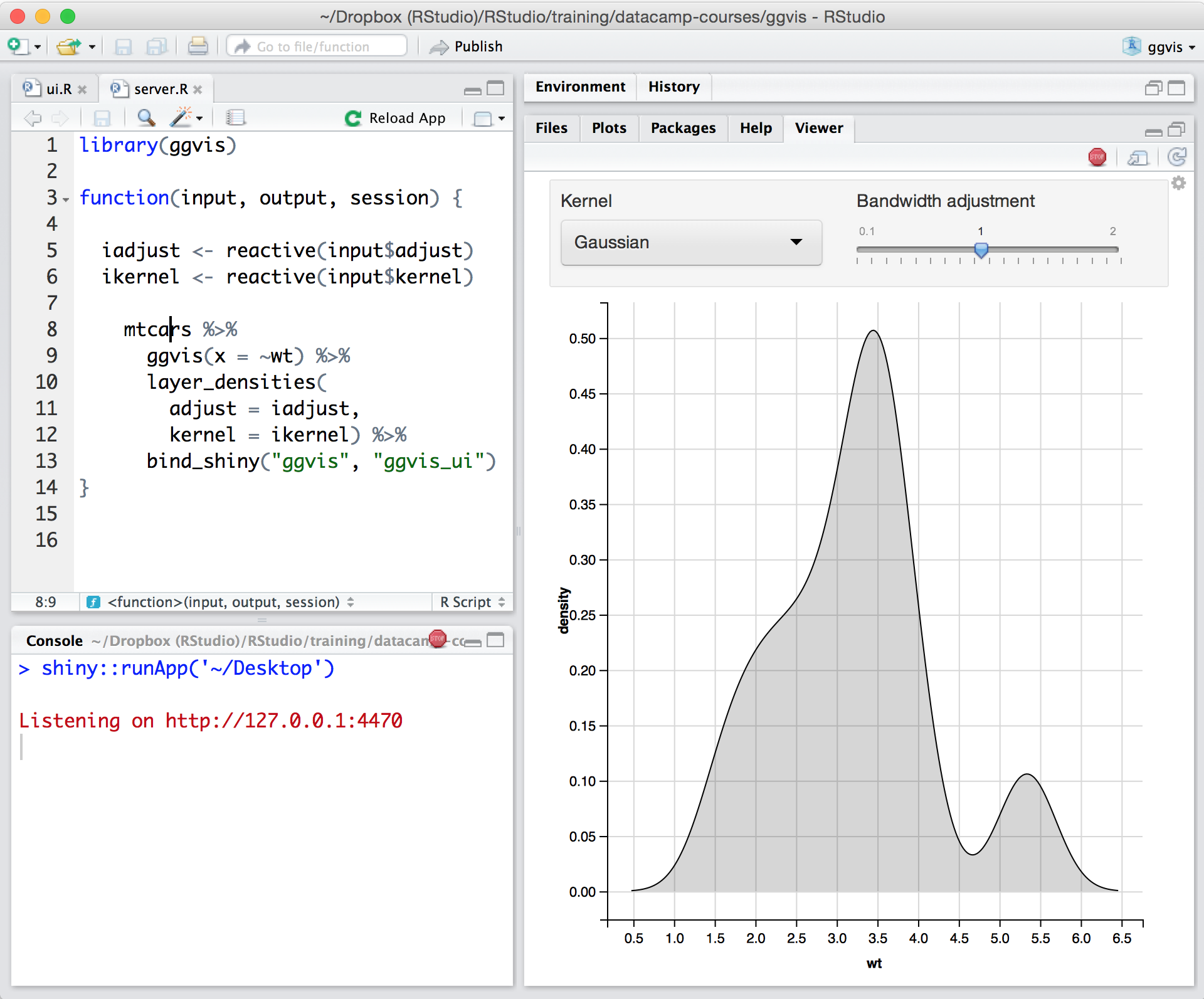
Screenshot of Posit runs on most desktops or on a server and accessed over the webScreenshot of Posit supports authoring HTML, PDF, Word Documents, and slide showsScreenshot of Posit supports interactive graphics with Shiny and ggvisScreenshot of Shiny combines the computational power of R with the interactivity of the modern webScreenshot of Remote Interactive Sessions: Start R and Python processes from Posit Workbench within various systems such as Kubernetes and SLURM with Launcher.Screenshot of Jupyter: Author and edit Python code with Jupyter using the same Posit Workbench infrastructure.