Overview
ProductRatingMost Used ByProduct SummaryStarting Price
HBase
Score 7.3 out of 10
N/A
The Apache HBase project's goal is the hosting of very large tables -- billions of rows X millions of columns -- atop clusters of commodity hardware. Apache HBase is an open-source, distributed, versioned, non-relational database modeled after Google's Bigtable.N/A
MongoDB
Score 8.8 out of 10
N/A
MongoDB is an open source document-oriented database system. It is part of the NoSQL family of database systems. Instead of storing data in tables as is done in a "classical" relational database, MongoDB stores structured data as JSON-like documents with dynamic schemas (MongoDB calls the format BSON), making the integration of data in certain types of applications easier and faster.
$0.10
million reads
Neo4j
Score 8.8 out of 10
N/A
Neo4j is an open source embeddable graph database developed by Neo Technologies based in San Mateo, California with an office in Sweden.
$65
per month
Pricing
Apache HBaseMongoDBNeo4j
Editions & Modules
No answers on this topic
Shared
$0
per month
Serverless
$0.10million reads
million reads
Dedicated
$57
per month
Aura Professional
$65
per month
Community Edition
Free
Enterprise Edition
Contact Sales
Aura Free
Free
Aura Enterprise
Contact Sales
Offerings
Pricing Offerings
HBaseMongoDBNeo4j
Free Trial
NoYesYes
Free/Freemium Version
NoYesYes
Premium Consulting/Integration Services
NoNoNo
Entry-level Setup FeeNo setup feeNo setup feeNo setup fee
Additional DetailsFully managed, global cloud database on AWS, Azure, and GCP
More Pricing Information
Community Pulse
Apache HBaseMongoDBNeo4j
Considered Multiple Products
HBase
Chose Apache HBase
Typically, Cassandra is faster on reads and HBase is faster on writes. You use Cassandra when you want to use a website, HBase is just an overall good general use database engine. Cassandra has its own storage engine and HBase uses HDFS and all its benefits. MongoDB is …
Chose Apache HBase
HBase is what you should use if you want a production ready scalable, JSON friendly, key-value, NoSQL, enterprise storage option. It excels over MongoDB due to integration with the extensive Hadoop stack and all the tools, frameworks and benefits there.

HBase has superior …
Chose Apache HBase
Compared NoSQL databases with traditional databases for faster retrieval and consistency. As MongoDB is a NoSQL supports dynamic fields, however, query performance is bad for aggregations and added maintenance. When compared with MySQL and Teradata, it could not scale up as …
Chose Apache HBase
These days I use Apache Cassandra more for even more scalability, good performance under different kind of workloads, and for providing highly available systems. Apache Cassandra also has connectors for Hadoop, Spark, and Solr.
MongoDB
Chose MongoDB
There are use cases for both relational and non-relational databases. MongoDB is simply a different method of storing data, but I find it to be faster and more intuitive than relational models.
Chose MongoDB
I use Cassandra more often these days for best in class performance, tunable consistency, linear scalability. In similar cases, I have used Apache HBase. But if there is a need for document store, MongoDB is the top choice.
Neo4j
Chose Neo4j
Neo4j is a graph store and has different use cases compared to another NoSQL Document store like MongoDB. MongoDB is a bad choice when joins are common as existing operators for joining two documents (similar to tables in a relational store) as Mongo 3.5 use SQL like join …
Chose Neo4j
  • For easy query language and better graphical representation on small dataset
  • Also easy to set up and handle on the server.
  • On top of that Neo4j also provides an API support to interact through any system.
Chose Neo4j
Neo4j is ahead of any of the leading competitors I know. The only one which comes close, in my opinion, is the "Titan-Distributed Graph Database" which is completely open source and free to use. Titan works on top of Apache Cassandra so it has some huge learning curves to do, …
Features
Apache HBaseMongoDBNeo4j
NoSQL Databases
Comparison of NoSQL Databases features of Product A and Product B
Apache HBase
7.7
5 Ratings
14% below category average
MongoDB
10.0
39 Ratings
12% above category average
Neo4j
-
Ratings
Performance7.15 Ratings10.039 Ratings00 Ratings
Availability7.85 Ratings10.039 Ratings00 Ratings
Concurrency7.05 Ratings10.039 Ratings00 Ratings
Security7.85 Ratings10.039 Ratings00 Ratings
Scalability8.65 Ratings10.039 Ratings00 Ratings
Data model flexibility7.15 Ratings10.039 Ratings00 Ratings
Deployment model flexibility8.25 Ratings10.038 Ratings00 Ratings
Best Alternatives
Apache HBaseMongoDBNeo4j
Small Businesses
IBM Cloudant
IBM Cloudant
Score 7.4 out of 10
IBM Cloudant
IBM Cloudant
Score 7.4 out of 10
IBM Cloudant
IBM Cloudant
Score 7.4 out of 10
Medium-sized Companies
IBM Cloudant
IBM Cloudant
Score 7.4 out of 10
IBM Cloudant
IBM Cloudant
Score 7.4 out of 10
IBM Cloudant
IBM Cloudant
Score 7.4 out of 10
Enterprises
IBM Cloudant
IBM Cloudant
Score 7.4 out of 10
IBM Cloudant
IBM Cloudant
Score 7.4 out of 10
IBM Cloudant
IBM Cloudant
Score 7.4 out of 10
All AlternativesView all alternativesView all alternativesView all alternatives
User Ratings
Apache HBaseMongoDBNeo4j
Likelihood to Recommend
7.7
(10 ratings)
10.0
(79 ratings)
2.1
(9 ratings)
Likelihood to Renew
7.9
(10 ratings)
10.0
(67 ratings)
-
(0 ratings)
Usability
-
(0 ratings)
10.0
(15 ratings)
6.0
(1 ratings)
Availability
-
(0 ratings)
9.0
(1 ratings)
-
(0 ratings)
Support Rating
-
(0 ratings)
9.6
(13 ratings)
-
(0 ratings)
Implementation Rating
-
(0 ratings)
8.4
(2 ratings)
-
(0 ratings)
User Testimonials
Apache HBaseMongoDBNeo4j
Likelihood to Recommend
Apache
Hbase is well suited for large organizations with millions of operations performing on tables, real-time lookup of records in a table, range queries, random reads and writes and online analytics operations. Hbase cannot be replaced for traditional databases as it cannot support all the features, CPU and memory intensive. Observed increased latency when using with MapReduce job joins.
Read full review
MongoDB
If asked by a colleague I would highly recommend MongoDB. MongoDB provides incredible flexibility and is quick and easy to set up. It also provides extensive documentation which is very useful for someone new to the tool. Though I've used it for years and still referenced the docs often. From my experience and the use cases I've worked on, I'd suggest using it anywhere that needs a fast, efficient storage space for non-relational data. If a relational database is needed then another tool would be more apt.
Read full review
Neo Technologies
Neo4J is great for creating network graphs or illustrating how things are related. It is also good for finding individuals or things that have greater influence than others in a system. It is not appropriate if you have standard data sets that can be analyzed using conventional methods or visualized using Tableau, for example.
Read full review
Pros
Apache
  • Scalability. HBase can scale to trillions of records.
  • Fast. HBase is extremely fast to scan values or retrieve individual records by key.
  • HBase can be accessed by standard SQL via Apache Phoenix.
  • Integrated. I can easily store and retrieve data from HBase using Apache Spark.
  • It is easy to set up DR and backups.
  • Ingest. It is easy to ingest data into HBase via shell, Java, Apache NiFi, Storm, Spark, Flink, Python and other means.
Read full review
MongoDB
  • Being a JSON language optimizes the response time of a query, you can directly build a query logic from the same service
  • You can install a local, database-based environment rather than the non-relational real-time bases such a firebase does not allow, the local environment is paramount since you can work without relying on the internet.
  • Forming collections in Mango is relatively simple, you do not need to know of query to work with it, since it has a simple graphic environment that allows you to manage databases for those who are not experts in console management.
Read full review
Neo Technologies
  • Mature Query language, I found Cypher QL to be mature in handling all sorts of problems we throw at it. Its expressive enough to be intuitive while providing rich features for various scenarios.
  • Native support for REST API, that makes interacting with Neo4J intuitive and easy.
  • Support for Procedures in Java, procedures are custom code that could be added to the Neo4J to write custom querying of data. The best part about the procedures is it could be invoked using the REST API. This allows us to overcome any shortcomings from their Cypher query language.
  • Nice UI and interface for executing the Query and visualizing the response.
  • UI access controlled by User credentials allows for neat access controls.
  • Awesome free community edition for small-scale projects.
Read full review
Cons
Apache
  • There are very few commands in HBase.
  • Stored procedures functionality is not available so it should be implemented.
  • HBase is CPU and Memory intensive with large sequential input or output access while as Map Reduce jobs are primarily input or output bound with fixed memory. HBase integrated with Map-reduce jobs will result in random latencies.
Read full review
MongoDB
  • An aggregate pipeline can be a bit overwhelming as a newcomer.
  • There's still no real concept of joins with references/foreign keys, although the aggregate framework has a feature that is close.
  • Database management/dev ops can still be time-consuming if rolling your own deployments. (Thankfully there are plenty of providers like Compose or even MongoDB's own Atlas that helps take care of the nitty-gritty.
Read full review
Neo Technologies
  • One of the hardest challenges that Neo4j had to solve was the horizontal scaling problem. I am not updated on recent developments, but at the time of my use, I couldn't find a viable solution.
  • Neo4j does not play with other open source APIs like Blueprint. You have to use the native Neo4j API.
  • There wasn't a visual tool to see your data. Of course, third party tools are always available, but I would have loved something which came with the Neo4j bundle. I love that Docker comes bundled with Kitematic, so it's not wrong to hope that Neo4j could also ship with some default visualization software.
Read full review
Likelihood to Renew
Apache
There's really not anything else out there that I've seen comparable for my use cases. HBase has never proven me wrong. Some companies align their whole business on HBase and are moving all of their infrastructure from other database engines to HBase. It's also open source and has a very collaborative community.
Read full review
MongoDB
I am looking forward to increasing our SaaS subscriptions such that I get to experience global replica sets, working in reads from secondaries, and what not. Can't wait to be able to exploit some of the power that the "Big Boys" use MongoDB for.
Read full review
Neo Technologies
No answers on this topic
Usability
Apache
No answers on this topic
MongoDB
NoSQL database systems such as MongoDB lack graphical interfaces by default and therefore to improve usability it is necessary to install third-party applications to see more visually the schemas and stored documents. In addition, these tools also allow us to visualize the commands to be executed for each operation.
Read full review
Neo Technologies
Learning cypher was super easy coming from a SQL background. Furthermore, the docs Neo4j provides on their website make it really easy to pull up a reference, guide or a quick example. The mac app they provide is also really well designed with good visualisation tools, with the ability to easily use colour, line thickness etc to help navigate your data.
Read full review
Support Rating
Apache
No answers on this topic
MongoDB
Finding support from local companies can be difficult. There were times when the local company could not find a solution and we reached a solution by getting support globally. If a good local company is found, it will overcome all your problems with its global support.
Read full review
Neo Technologies
No answers on this topic
Implementation Rating
Apache
No answers on this topic
MongoDB
While the setup and configuration of MongoDB is pretty straight forward, having a vendor that performs automatic backups and scales the cluster automatically is very convenient. If you do not have a system administrator or DBA familiar with MongoDB on hand, it's a very good idea to use a 3rd party vendor that specializes in MongoDB hosting. The value is very well worth it over hosting it yourself since the cost is often reasonable among providers.
Read full review
Neo Technologies
No answers on this topic
Alternatives Considered
Apache
Cassandra os great for writes. But with large datasets, depending, not as great as HBASE. Cassandra does support parquet now. HBase still performance issues. Cassandra has use cases of being used as time series. HBase, it fails miserably. GeoSpatial data, Hbase does work to an extent. HA between the two are almost the same.
Read full review
MongoDB
We have [measured] the speed in reading/write operations in high load and finally select the winner = MongoDBWe have [not] too much data but in case there will be 10 [times] more we need Cassandra. Cassandra's storage engine provides constant-time writes no matter how big your data set grows. For analytics, MongoDB provides a custom map/reduce implementation; Cassandra provides native Hadoop support.
Read full review
Neo Technologies
Neo4j is a graph store and has different use cases compared to another NoSQL Document store like MongoDB. MongoDB is a bad choice when joins are common as existing operators for joining two documents (similar to tables in a relational store) as Mongo 3.5 use SQL like join algorithms which are expensive. MongoDB is a great choice when distributed schemaless rich document structures are important requirements. Cross document transaction support is not native to MongoDB yet, whereas Neo4J is ACID complaint with all its operations.
Read full review
Return on Investment
Apache
  • As Hbase is a noSql database, here we don't have transaction support and we cannot do many operations on the data.
  • Not having the feature of primary or a composite primary key is an issue as the architecture to be defined cannot be the same legacy type. Also the transaction concept is not applicable here.
  • The way data is printed on console is not so user-friendly. So we had to use some abstraction over HBase (eg apache phoenix) which means there is one new component to handle.
Read full review
MongoDB
  • Open Source w/ reasonable support costs have a direct, positive impact on the ROI (we moved away from large, monolithic, locked in licensing models)
  • You do have to balance the necessary level of HA & DR with the number of servers required to scale up and scale out. Servers cost money - so DR & HR doesn't come for free (even though it's built into the architecture of MongoDB
Read full review
Neo Technologies
  • Positive: Less complex queries on graph structures, than in relational databases.
  • Negative: maintenance is a huge deal, things doesn't work and break, requiring lengthy restore operations.
Read full review
ScreenShots

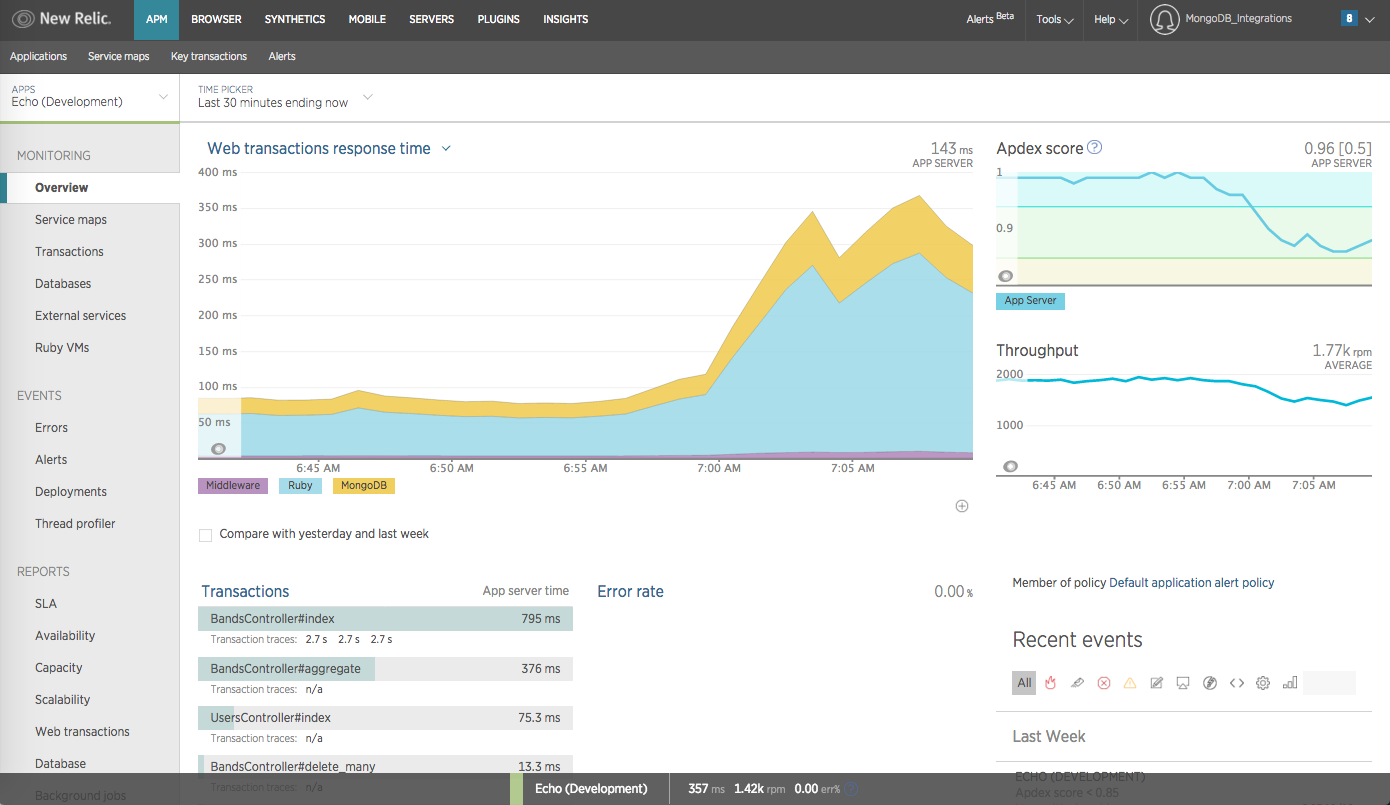
MongoDB Screenshots

Screenshot of Screenshot of Screenshot of Screenshot of Screenshot of Screenshot of