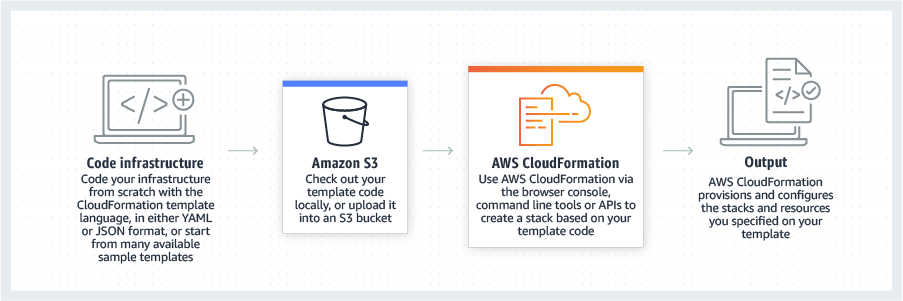
AWS CloudFormation gives developers and systems administrators a way to create and manage a collection of related AWS resources, provisioning and updating them in a predictable fashion. Use AWS CloudFormation’s sample templates or create templates to describe the AWS resources, and any associated dependencies or runtime parameters, required to run an application. Users don’t need to figure out the order for provisioning AWS services or the subtleties of making those dependencies work.…
$0
Progress Chef
Score 6.5 out of 10
N/A
Chef IT infrastructure automation suites were developed by Chef Software in Seattle and acquired by Progress Software in September 2020. The Chef Enterprise Automation Stack is an integrated suite of automation technologies presented as a solution for delivering change quickly, repeatedly, and securely over every application's lifecycle. The Chef Effortless Infrastructure Suit is an integrated suite of automation technologies to codify infrastructure, security, and compliance, as well as…
N/A
SUSE Manager
Score 10.0 out of 10
N/A
German company SUSE offers SUSE Manager, a software defined infrastructure Linux server configuration management tool supporting patching, provisioning of Linux servers, and related actions.
N/A
Pricing
AWS CloudFormation
Progress Chef
SUSE Manager
Editions & Modules
Free Tier - 1,000 Handler Operations per Month per Account
$0.00
Handler Operation
$0.0009
per handler operation
No answers on this topic
No answers on this topic
Offerings
Pricing Offerings
AWS CloudFormation
Progress Chef
SUSE Manager
Free Trial
Yes
No
No
Free/Freemium Version
Yes
No
No
Premium Consulting/Integration Services
Yes
No
No
Entry-level Setup Fee
No setup fee
No setup fee
No setup fee
Additional Details
There is no additional charge for using AWS CloudFormation with resource providers in the following namespaces: AWS::*, Alexa::*, and Custom::*. In this case you pay for AWS resources (such as Amazon EC2 instances, Elastic Load Balancing load balancers, etc.) created using AWS CloudFormation as if you created them manually. You only pay for what you use, as you use it; there are no minimum fees and no required upfront commitments.
When you use resource providers with AWS CloudFormation outside the namespaces mentioned above, you incur charges per handler operation. Handler operations are create, update, delete, read, or list actions on a resource.
—
—
More Pricing Information
Community Pulse
AWS CloudFormation
Progress Chef
SUSE Manager
Features
AWS CloudFormation
Progress Chef
SUSE Manager
Configuration Management
Comparison of Configuration Management features of Product A and Product B
I still give it an 8 because it's one of those tools that just quietly does the heavy lifting for you but it can really test your patience when it breaks esp with deep nested stacks. It's perfect for projects where we need clean consistent environments every time. It's less ideal for quick experimental setups like new EC2 configs or Lambda permission tweaks.
Chef is a fantastic tool for automating software deployments that aren't able to be containerized. It's more developer-oriented than its other competitors and thus allows you to do more with it. The Chef Infra Server software is rock-solid and has been extremely stable in our experience. I would definitely recommend its use if you're looking for an automation framework. And it also offers InSpec which is a very good tool for testing your infrastructure to ensure it deployed as intended.
In our specific use case, SUSE Manager is extremely useful. We're having a large landscape that is divided into intake, development, quality and production with a couple of different SUSE flavours that need to be automatically rolled out, configured, patched and maintained, everything from up to date repositories that are cloned on a daily basis straight from SUSE.
Chef could do a better job with integration with other DevOps tools. Our company relies on Jenkins and Ansible, which took some development and convincing for plug-ins to be created/available.
It would be nice if kitchen didn't only have a vagrant/virtual-box prerequisite. Our company one day stop allowing virtual-box to run without special privileges, and that caused a lot of issues for people trying to do kitchen tests.
Chef could use more practice materials for the advanced certification badges. There was not a lot of guidance in what to study or examples of certain topics.
It's easy enough to get a shared template & apply it. You don't even have to download-then-upload or copy-and-paste, a publicly-accessible url works.
Diving deeper, it has enough powerful capabilities to make the life of a platform / DevOps engineer bearable.
However, you need equally deep knowledge to troubleshoot issues, when they inevitably pop up. This is the same for all IaC technologies, as they are additional abstraction layers on top of the native API provided by the cloud providers.
The suite of tools is very powerful. The ability to create custom modules allows for unlimited potential for managing all aspects of a system. However, there is pretty significant learning curve with the toolset. It currently takes approx 3-4 months for new engineers to feel comfortable with our implementation
The gui is extremely user friendly. The installation and configuration does have a learning curve, it takes a while to set everything up. But once you're passed this initial learning curve, everything is very intuitive. If you want extra automation, there's an api (eventough i personally find the documentation of the api could be ordered better). I gave this product a 9 because of the initial learning curve and the api documentation, but for the rest it suits my needs perfectly.
It loads quick enough for basically all our systems. Because we have this for local dev environments, speed isn't really a big issue here. Yes, depending on the system, sometimes it does take a relatively long time, but it's not an issue for me. One thing that is annoying is that if I want to make a small change to a cookbook and re-run the Chef client, I can't just make the change in the cache and run it. I have to do the whole process of updating the server.
Support for Chef is easily available for fee or through the open source community as most the issues you will face will have been addressed through the Chef developer community forums. The documentation for Chef is moderate to great and easily readable.
SUSE Manager provided a top-tier support person on site to us for two days to help integration. We did all the standard stuff they help with before he arrived. We were able to use him to get all the tricky stuff identified and solved in the short time we had. Had they sent us a lower-tier guy, it would have been a waste. I was impressed they sent such knowledgeable person.
Cloning a virtual machine creates a virtual machine that is cloning a virtual machine creates a virtual machine that is a copy of the original. The new virtual machine is configured with the same virtual hardware, installed software, and other properties that were configured for the original virtual machine. For information about persistent memory and PMem storage, see the vSphere Cloning a virtual machine creates a virtual machine that is a copy of the original. The new virtual machine is configured with the same virtual hardware, installed software, and other properties that were configured for the original virtual machine. For information. Management guide.For information copy of the original. The new virtual Cloning virtual machine creates a virtual machine that is a copy of the original. The new virtual machine is configured with the same virtual hardware, installed software, and other properties that were configured for the original virtual machine. For information about persistent memory and PMem storage, see the vSphere Resource Management Guide. For information is configured with the same virtual hardware, installed software, and other properties that were configured for the original virtual machine. For information about persistent memory and PMem storage, see the vSphere Resource Management Guide. For information
We considered the three leading competitors in the field: Chef, Puppet and Ansible. Ansible is a very strong competitor and has a nice degree of flexibility in that it does not require a client install. Instead the configuration is delivered by SSH which is very simple. Puppet seems like it has fallen off the pace of the competition and lacked the strong community offered by Chef. We chose Chef because of the strong support by the company and the dynamic and deep community support.
The other competitors also have a good platform and service, but we went with SUSE due to cost. The price was best and we needed to keep under a certain budget. The functionality was perfect for what we needed so we took the step forward. This allows us to manage our Linux environment within the manager and update or deploy specific tasks to each as needed.
The entire professional services team was great to work with. The curriculum was tailored to our specific use cases. The group we worked with were very responsive, listened to our feedback, was very easy to schedule and accommodate. I cannot say enough good things about our professional services experience
Chef is a good tool for baselining servers. It will be a good ROI when there are huge number of servers. For less number of servers maintaining a master will be an over head.
One good ROI will be that the Operations Team also gets into agile and DevOps methodologies. Operational teams can start writing scripts/automations to keep their infra more stable and their application stack more reliable.
Implementation of Chef eliminates the manual mode of doing things and everyone aligns to automation mind set. It helps in change of culture.