AWS CodePipeline is a fully managed continuous delivery service that helps users automate release pipelines. CodePipeline automates the build, test, and deploy phases of the release process every time there is a code change, based on the release model a user defines.
$1
per active pipeline/per month
Jenkins
Score 8.4 out of 10
N/A
Jenkins is an open source automation server. Jenkins provides hundreds of plugins to support building, deploying and automating any project. As an extensible automation server, Jenkins can be used as a simple CI server or turned into a continuous delivery hub for any project.
N/A
Katalon
Score 7.6 out of 10
N/A
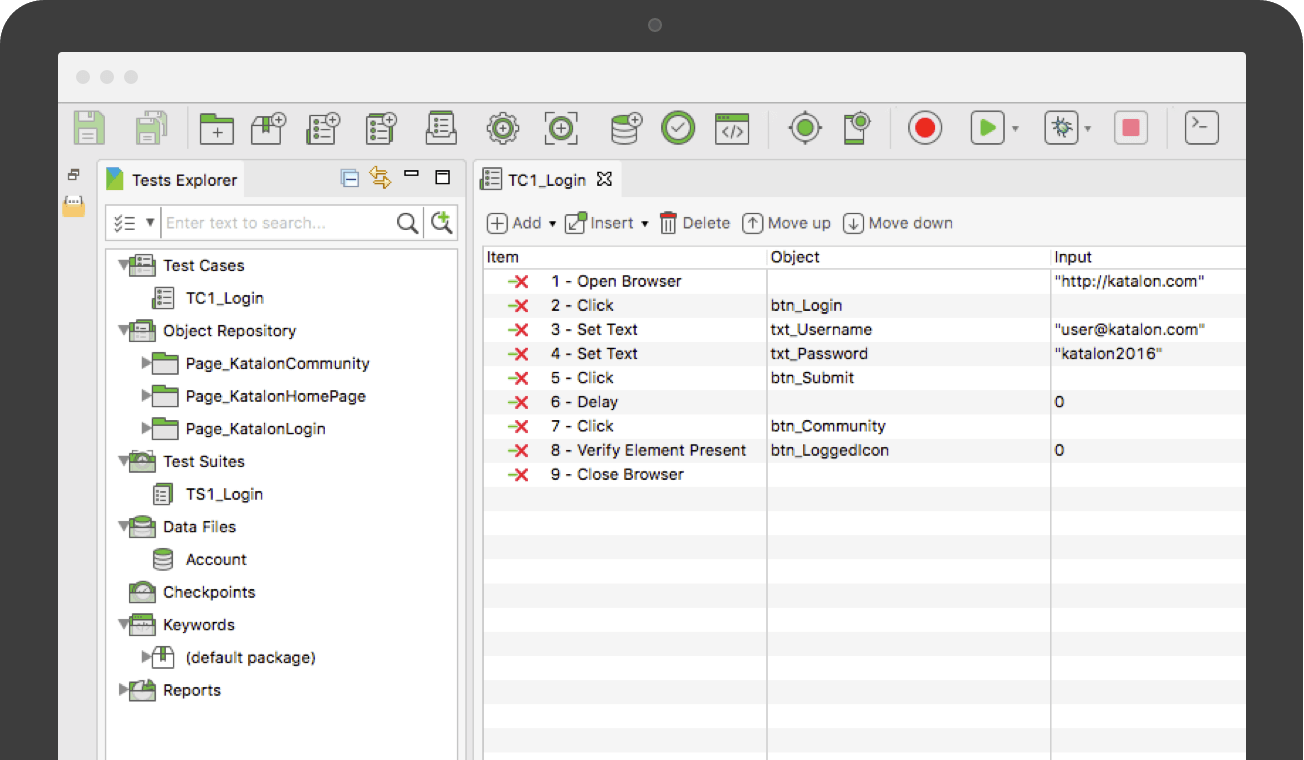
Katalon Studio is provided by the vendor as a free and robust automation solution for API, Web and Mobile testing. It is designed to eliminate the complexities of building an automation framework by integrating all necessary test components with built-in keywords and project templates. Katalon Studio includes a full feature set for a complete test automation process covering multiple platforms and testing types. New users can get started with test automation using its easy-to-use…
$69
per month
Pricing
AWS CodePipeline
Jenkins
Katalon
Editions & Modules
AWS CodePipeline
$1
per active pipeline/per month
Free Tier
Free
No answers on this topic
Node Locked License
$69.00
per month
Floating License
$1,529.00
per year
Offerings
Pricing Offerings
AWS CodePipeline
Jenkins
Katalon
Free Trial
No
No
Yes
Free/Freemium Version
Yes
Yes
Yes
Premium Consulting/Integration Services
No
No
Yes
Entry-level Setup Fee
No setup fee
No setup fee
No setup fee
Additional Details
—
—
Katalon Studio was originated from KMS Technology R&D. It has been a successful solution for numerous automation projects ranging from small team to enterprise client.
Katalon Studio is free for use, product development is funded by the testing services provided by KMS Technology. To support future releases, please consider subscribing to our business support services.
More Pricing Information
Community Pulse
AWS CodePipeline
Jenkins
Katalon
Considered Multiple Products
AWS CodePipeline
Verified User
Engineer
Chose AWS CodePipeline
CodeCommit and CodeDeploy can be used with CodePipeline so it’s not really fair to stack them against each other as they can be quite the compliment. The same goes for Beanstalk, which is often used as a deployment target in relation to CodePipeline.
CodePipeline fulfills the …
We selected AWS CodePipeline mainly because we wanted to keep the application stack completely native to AWS, and CodePipeline provided the best integrations with AWS services that we were using, such as S3, Elastic Beanstalk, and Lamba. Furthermore, AWS CodePipeline provided …
I felt that, out of the alternatives, AWS CodePipeline was the simplest to setup and most reliable. Since my client's infrastructure was already hosted in AWS, I felt it was a no-brainer. If a client needed a similar solution with on-prem or non-AWS infrastructure, I would …
AWS Codepipeline is proprietary to Amazon Web Services and works well when you're working with other AWS products. If you're using a different technology stack, then Codepipeline may not be the best tool and some open source/closed source tools available on the web may suffice.
They all pretty much have the same feature set. AWS CodePipeline has been improving in recent years, and it just makes sense to keep everything within Amazon's ecosystem.
Originally Jenkins was selected because it was the best around, but it has since been outclassed by more specific services or cloud-based services and tools that will do all of the heavy lifting for you. Jenkins still has a use case - but it's hard to argue the additional …
I think AWS CodePipeline is a great tool for anyone wanted automated deployments in a multi-server/container AWS environment. AWS also offers services like Elastic Beanstalk that provide a more managed hosting & deployment experience. CodePipeline is a good middle ground with solid, built-in automation with enough customizability to not lock people into one deployment or architecture philosophy.
Jenkins is a highly customizable CI/CD tool with excellent community support. One can use Jenkins to build and deploy monolith services to microservices with ease. It can handle multiple "builds" per agent simultaneously, but the process can be resource hungry, and you need some impressive specs server for that. With Jenkins, you can automate almost any task. Also, as it is an open source, we can save a load of money by not spending on enterprise CI/CD tools.
Katalon TestOps is well suited for an oraganization who want to organize their automation collections and have everything in one place. It provides good insight on test runs, failures and also helps in defect tracking. It is extremely easy to schedule and run test suites automatically. With the help of test history, it becomes easier to triage the report and identify if it is a product issue or a test flakiness. Also with the automation run scheduling features with custom options, user do not have to manually trigger the runs and just run the scheduler to do the job.
Automated Builds: Jenkins is configured to monitor the version control system for new pull requests. Once a pull request is created, Jenkins automatically triggers a build process. It checks out the code, compiles it, and performs any necessary build steps specified in the configuration.
Unit Testing: Jenkins runs the suite of unit tests defined for the project. These tests verify the functionality of individual components and catch any regressions or errors. If any unit tests fail, Jenkins marks the build as unsuccessful, and the developer is notified to fix the issues.
Code Analysis: Jenkins integrates with code analysis tools like SonarQube or Checkstyle. It analyzes the code for quality, adherence to coding standards, and potential bugs or vulnerabilities. The results are reported back to the developer and the product review team for further inspection.
Easy to setup and quick to get started: As Katalon comes with built-in features a new automation tester can automate easily. Script creation time is quick.
Test Analytics: Katalon also provides analytics which tells you the pattern of your automated tests at a different instance of time.
Third Party Integration: Katalon provides amazing integration with 3rd party tools like JIRA, ALM, GIT, JENKINS, etc.
Image-based testing: Katalon also provides inbuilt image based test automation.
Integration with Azure is painstakingly slow as it takes too much time to upload reports to Azure. When raised with the support team i was advised to contact Microsoft who promptly and correctly replied that its an issue with the katalon plugin.
Non Responsive Customer Support. Several mails were replied late.
The Desktop app uses too much memory when booting up and running tests even on a 16gb RAM.
We have a certain buy-in as we have made a lot of integrations and useful tools around jenkins, so it would cost us quite some time to change to another tool. Besides that, it is very versatile, and once you have things set up, it feels unnecessary to change tool. It is also a plus that it is open source.
Overall, I give AWS Codepipeline a 9 because it gets the job done and I can't complain much about the web interface as much of the action is taking place behind the scenes on the terminal locally or via Amazon's infrastructure anyway. It would be nicer to have a better flowing and visualizable web interface, however.
Jenkins streamlines development and provides end to end automated integration and deployment. It even supports Docker and Kubernetes using which container instances can be managed effectively. It is easy to add documentation and apply role based access to files and services using Jenkins giving full control to the users. Any deviation can be easily tracked using the audit logs.
Our pipeline takes about 30 minutes to run through. Although this time depends on the applications you are using on either end, I feel that it is a reasonable time to make upgrades and updates to our system as it is not an every day push.
No, when we integrated this with GitHub, it becomes more easy and smart to manage and control our workforce. Our distributed workforce is now streamlined to a single bucket. All of our codes and production outputs are now automatically synced with all the workers. There are many cases when our in-house team makes changes in the release, our remote workers make another release with other environment variables. So it is better to get all of the work in control.
We didn't need a lot of support with AWS CodePipeline as it was pretty straightforward to configure and use, but where we ran into problems, the AWS community was able to help. AWS support agents were also helpful in resolving some of the minor issues we encountered, which we could not find a solution elsewhere.
As with all open source solutions, the support can be minimal and the information that you can find online can at times be misleading. Support may be one of the only real downsides to the overall software package. The user community can be helpful and is needed as the product is not the most user-friendly thing we have used.
I love the support. They have provided answers and solutions for most of our questions or doubts that could come up. They also have provided basic tutorials on how to get familiarized with the program.
It is worth well the time to setup Jenkins in a docker container. It is also well worth to take the time to move any "Jenkins configuration" into Jenkinsfiles and not take shortcuts.
CodeCommit and CodeDeploy can be used with CodePipeline so it’s not really fair to stack them against each other as they can be quite the compliment. The same goes for Beanstalk, which is often used as a deployment target in relation to CodePipeline.
CodePipeline fulfills the CI/CD duty, where the other services do not focus on that specific function. They are supplements, not replacements. CodePipeline will detect the updated code and handle deploying it to the actual instance via Beanstalk.
Jenkins is open source and not a native AWS service, that is its primary differentiator. Jenkins can also be used as a supplement to CodePipeline.
Overall, Jenkins is the easiest platform for someone who has no experience to come in and use effectively. We can get a junior engineer into Jenkins, give them access, and point them in the right direction with minimal hand-holding. The competing products I have used (TravisCI/GitLab/Azure) provide other options but can obfuscate the process due to the lack of straightforward simplicity. In other areas (capability, power, customization), Jenkins keeps up with the competition and, in some areas, like customization, exceeds others.
Katalon Studio is above both the tools is due to its codeless test automation feature and having API, desktop, web, and mobile automation in one place but obviously there is room for improvement when desktop automation is of primary importance in the automation.
CodePipeline has reduced ongoing devops costs for my clients, especially around deployment & testing.
CodePipeline has sped up development workflow by making the deployment process automated off git pushes. Deployment takes very little coordination as the system will just trigger based on what is the latest commit in a branch.
CodePipeline offered a lot of out-of-the-box functionality that was much simpler to setup than a dedicated CI server. It allowed the deployment process to built and put into production with much less and effort and cost compared to rolling the functionality manually.
Support can be better: As mentioned before, katlon community is still growing but is currently a small community. If you are stuck, its hard to find help in the community and one has to reach out to the support for help. This takes a while before you can get solution to your problem.
Result upload takes little longer time: It is been observed that uploading tests results takes little longer.
Sometimes it gets hard to integrate: Since this is fairly a new tool, requires lot of learning curve to get the job done effectively.