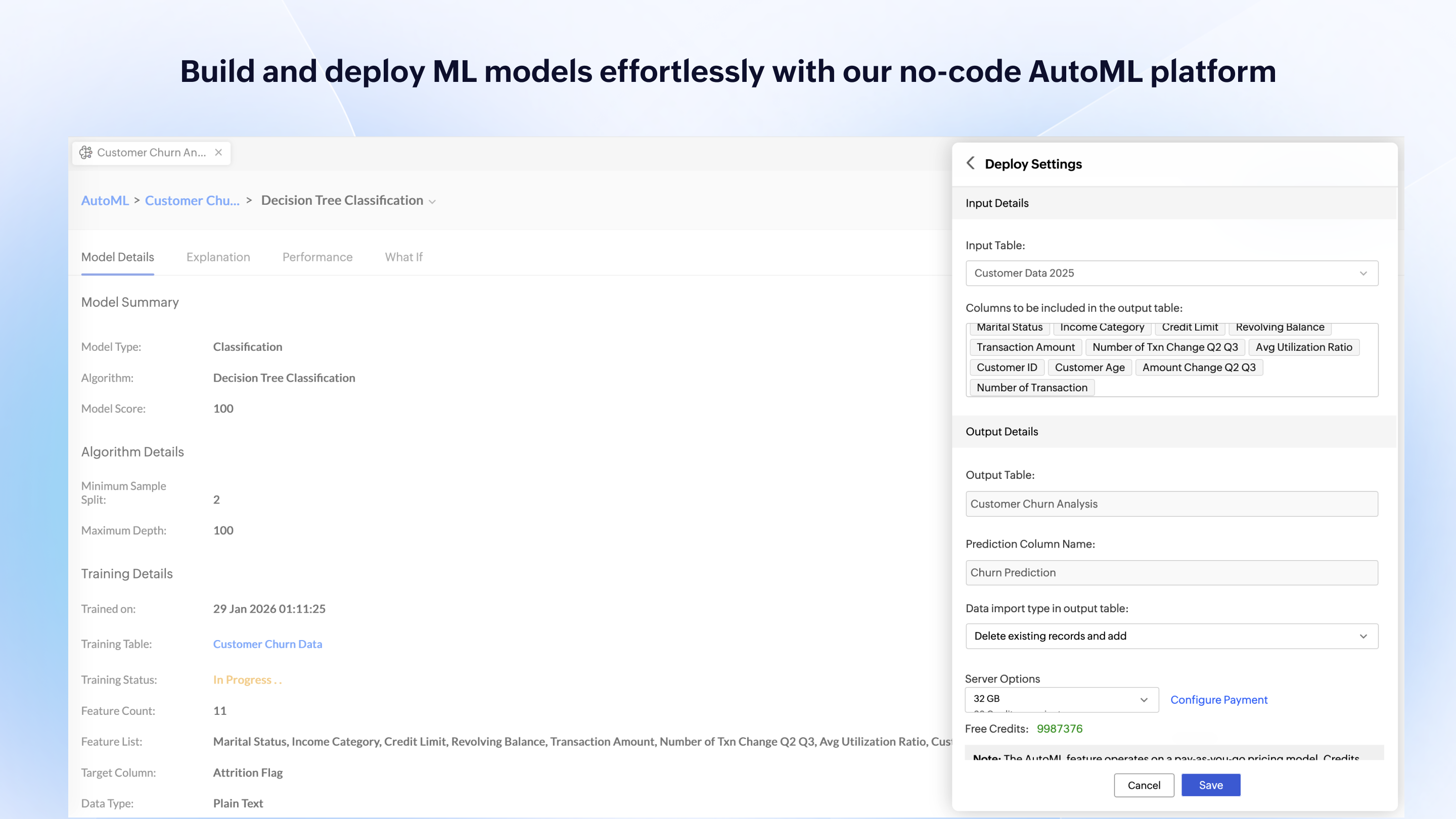
Microsoft's Azure Machine Learning is and end-to-end data science and analytics solution that helps professional data scientists to prepare data, develop experiments, and deploy models in the cloud. It replaces the Azure Machine Learning Workbench.
$0
per month
Zoho Analytics
Score 8.4 out of 10
Small Businesses (1-50 employees)
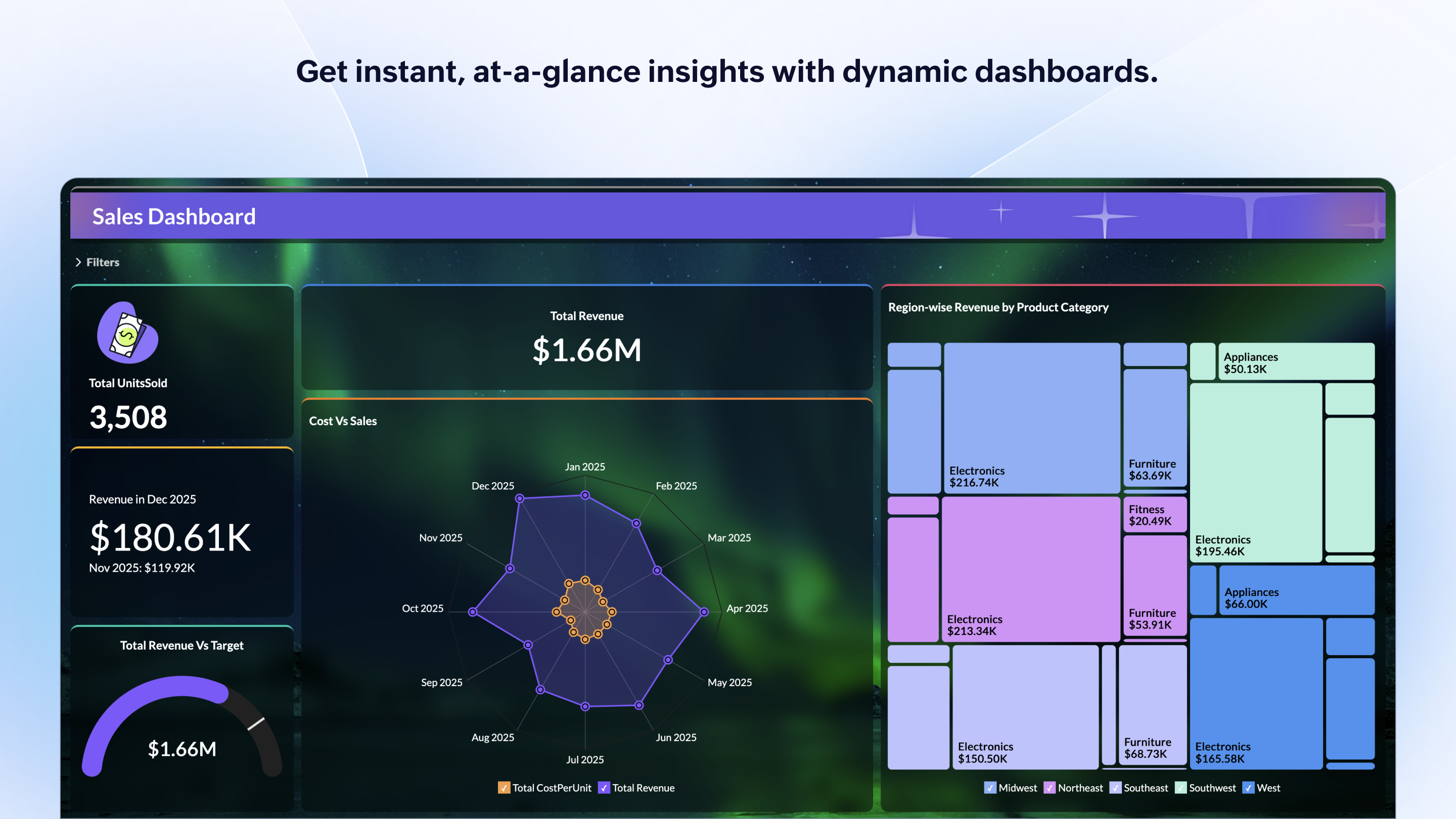
Zoho Analytics is a self-service BI and analytics platform that uncovers patterns, spots emerging trends, tracks business metrics, and detects anomalies. Designed for ease of use, it enables business users to create reports and dashboards independently, without relying on IT.
$60
per month 5 users
Pricing
Azure Machine Learning
Zoho Analytics
Editions & Modules
Studio Pricing - Free
$0.00
per month
Production Web API - Dev/Test
$0.00
per month
Studio Pricing - Standard
$9.99
per ML studio workspace/per month
Production Web API - Standard S1
$100.13
per month
Production Web API - Standard S2
$1000.06
per month
Production Web API - Standard S3
$9999.98
per month
Standard
$60
per month Starts at 5 Users
Premium
$145
per month Starts at 15 Users
Enterprise
$575
per month Starts at 50 Users
Offerings
Pricing Offerings
Azure Machine Learning
Zoho Analytics
Free Trial
No
Yes
Free/Freemium Version
No
Yes
Premium Consulting/Integration Services
No
Yes
Entry-level Setup Fee
No setup fee
No setup fee
Additional Details
—
There is a 20% discount for all plans if subscribed yearly. Customers can buy add-on rows and users, in addition to the plans listed above.
More Pricing Information
Community Pulse
Azure Machine Learning
Zoho Analytics
Features
Azure Machine Learning
Zoho Analytics
BI Standard Reporting
Comparison of BI Standard Reporting features of Product A and Product B
Azure Machine Learning
-
Ratings
Zoho Analytics
8.7
135 Ratings
6% above category average
Pixel Perfect reports
00 Ratings
8.9106 Ratings
Customizable dashboards
00 Ratings
8.6135 Ratings
Ad-hoc Reporting
Comparison of Ad-hoc Reporting features of Product A and Product B
Azure Machine Learning
-
Ratings
Zoho Analytics
8.2
137 Ratings
2% above category average
Drill-down analysis
00 Ratings
8.1131 Ratings
Formatting capabilities
00 Ratings
7.7136 Ratings
Report sharing and collaboration
00 Ratings
8.7137 Ratings
Report Output and Scheduling
Comparison of Report Output and Scheduling features of Product A and Product B
Azure Machine Learning
-
Ratings
Zoho Analytics
8.5
129 Ratings
3% above category average
Publish to Web
00 Ratings
8.4108 Ratings
Publish to PDF
00 Ratings
8.6127 Ratings
Report Delivery Scheduling
00 Ratings
8.5112 Ratings
Data Discovery and Visualization
Comparison of Data Discovery and Visualization features of Product A and Product B
Zoho Analytics is the best way to consume data created by Zoho products . It's robust and quick build formula libraries and auto generated reports. A data source can be integrated and be ready for consumption within minutes. This gives a well developed baseline for organizing to develop advance analytics. It's mobile dashboards are very intuitive and useful for leaders who are on the move.
User friendliness: This is by far the most user friendly tool I've seen in analytics. You don't need to know how to code at all! Just create a few blocks, connect a few lines and you are capable of running a boosted decision tree with a very high R squared!
Speed: Azure ML is a cloud based tool, so processing is not made with your computer, making the reliability and speed top notch!
Cost: If you don't know how to code, this is by far the cheapest machine learning tool out there. I believe it costs less than $15/month. If you know how to code, then R is free.
Connectivity: It is super easy to embed R or Python codes on Azure ML. So if you want to do more advanced stuff, or use a model that is not yet available on Azure ML, you can simply paste the code on R or Python there!
Microsoft environment: Many many companies rely on the Microsoft suite. And Azure ML connects perfectly with Excel, CSV and Access files.
Zoho Analytics’ predictive analytics capabilities can help forecast future trends, allowing for proactive planning and risk management.
Performance Monitoring: We can track key performance indicators (KPIs) across departments, such as sales, marketing, finance, and HR. This aids in identifying bottlenecks and areas for improvement.
I'm guessing it's out there somewhere but I really could have used a 'quick start guide' or guided start.
Once I figured it out, it makes sense how to make sure the right data is provided in order to make dashboards quite flexible--- but without examples, I found it quite a challenge
The initial organization of Analytics is NOT intuitive. Once in context, the organizational features make sense, but (at least initially) it would have been most useful if the organization of Analytics reports in Zoho Analytics had saved me a lot of time.
I'd give this an 11 if I could! As our business moves forward we hope to use Zoho Analytics more then we do now. Creating better reports and dashboards for our management team to evaluate the health of our business and to provide more insightful reports for our customers. The possibilities are endless with this tool
For an end user, Zoho Analytics is pretty easy to use and very easy to access the dashboard. Linking data from multiple sources is very convenient. Multiple people can work on preparing and publishing the dashboards simultaneously, which helps delegate tasks.
ZOHO is a very reliable company/product. We never had any issues with downtime or inaccessibility to our data. Any type of maintenance that they had to perform was clearly communicated and never an issue. We use a lot of external hooks and we've never had any issues with getting ZOHO to communicate with any of those hooks.
ZOHO has obviously invested a lot of time effort and money in to creating a reliable infrastructure with high availability. We've never had any issues with performance and all of our data crunching small to large has always been well within reason. We have come to appreciate the performance of ZOHO and will continue to use it for all of our data needs.
The support team is honestly not that great. At times, it seems as if members of our own team know more about the product than the support team. They must not have a lot of training or the turnaround is quick
If your external data sources are previously organized and correlated (e.g.: in your datawarehouse or database) your implementation will be easier. Of cource some not previously predicted correlation would be necessary to be done during the implementation, but if your organization let it to be all done into Zoho Analytics, it will take more time from your team.
It is easier to learn, it has a very cost effective license for use, it has native build and created for Azure cloud services, and that makes it perfect when compared against the alternatives. As a Microsoft tool, it has been built to contain many visual features and improved usability even for non-specialist users.
Zoho Analytics has the best UI and user friendly to create reports and dashboard along with features like Zia Assistance that guide in creating reports and dashboard and also help in the forecasting of the data based on the past records.
As far as I know, Zoho Analytics has been able to fulfill every need we've had for it. Our reports have gotten better and more detailed with pretty much every new issue of our magazine. It just keeps getting better, and we keep feeding it more data to digest and present to us.
Productivity: Instead of coding and recoding, Azure ML helped my organization to get to meaningful results faster;
Cost: Azure ML can save hundreds (or even thousands) of dollars for an organization, since the license costs around $15/month per seat.
Focus on insights and not on statistics: Since running a model is so easy, analysts can focus more on recommendations and insights, rather than statistical details