
BigMind DR vs. OpenText Availability
BigMind DR vs. OpenText Availability
| Product | Rating | Most Used By | Product Summary | Starting Price |
|---|---|---|---|---|
 BigMind DR | Small Businesses (1-50 employees) | BigMind DR — Local Disaster Recovery for Windows BigMind DR is a local Disaster Recovery and Disk Imaging solution for Windows developed by Genie9. The platform is designed for IT professionals and regulated small offices in the legal, medical, and accounting sectors that require local Disaster Recovery capabilities without cloud dependency. Core Features BigMind DR utilizes Block-Level Imaging technology to capture system… | $59 one-time fee per user | |
 OpenText Availability | N/A | Carbonite acquired Double-Take, a data replication and disaster recovery option, in early 2017. The technology now powers OpenText Availability, the high availability and data replication product. | N/A |
| BigMind DR | OpenText Availability | |||||||||||||||
|---|---|---|---|---|---|---|---|---|---|---|---|---|---|---|---|---|
| Editions & Modules |
| No answers on this topic | ||||||||||||||
| Offerings |
| |||||||||||||||
| Entry-level Setup Fee | No setup fee | No setup fee | ||||||||||||||
| Additional Details | BigMind DR uses per-account pricing, not per-endpoint or per-device. The Plus plan covers 10 users and up to 20 devices for a one-time $59 lifetime payment. The Pro plan covers 15 users and up to 45 devices for $119 lifetime. Unlike competitors such as Acronis and Veeam which charge $50–$130 per workstation annually, BigMind DR offers a single lifetime price with no recurring fees and no cloud storage costs — the customer brings their own storage device. | — | ||||||||||||||
| More Pricing Information | ||||||||||||||||
| BigMind DR | OpenText Availability |
|---|
| BigMind DR | OpenText Availability | |
|---|---|---|
| Small Businesses |  NinjaOne Score 9.2 out of 10 |  Hornetsecurity VM Backup Score 8.1 out of 10 |
| Medium-sized Companies |  Keepit Score 9.4 out of 10 |  IBM Storage Protect Score 8.8 out of 10 |
| Enterprises | Keepit Score 9.4 out of 10 | IBM Storage Protect Score 8.8 out of 10 |
| All Alternatives | View all alternatives | View all alternatives |
| BigMind DR | OpenText Availability | |
|---|---|---|
| Likelihood to Recommend | - (0 ratings) | 10.0 (11 ratings) |
| Usability | - (0 ratings) | 9.0 (2 ratings) |
| Support Rating | - (0 ratings) | 7.3 (1 ratings) |
| BigMind DR | OpenText Availability | |
|---|---|---|
| Likelihood to Recommend | Genie9 No answers on this topic |  OpenText
|
| Pros | Genie9 No answers on this topic | OpenText
|
| Cons | Genie9 No answers on this topic | OpenText
 Ron Sisler Jr IT Support Specialist |
| Usability | Genie9 No answers on this topic | OpenText
|
| Support Rating | Genie9 No answers on this topic | OpenText
|
| Alternatives Considered | Genie9 No answers on this topic | OpenText
|
| Return on Investment | Genie9 No answers on this topic | OpenText
|
| ScreenShots | BigMind DR Screenshots 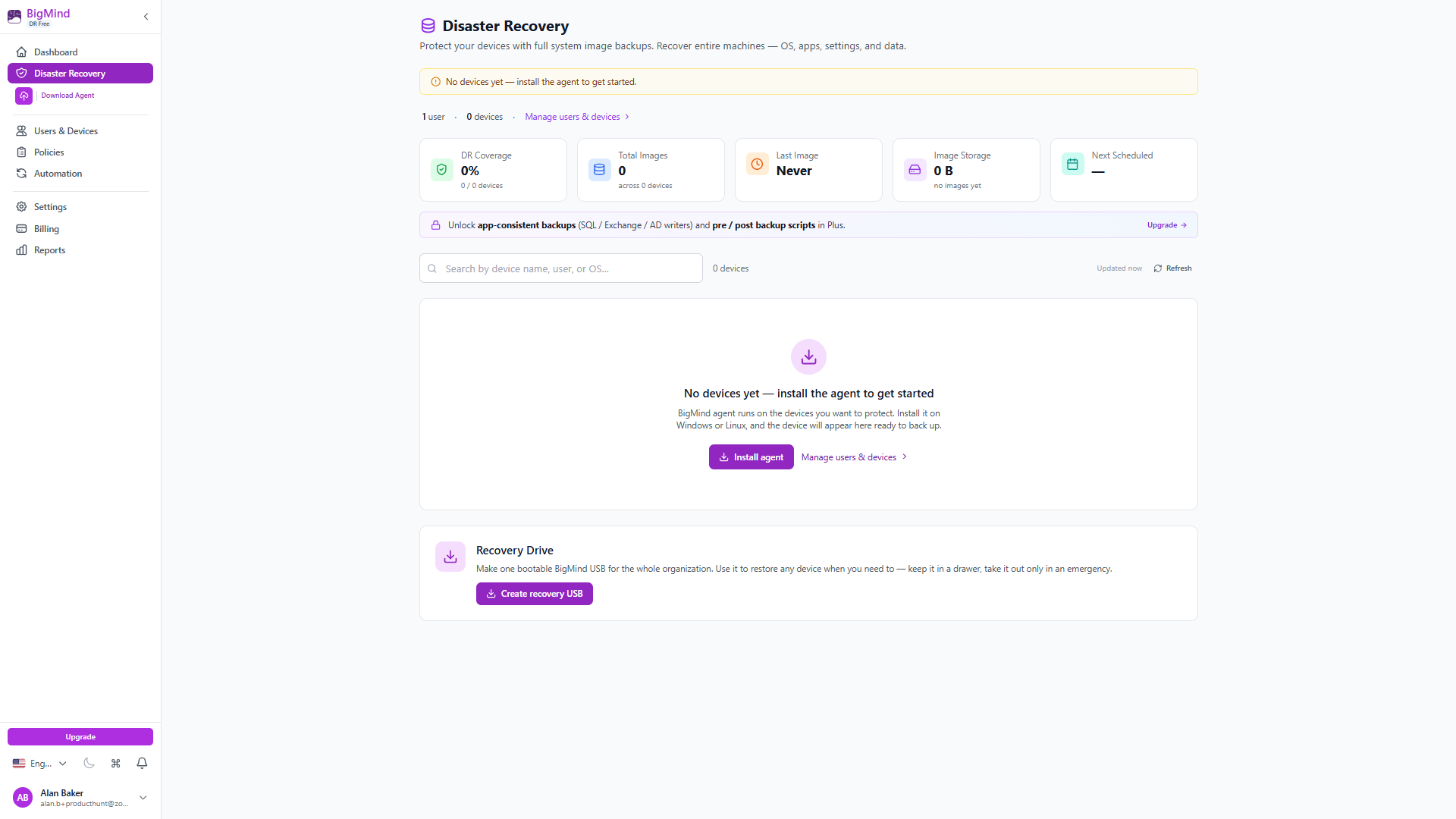   |