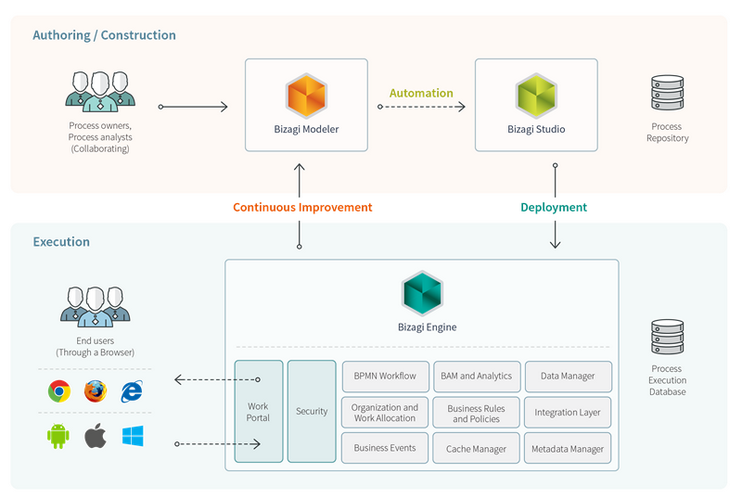
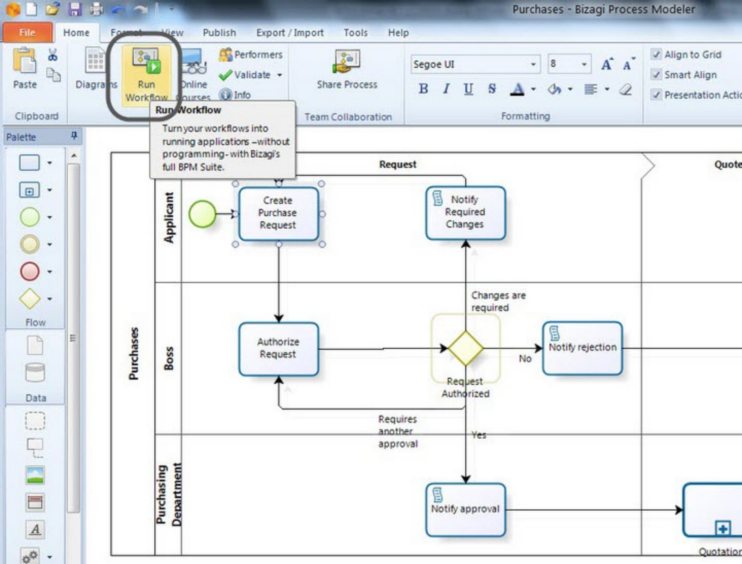
The Digital Business Platform from Bizagi is a rapid process automation platform for enterprises. The solution is comprised of three components: Bizagi Modeler, Bizagi Studio and Bizagi Engine.
N/A
Camunda
Score 7.8 out of 10
N/A
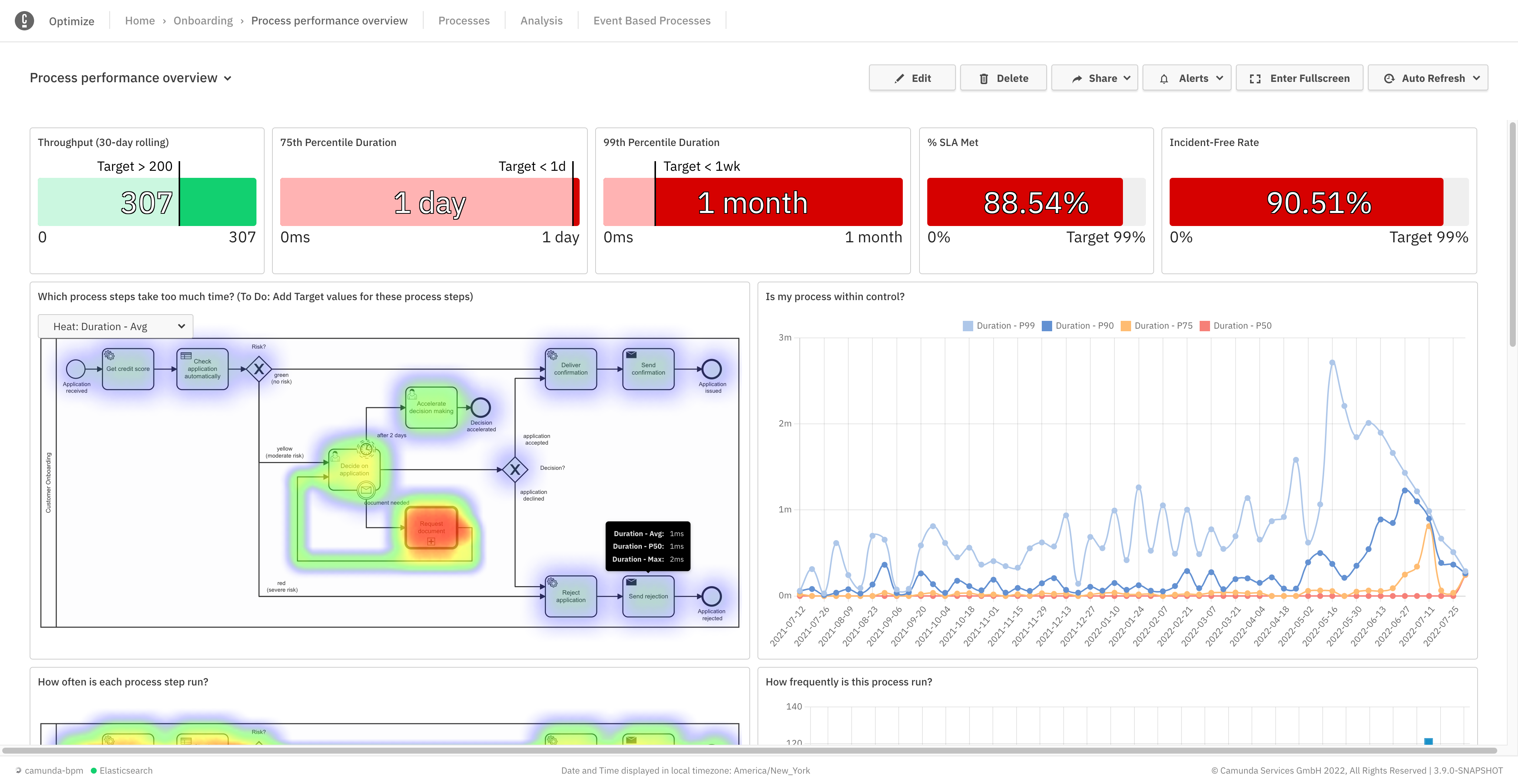
Camunda is a process orchestration tool designed to help organizations design, automate, and improve any process. Built for business and IT collaboration using BPMN and DMN standards, Camunda aims to enable seamless integration across endpoints to transform mission-critical processes.
N/A
Oracle BPM Suite
Score 8.5 out of 10
N/A
The Oracle Business Process Management Suite is an integrated environment for developing, administering, and using business applications centered around business processes.
N/A
Pricing
Bizagi Digital Business Platform
Camunda
Oracle BPM Suite
Editions & Modules
No answers on this topic
Self-Managed Enterprise
Contact Sales
per year
SaaS Enterprise
Contact Sales
per year
No answers on this topic
Offerings
Pricing Offerings
Bizagi Digital Business Platform
Camunda
Oracle BPM Suite
Free Trial
No
Yes
No
Free/Freemium Version
Yes
Yes
No
Premium Consulting/Integration Services
Yes
Yes
No
Entry-level Setup Fee
No setup fee
No setup fee
No setup fee
Additional Details
—
—
—
More Pricing Information
Community Pulse
Bizagi Digital Business Platform
Camunda
Oracle BPM Suite
Considered Multiple Products
Bizagi Digital Business Platform
Verified User
Analyst
Chose Bizagi Digital Business Platform
Bizagi Digital Business Platform is a well-rounded, well-integrated choice of provider for any scenario where it is required to not only connect processes, departments and people but technology as well. With its output customizing options and wait stages, it seemlessly …
We evaluated Bonita and found that it might fit a smaller-sized company better; we found that Oracle BPM Suite scaled much more evenly. We almost went with one of the competitors, but in the end chose Oracle BPM Suite after we factored in the cost of VMware licensing. There are …
The presentation of the diagrams that the tool can generate is ostentatious and very striking. If you are going to work with Oracle database, the tool allows you great integration capabilities. Bizagi is a very good alternative, although in simulation and in final results …
Permits dependence reduction on external IT suppliers, maximum value extraction from large/legacy systems, and business and IT collaboration. For big Companies, while an enterprise should expect to face a lot of difficulties, thus increasing the learning curve, while dealing with the platform's rollout the timeline to deploy is extensive.
Camunda Platform is well suited for scenarios where there are different stages in a business flow and the flow is driven by user action at each stage. For example placing of an order on an ecommerce platform. Depending on whether user was able to make the payment or not the workflow would go to dispatch or retry stage. Now the retry stage would trigger further actions like sending follow up emails etc. Likewise, dispatch stage would have a different set of actions. Since every order is important and we need to know where it stands, using Camunda Platform is imperative. Camunda Platform might not be a right choice where just a one off thing needs to be done. For example, uploading of product information by user or periodic processing of heavy images by a worker. These are all either one step processes or periodic automated processes where we can track the status without using a business modeler like Camunda Platform.
Oracle BPM is well suited to organizations and environments that have a good understanding of their business processes and organizational structures. Trying to introduce a tool such as Oracle BPM into the organization without a good grasp on how the business operates is a recipe for disaster as the implementation will uncover all of the dirty secrets of an organizations business processes and bring them to light. BPM is not to be utilized for smaller service orchestrations or technical service implementations, these should be handled by the Oracle SOA Suite using the BPEL process manager, leaving BPM to handle the organizational business processes, referring to and including lower level services and BPEL processes as needed.
Some minor things to improve but works pretty well. If you have an idea to improve Bizagi Modeler, you can post it on the Bizagi forum, and maybe, in a next release, you will find it realized. Yes, it happened to me.
Oracle BPM is left behind by other tools more modern in terms of user experience, usability and ability to integrate with everything else.
To really harvest the potential of Oracle BPM you need to do it in JDeveloper and with ADF. This restricts its usage to very technical people.
The administration of the Oracle BPM tools has really put a burden on our team. It is running on Weblogic and we experience issues very often either with performance or with a bad configuration of the system.
As with all Oracle products, the price can be an issue for smaller shops.
It is applicable in any complex process scenario- regardless of company function. Though it is very useful and customizable, it is best to be deployed by a centralized team or experts in BPMN and coding, as all of the customizing options can quickly overwhelm any citizien developer and lead to harmful results
Lacks good documentation. Training and documentation is geared towards those who are already technically adept. Does not have as many data integrations as other full fledged products. Paid version of Camunda is not as fully fledged as other products.
We evaluated Bonita and found that it might fit a smaller-sized company better; we found that Oracle BPM Suite scaled much more evenly. We almost went with one of the competitors, but in the end chose Oracle BPM Suite after we factored in the cost of VMware licensing. There are literally tons of analytics on the back end which are great for upper management, but not so much for average users, but this fits our business model quite well.
The positive impact is that we are able to ensure the business process is being followed and that results in orders getting processed successfully leading to customer satisfaction and revenue
Another positive impact is that we are able to track any anomalies and any errors in the order flow and retry them so that users don't have a negative experience.
A negative point is that it is an overhead to maintain so there is significant engineering effort getting invested there
You'll most certainly need a deep dive and extensive training before your users can even think of using the product and they are very expensive.
Lack of documentation makes it very difficult to manage the application if any error is encountered which will result in you ending up hiring a dedicated person to look into the application once it's deployed.
For a very large org., if properly implemented and used, it can help identify the cost-intensive and inefficient processes.