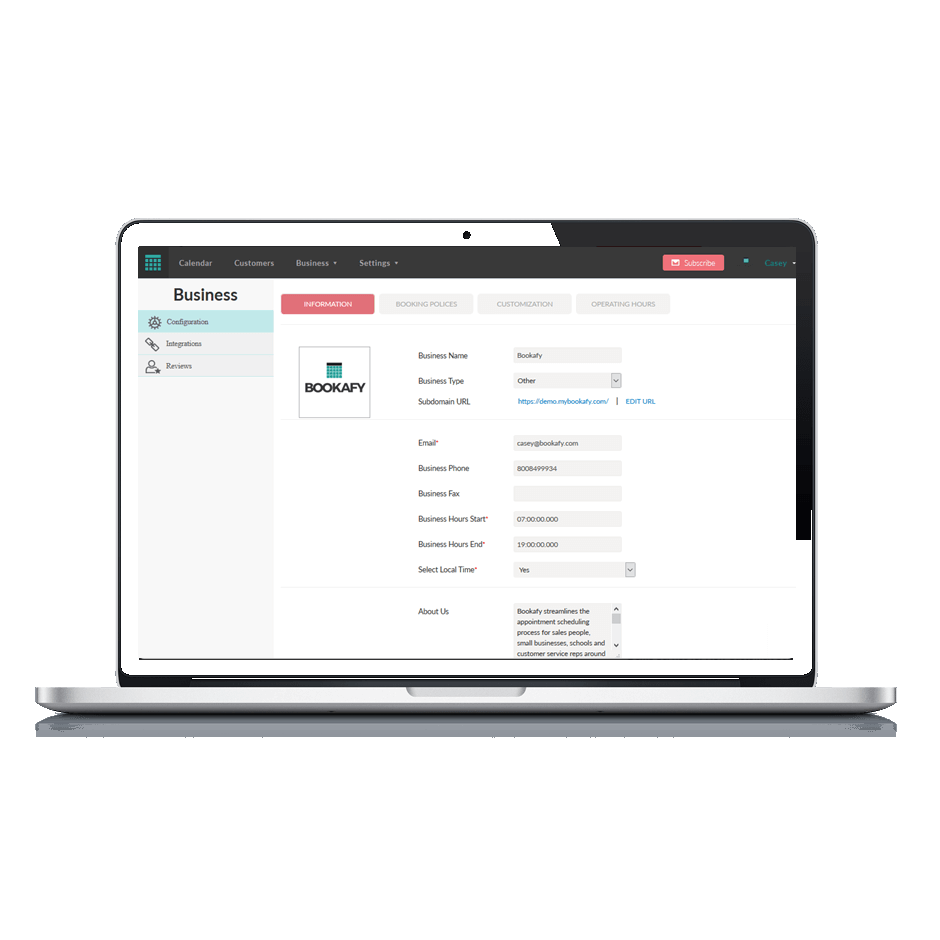
Bookafy is an online appointment scheduling solution targeted at a variety of industries. The vendor’s value proposition is that their solution is simple to use, fully customizable, has an elegant user interface and can be embedded into the business user’s website. Support is available via phone, email or chat.
$9
per month
Google Cloud AI
Score 8.4 out of 10
N/A
Google Cloud AI provides modern machine learning services, with pre-trained models and a service to generate tailored models.
In my experience, Bookafy has pretty much the same features as the other well-known scheduling apps. In terms of functionality, the two obstacles I experience were setting up a hidden (not shown on the main booking page) meeting for special bonus calls you don't want anyone to have access to. Yes, you can set up a paid meeting and give someone a coupon to access it free but that seems like an extra unnecessary step. The other limitation was how ugly it looks to embed meetings on a website. The scheduler looks fine inside Bookafy, but when embedded, it doesn't flow as well. For everything else, it works well. If you want to sync the scheduler with email marketing systems, most of the integrations work through Zapier so that can be an additional cost. Bookafy focuses on the meeting schedules.
Google Cloud AI is a wonderful product for companies that are looking to offset AI and ML processing power to cloud APIs, and specific Machine Learning use cases to APIs as well. For companies that are looking for very specific, customized ML capabilities that require lots of fine-tuning, it may be better to do this sort of processing through open-source libraries locally, to offset the costs that your company might incur through this API usage.
Some of the build in/supported AI modules that can be deployed, for example Tensorflow, do not have up-to-date documentation so what is actually implemented in the latest rev is not what is mentioned in the documentation, resulting in a lot of debugging time.
Customization of existing modules and libraries is harder and it does need time and experience to learn.
Google Cloud AI can do a better job in providing better support for Python and other coding languages.
We are extremely satisfied with the impact that this tool has made on our organization since we have practically moved from crawling to walking in the process of generating information for our main task to investigate in the field through interviews. With the audio to text translation tool there is a difference from heaven to earth in the time of feeding our internal data.
I give 8 because although it´s a tool I really enjoy working with, I think Google Cloud AI's impact is just starting, therefore I can visualize a lot/space of improvements in this tool. As an example the application of AI in international environments with different languages is a good example of that space/room to improve.
Every rep has been nice and helpful whenever I call for help. One of the systems froze and wouldn't start back up and with the help of our assigned rep we got everything back up in a timely manner. This helped us not lose customers and money.
In fact, you only need the basic tech knowledge to do a Google search. You need to know if your organization requires it or not,. our organization required it. And that is why we acquired it and solved a need that we had been suffering from. This is part of the modernization of an organization and part of its growth as a company.
Bookafy is more advanced and has more features that I need comparing to these other brands. Calendly is very basic while Bookfy offers more robust features.
These are basic tools although useful, you can't simply ignore them or say they are not good. These tools also have their own values. But, Yes, Google is an advanced one, A king in the field of offering a wide range of tools, quality, speed, easy to use, automation, prebuild, and cost-effective make them a leader and differentiate them from others.
Artificial intelligence and automation seems 'free' and draws the organization in, without seeming to spend a lot of funds. A positive impact, but who is actually tracking the cost?
We want our employees to use it, but many resist technology or are scared of it, so we need a way to make them feel more comfortable with the AI.
The ROI seems positive since we are full in with Google, and the tools come along with the functionality.