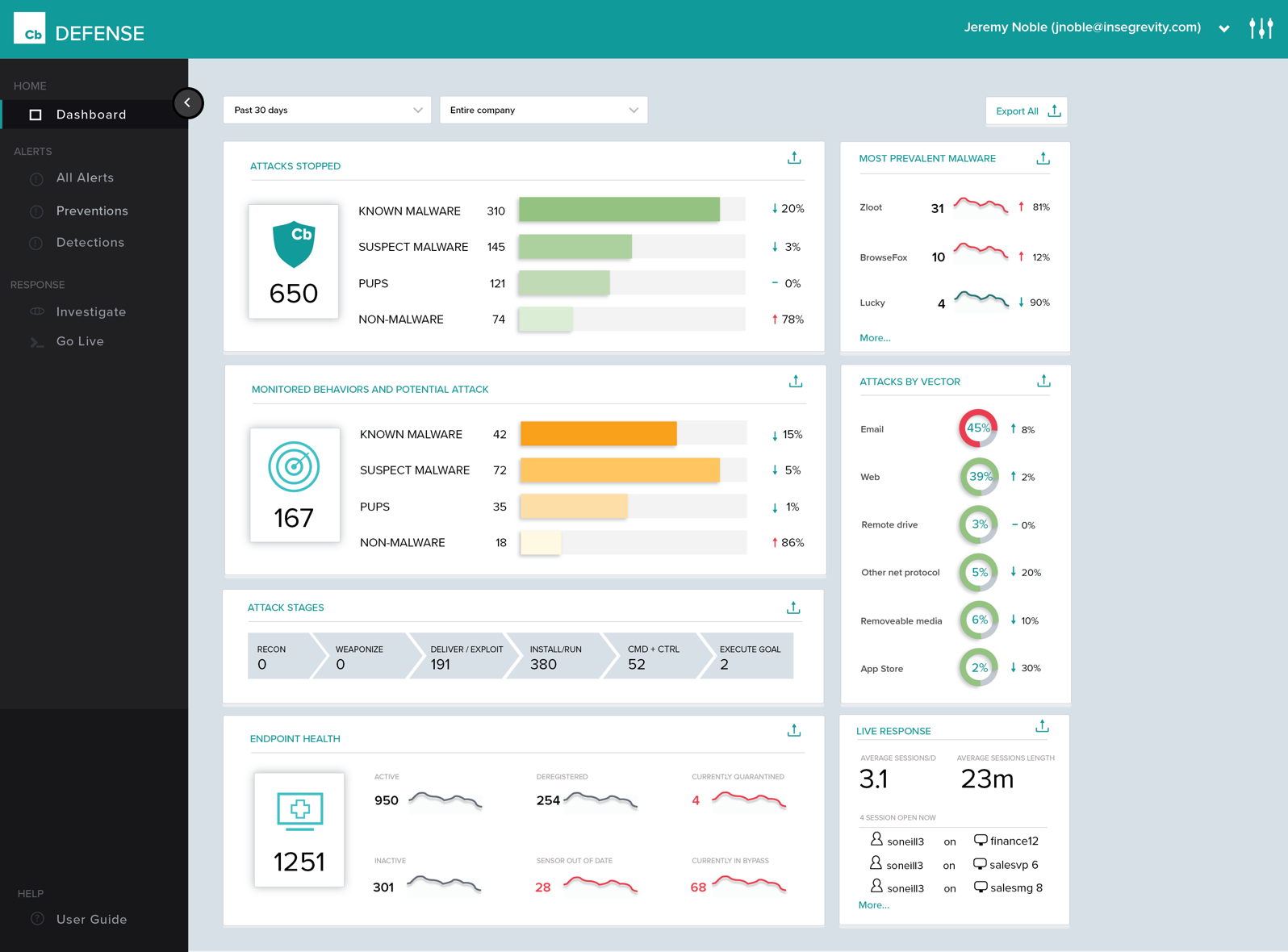
Carbon Black Endpoint is an endpoint security and "next-gen antivirus (NGAV)" that uses machine learning and behavioral models to analyze endpoint data and uncover malicious activity to stop all types of attacks before they reach critical systems.
N/A
Palo Alto Networks Next-Generation Firewalls - PA Series
Score 9.0 out of 10
N/A
Palo Alto Network’s Next-Generation Firewalls is a firewall option integrated with other Palo Alto security products. Released in late 2023, the PA-7500 ML-Powered NextGeneration Firewall (NGFW) enables enterprise-scale organizations and service providers to deploy security in high-performance environments.
$1.50
per hour per available zone
Pricing
Carbon Black Endpoint
Palo Alto Networks Next-Generation Firewalls - PA Series
Editions & Modules
No answers on this topic
No answers on this topic
Offerings
Pricing Offerings
Carbon Black Endpoint
Palo Alto Networks Next-Generation Firewalls - PA Series
Free Trial
No
Yes
Free/Freemium Version
No
No
Premium Consulting/Integration Services
No
No
Entry-level Setup Fee
No setup fee
No setup fee
Additional Details
—
Users may also choose to pay per gigabyte of data used starting at .065/GB. Note that prices listed here reflect installations via Amazon Web Services. Pricing may differ if other service providers are used.
More Pricing Information
Community Pulse
Carbon Black Endpoint
Palo Alto Networks Next-Generation Firewalls - PA Series
Palo Alto Networks Next-Generation Firewalls - PA Series
Likelihood to Recommend
Broadcom
Cb Defense has been working very well in our organization. It is giving us much better insight into the applications that people are running on their systems (without authorization). This software is also great because it provides visibility into systems that are remote (off the network but still have Internet access). The out of band feature is great to help ensure that the systems are protected even when a user is traveling.
It is well-suited for a company needing strong edge security with ease of administration. It comes standard with many features such as VPN, Application ID and "Day-1 Config" that make the networks it protects secure from the very start. Palo is definitely a premium product and is much more expensive than other firewalls, but the value is realized immediately. The robust options for firewall rules/policies allow the administrator to apply security in new and creative ways to hit the sweet spot between security and usability.
History of Process Execution, really anything that happens in the system is easily seen within the Dashboard. I can determine if a bad actor has infected the system, be it malware, backdoor, rootkit, Trojan, then from that point, I can put the system into Quarantine.
Being able to quarantine the system from the Dashboard. With these type of tools, pulling the power and running a hard drive image is not needed. Put the system in quarantine, start the analysis. A year ago, the network engineer might move the system into a VLAN that has no access to anything, except the system performing the remote analysis... Now I do not have to rely on anyone to move a system, power it down, pull the drive, or image the drive. I can just start the analysis right from my workstation.
The Live Response, again goes hand in hand with the quarantine feature.
By now, I am sure you see a process. Its simple, and easy and all done from a cloud-based console, called the dashboard. .. deploy the agent, create the policy, and active live response, set up email alerts, and monitor your endpoints... you are now ready to perform a triage in the event of an infection. We have step 1, step 2, step 3... but, just remember, things do happen, nothing is perfect, but this product has its advantages.
The PA handles VPN connectivity without missing a beat. We have multiple VPN tunnels in use for redundancy to cloud-based services.
The PA has great functionality in supporting failover internet connections, again with the ability to have multiple paths out to our cloud-based services.
The PA is updated on the regular with various security updates, we are not concerned with the firewall's ability to see what packets are really flowing across the network. Being able to see beyond just IP and port requests lets you know things are locked down better than traditional firewalls.
It is a great overall kit, with URL filtering and other services that fill in the gaps between other solutions without breaking the bank.
Policy management can be cumbersome. It is simple to set up a single policy but you have no way to apply the rules to multiple groups. If you need to set up the same rule to multiple policies, you need to type it over again.
Agent updates can be very slow to deploy. We use a mix of rolling out updates via the web console and our management appliance. It can take several weeks to update all agents.
We can be confused on why a rule will apply to a file. Sometimes something is blocked but we don't understand why.
The PA5220s have far exceeded what we have expected out of them. It was a bit of a learning curve coming from another vendor, but everything falls into place now with ease. The capabilities of the solution still surprise us, allowing us to remove other costly hardware and providing a single point of management needed
The console of the product is very easy to use. It provides great detailed information about all aspects of things occurring on the endpoint. It was easy to deploy and set up. The centralized cloud-based interface has made it easy to add two domains and manage them under a single pane with multiple admins. The only reason I wouldn't give it a higher score is a little bit of lag between updated info from the clients and also the lack of accountability in the deployment process. You set the deployment up for multiple machines and can't easily see if it was successful and/or it takes a while to see if it succeeded or failed.
It can be a little tricky at first if you have never used the product or a firewall before. If you have experience with firewalls in general, it does not take long to learn the Palo Alto Networks Next-Generation Firewalls - PA Series interface. They offer great training resources and knowledge base articles to help get up to speed.
First, I need to disclose that our support is provided by SecureWorks. We purchased CB Defense from them, and they provide 24x7 monitoring and notification services for the solution and its deployment on our endpoints. To date, we are very pleased with this arrangement
We've run into a couple undocumented bugs, but that seems to happen with every brand and technology. Any time we've had to engage Palo Alto support they've always been professional, knowledgeable and prompt. In almost all cases we've been able to resolve our issues without having to escalate our tickets.
Cb is cloud-based and has a more advanced policy management. It also has better forensics information. Cost was similar, but Cb added cost savings in terms of IT management resources. We also have the ability to talk directly with engineers and have input on feature updates.
We are using Cisco ASA before in our environment but when it comes to deep scanning & layer 7 security it doesn't have that capability. After using Palo Alto Networks Next-Generation Firewall we are using sandboxing & advance malware protection that provides high-level end-user security. Also after implementing it we can easily monitor user-level traffic.
We used to outsource our Firewall and it's management. Not only did we find their SLA's to be lacking, in general, but communication between us was horrible. Many times we could not understand them and that resulted in less than desirable rule creation or troubleshooting.
Since we no longer have to pay a company for 24/7 management (and SLOW SLA's) we are saving a ton of money each year. Also our fellow employee's are much happier that things can be resolved in a timely manner.