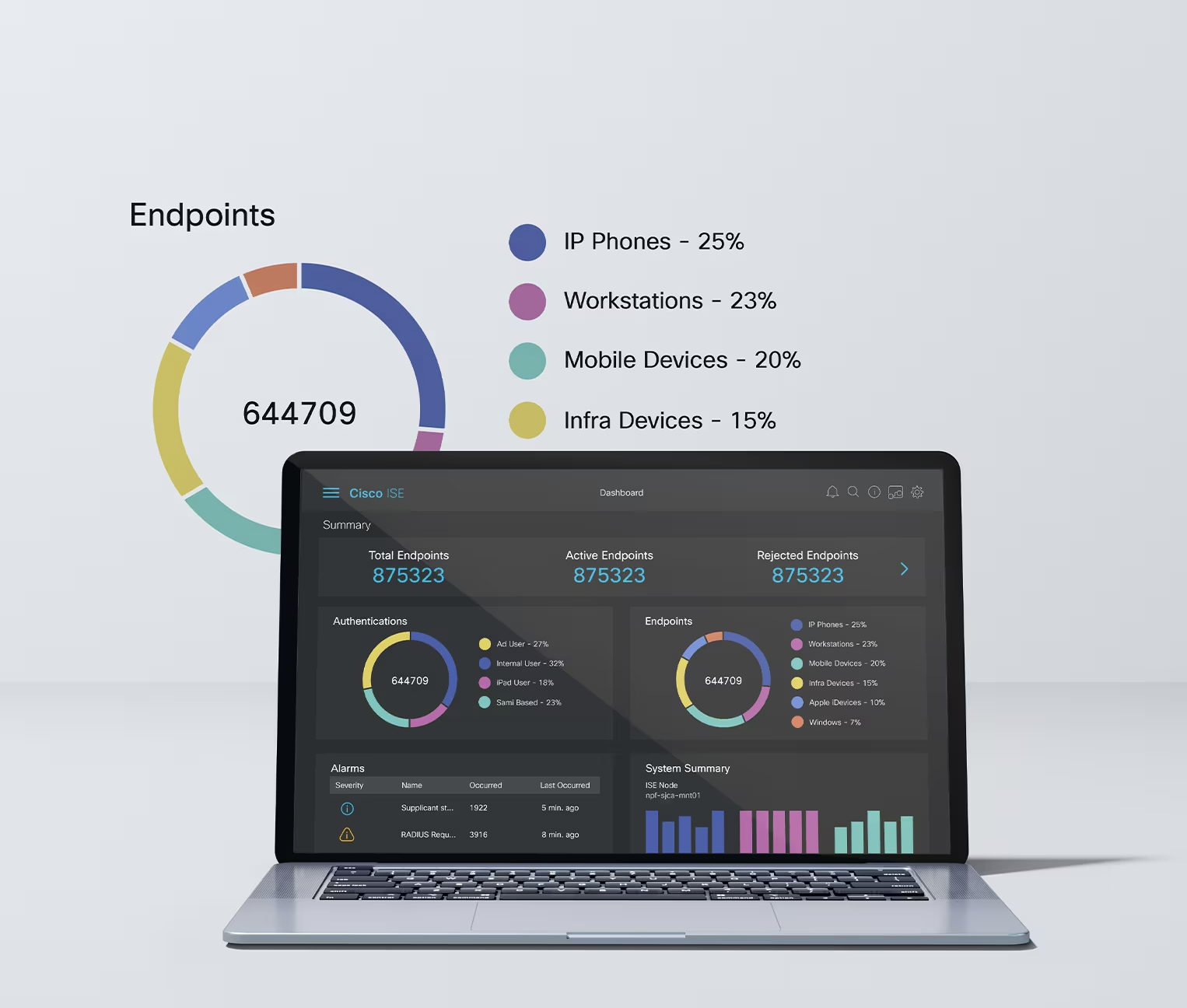
The Cisco Identity Services Engine (ISE) offers a network-based approach for adaptable, trusted access everywhere, based on context. It gives the user intelligent, integrated protection through intent-based policy and compliance solutions.
N/A
SolarWinds NetFlow Traffic Analyzer (NTA)
Score8.5 out of 10
N/A
SolarWinds Netflow Traffic Analyzer is a network monitoring tool within the broader SolarWinds ecosystem. It includes core traffic monitoring features, as well as customizable traffic reports and alerts.
Well suited... I've used it for both wired and wireless access, and it's perfect for that. In addition to enforcing security on the port, you can also lock down east-west traffic. When you get to the point where you're configuring secure group tags and things like that, you can keep people from getting to places they shouldn't. Basically, you could turn your entire network into a firewall if you wanted to. You can secure access based on the identity of any given user through role-based authentication. For example, if you have salespeople and you don't want them accessing your financial or PCI environment, they authenticate as a salesperson and you can completely stop them from getting to any of that. That's really important, especially for us. Our payment card infrastructure servers are heavily locked down. Granted, in our situation, we firewall all that off anyway, but you still don't want some random individual to be able to even attempt that sort of thing. That's what it's really good for. I'm trying to think of a weakness. I don't know. We don't really struggle with it. There's nothing that I use it for where I wish it were better, at least not that I can think of offhand. I'm sure there are things, I just can't think of anything off the top of my head.
A de minimis incentive was given to thank the reviewer for their time. The incentive was not used to bias or drive a particular response, nor was the incentive contingent on a positive endorsement. More Info
We use and depend on it for status state of our network gear, switches and routers. It does an excellent job of getting you the details you need to confirm all devices and products are working at the level needed. At times, it does tend to flag network switch ports and/or switches themselves as exceeding their rated capacity when frequently it was a quick blip of high traffic due to downloads, or uploads causing the max'ing of the device. Again, you can adjust the settings but then you adjust it too high and miss real activity. It can become nuisance alerting when you tend to then ignore
A de minimis incentive was given to thank the reviewer for their time. The incentive was not used to bias or drive a particular response, nor was the incentive contingent on a positive endorsement. More Info
A de minimis incentive was given to thank the reviewer for their time. The incentive was not used to bias or drive a particular response, nor was the incentive contingent on a positive endorsement. TR verified that a representative sample of customers was invited. More Info
The level of customization possible with Network Bandwidth Analyzer is very valuable. Rather than being stuck with a "one-size-fits-all" presentation, an administrator can easily create customized views, reports, and alerts so that users can have a more tailored view of the data provided by Network Bandwidth Analyzer. This has the effect of making the tool more attractive to the end user.
The NetFlow Traffic Analyzer piece of Network Bandwidth Analyzer provides the details on bandwidth usage on the network. More than knowing how much bandwidth is being used, one is provided with detailed information on how that bandwidth is being used. This provides invaluable information for capacity planning and even certain forensic tasks faced by the network engineer.
The ability to produce network maps provides an easy way to create an attractive and functional NOC/SOC view of the entire network. Both technician and the occasional passerby can quickly determine if there are issues to be addressed. The ability to customize a map with background images and custom icons and stencils can make these maps really pop.
A de minimis incentive was given to thank the reviewer for their time. The incentive was not used to bias or drive a particular response, nor was the incentive contingent on a positive endorsement. More Info
A de minimis incentive was given to thank the reviewer for their time. The incentive was not used to bias or drive a particular response, nor was the incentive contingent on a positive endorsement. More Info
The ability to intuitively and quickly serve up specified information up to a dashboard for general “public” consumption, that cycles through several pages of information.
The ability to intuitively set up alerting on bandwidth levels, instead of having to dig through all types of alerts available to find the one needed.
Provide a pricing model based on different support levels: if I want only available update installations, don’t make me pay the same amount as those wanting full support.
A de minimis incentive was given to thank the reviewer for their time. The incentive was not used to bias or drive a particular response, nor was the incentive contingent on a positive endorsement. TR verified that a representative sample of customers was invited. More Info
A de minimis incentive was given to thank the reviewer for their time. The incentive was not used to bias or drive a particular response, nor was the incentive contingent on a positive endorsement. TR verified that a representative sample of customers was invited. More Info
For us the solution is very easily useable on its own. Perhaps that has to do because we started using ISE in the 1.2 days and have seen it grow during the years. Policy creation, etc. is all very visible and thus easy to use. Deployment of multiple nodes is also incredibly easy and flexible. You can easily add or remove nodes as you wish.
A de minimis incentive was given to thank the reviewer for their time. The incentive was not used to bias or drive a particular response, nor was the incentive contingent on a positive endorsement. More Info
As far as rating for usability is concerned I would give 10/10 as NTA is very easy to use. All you need to do is install that module and ask network Team to configure the Netflow towards Server IP. [The] rest is pre-configured and reports are pre-built. Moment you receive the flows from Network all you will have is information about traffic.
A de minimis incentive was given to thank the reviewer for their time. The incentive was not used to bias or drive a particular response, nor was the incentive contingent on a positive endorsement. More Info
We do have to occasionally reboot the servers when they get low on memory, but we're also a few versions behind. Availability has generally been pretty good though with no major outages in the time that we've had it implemented.
A de minimis incentive was given to thank the reviewer for their time. The incentive was not used to bias or drive a particular response, nor was the incentive contingent on a positive endorsement. TR verified that a representative sample of customers was invited. More Info
A de minimis incentive was given to thank the reviewer for their time. The incentive was not used to bias or drive a particular response, nor was the incentive contingent on a positive endorsement. TR verified that a representative sample of customers was invited. More Info
Cisco support is second to none, both in terms of how you access support but also the knowledge of the individual support teams. If you focus on one technology and provide "manufacturer support" then you can rest assured that you are accessing Cisco's top individuals. I feel like this is a USP for Cisco support.
A de minimis incentive was given to thank the reviewer for their time. The incentive was not used to bias or drive a particular response, nor was the incentive contingent on a positive endorsement. More Info
I know we could probably pay for it, but it would be nice if we could get to a tier 2 technician faster. Spending a couple of hours on the phone with the level 1 technician, when we have already tried the troubleshooting they are walking us through, is just a waste of time.
A de minimis incentive was given to thank the reviewer for their time. The incentive was not used to bias or drive a particular response, nor was the incentive contingent on a positive endorsement. TR verified that a representative sample of customers was invited. More Info
A de minimis incentive was given to thank the reviewer for their time. The incentive was not used to bias or drive a particular response, nor was the incentive contingent on a positive endorsement. TR verified that a representative sample of customers was invited. More Info
The training offered by SolarWinds is some of the best out there. They have several different videos that go into great detail from initial setup to advanced configurations. In addition to the view at your own pace video, they also have live training for customers that focus on a single product and you can ask questions with the folks who develop the software. I have had good success with their live sessions and getting questions answered.
A de minimis incentive was given to thank the reviewer for their time. The incentive was not used to bias or drive a particular response, nor was the incentive contingent on a positive endorsement. More Info
I think our system integrators lacks some competencies and this has led to an implementation that is still perfectible. (i.e. dedicating an interface for intra-cluster communication)
A de minimis incentive was given to thank the reviewer for their time. The incentive was not used to bias or drive a particular response, nor was the incentive contingent on a positive endorsement. More Info
I think all give some visibility of device monitoring and management, but Cisco Identity Services Engine gives a good way to manage more details about the device in a centralized way that gives a wider range of monitoring and control than the other softwares individually. I don't think Cisco Identity Services Engine eliminates the need for these other software as of now, but there is potential for Cisco Identity Services Engine to be able to take over more of these roles.
A de minimis incentive was given to thank the reviewer for their time. The incentive was not used to bias or drive a particular response, nor was the incentive contingent on a positive endorsement. TR verified that a representative sample of customers was invited. More Info
SolarWinds NetFlow Traffic Analyzer compared to Wireshark and PRTG Network Monitor beats it by just the simple interface. Though all are manual setup, NTA takes it a step further with graphs and reports that analyze the data for you. In comparing to Extrahop from a bandwidth comparison, Extrahop wins but Extrahop is a lot more than just a bandwidth monitoring and cost.
A de minimis incentive was given to thank the reviewer for their time. The incentive was not used to bias or drive a particular response, nor was the incentive contingent on a positive endorsement. More Info
A de minimis incentive was given to thank the reviewer for their time. The incentive was not used to bias or drive a particular response, nor was the incentive contingent on a positive endorsement. TR verified that a representative sample of customers was invited. More Info
It's fully customised and comprehensive. only thing is you need to know what you want. Proper research and planning would save lots of time and effort .
A de minimis incentive was given to thank the reviewer for their time. The incentive was not used to bias or drive a particular response, nor was the incentive contingent on a positive endorsement. TR verified that a representative sample of customers was invited. More Info
I don't know about negatives because we haven't seen it right now, but positive impact is one is the roadmap we have. And now since we are going ahead with doing the deployment of Cisco ISE, we see that we are getting closure to, so at the end of the day, we have to make sure that operationally we stay excellent. So that's where operational excellence comes in. Cisco ISE is basically addressing that for us. Right now we are in a situation if there is a WIFI issue or if there is an authentication issue, it gets really difficult to isolate the problem. But with Cisco ISE , this functionality is going to come in. So we believe that it would be a good ROI.
A de minimis incentive was given to thank the reviewer for their time. The incentive was not used to bias or drive a particular response, nor was the incentive contingent on a positive endorsement. TR verified that a representative sample of customers was invited. More Info
Be prepared to answer lots of questions. When people see the data in NTA they are going to want to know why App A is talking to App B. Be ready to explain!
Hand the keys to the NTA kingdom to the network team. They will thank you. Everyone wants to have friends on the network team, right?
Be prepared to invest in some significant compute and storage performance to keep up with your NTA monitoring
Running the latest firmware for your network gear is (often) required to take advantage of all the flow-monitoring. You upgrade regularly, right??
A de minimis incentive was given to thank the reviewer for their time. The incentive was not used to bias or drive a particular response, nor was the incentive contingent on a positive endorsement. More Info