
IBM Cloudant vs. Percona Server for MongoDB
IBM Cloudant vs. Percona Server for MongoDB
| Product | Rating | Most Used By | Product Summary | Starting Price |
|---|---|---|---|---|
 IBM Cloudant | N/A | Cloudant is an open source non-relational, distributed database service that requires zero-configuration. It's based on the Apache-backed CouchDB project and the creator of the open source BigCouch project. Cloudant's service provides integrated data management, search, and analytics engine designed for web applications. Cloudant scales your database on the CouchDB framework and provides hosting, administrative tools, analytics and commercial support for CouchDB and BigCouch. Cloudant is often… | $1 per month per GB of storage above the included 20 GB | |
 Percona Server for MongoDB | N/A | Percona Server for MongoDB is a free and open-source drop-in replacement for MongoDB Community Edition. It combines all the features and benefits of MongoDB Community Edition with enterprise-class features from Percona. Built on the MongoDB Community Edition, Percona Server for MongoDB provides flexible data structure, native high availability, easy scalability, and developer-friendly syntax. It also includes an in-memory engine, hot backups, LDAP authentication, database auditing, and log… | N/A |
| IBM Cloudant | Percona Server for MongoDB | |||||||||||||||
|---|---|---|---|---|---|---|---|---|---|---|---|---|---|---|---|---|
| Editions & Modules |
| No answers on this topic | ||||||||||||||
| Offerings |
| |||||||||||||||
| Entry-level Setup Fee | No setup fee | Optional | ||||||||||||||
| Additional Details | — | Free and open-source | ||||||||||||||
| More Pricing Information | ||||||||||||||||
| IBM Cloudant | Percona Server for MongoDB |
|---|
| IBM Cloudant | Percona Server for MongoDB | ||||||||||||||||||||||||
|---|---|---|---|---|---|---|---|---|---|---|---|---|---|---|---|---|---|---|---|---|---|---|---|---|---|
| NoSQL Databases |
|
| IBM Cloudant | Percona Server for MongoDB | |
|---|---|---|
| Small Businesses |  Redis Software Score 9.1 out of 10 | IBM Cloudant Score 7.4 out of 10 |
| Medium-sized Companies | Redis Software Score 9.1 out of 10 | IBM Cloudant Score 7.4 out of 10 |
| Enterprises | Redis Software Score 9.1 out of 10 | IBM Cloudant Score 7.4 out of 10 |
| All Alternatives | View all alternatives | View all alternatives |
| IBM Cloudant | Percona Server for MongoDB | |
|---|---|---|
| Likelihood to Recommend | 7.0 (45 ratings) | 8.0 (1 ratings) |
| Likelihood to Renew | 7.3 (1 ratings) | - (0 ratings) |
| Usability | 7.7 (5 ratings) | 7.0 (1 ratings) |
| Availability | 8.2 (1 ratings) | - (0 ratings) |
| Performance | 8.2 (1 ratings) | - (0 ratings) |
| Support Rating | 8.6 (4 ratings) | 8.0 (1 ratings) |
| Online Training | 7.3 (2 ratings) | - (0 ratings) |
| Implementation Rating | 8.2 (4 ratings) | - (0 ratings) |
| Configurability | 8.5 (3 ratings) | - (0 ratings) |
| Product Scalability | 9.6 (23 ratings) | - (0 ratings) |
| Vendor pre-sale | 9.1 (1 ratings) | - (0 ratings) |
| IBM Cloudant | Percona Server for MongoDB | |
|---|---|---|
| Likelihood to Recommend | IBM
| Percona
 Jose Manuel Ortega Software Engineer && Security researcher |
| Pros | IBM
 Naresh Jasotani Director - Data and Analytics Services (Presales) | Percona
Jose Manuel Ortega Software Engineer && Security researcher |
| Cons | IBM
| Percona
Jose Manuel Ortega Software Engineer && Security researcher |
| Likelihood to Renew | IBM
 victor pease solano General Manager | Percona No answers on this topic |
| Usability | IBM
 Bryan Redeagle Developer | Percona
Jose Manuel Ortega Software Engineer && Security researcher |
| Reliability and Availability | IBM
| Percona No answers on this topic |
| Performance | IBM
| Percona No answers on this topic |
| Support Rating | IBM
 Nicolas Peeters VP of Engineering | Percona
Jose Manuel Ortega Software Engineer && Security researcher |
| Online Training | IBM
victor pease solano General Manager | Percona No answers on this topic |
| Implementation Rating | IBM
Nicolas Peeters VP of Engineering | Percona No answers on this topic |
| Alternatives Considered | IBM
| Percona
Jose Manuel Ortega Software Engineer && Security researcher |
| Scalability | IBM
 Wes Wilson CTO (Chief Technical Officer) | Percona No answers on this topic |
| Return on Investment | IBM
| Percona
Jose Manuel Ortega Software Engineer && Security researcher |
| ScreenShots | Percona Server for MongoDB Screenshots 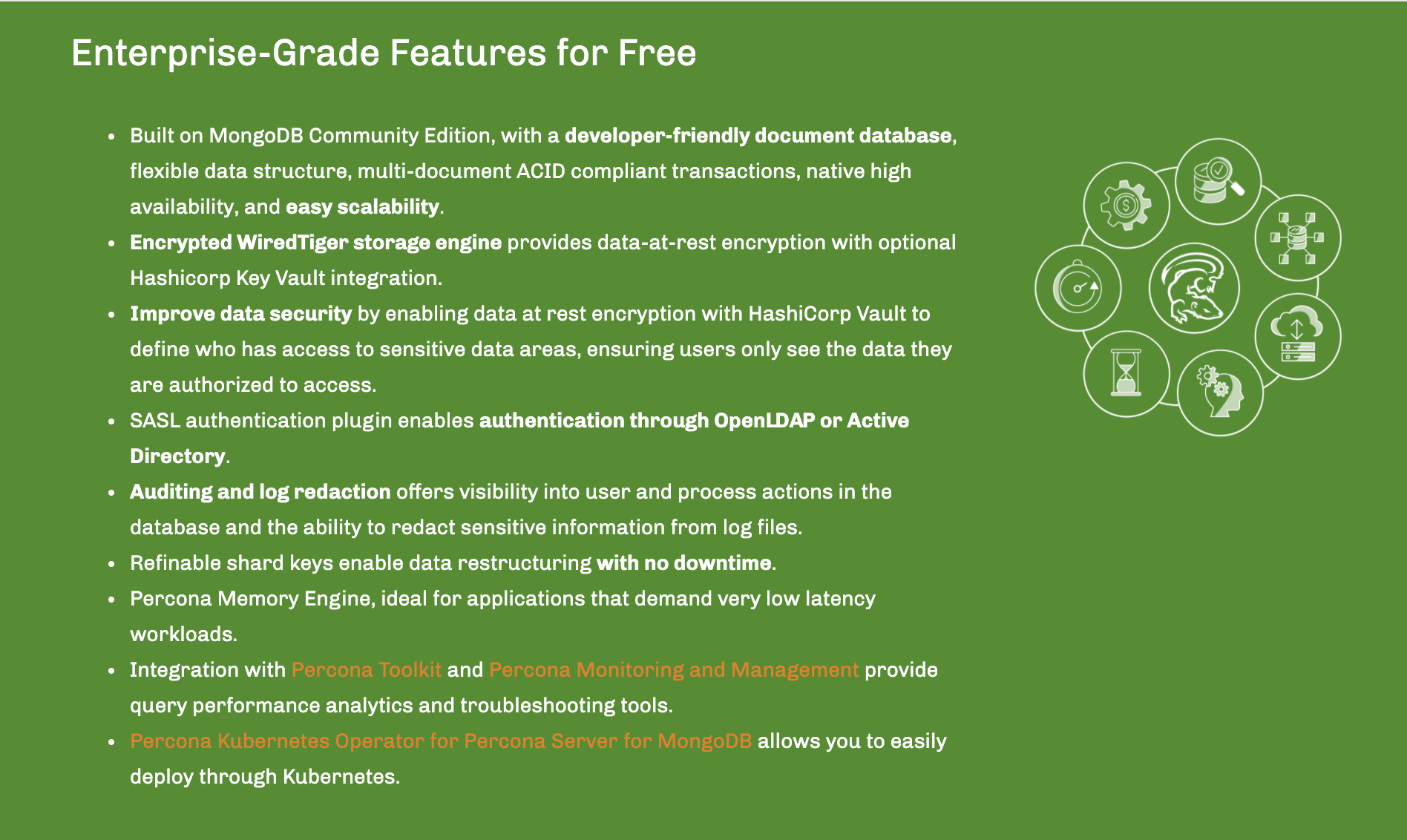  |