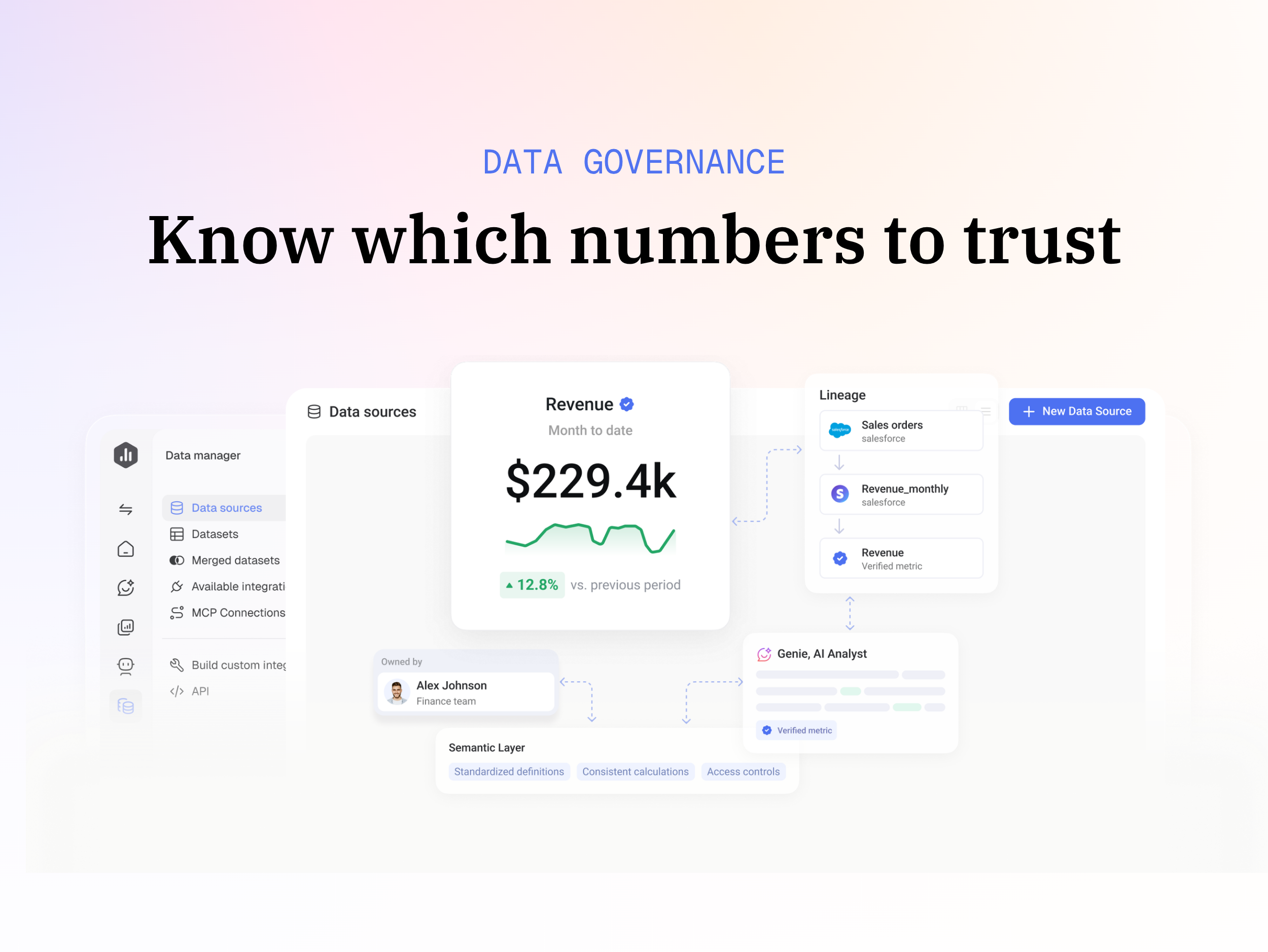
Databox is business intelligence software built for teams that need fast, actionable insights.
$199
per month
Grafana Cloud
Score 8.7 out of 10
N/A
Grafana Cloud is a fully managed Observability Platform designed to aggregate, visualize, and analyze telemetry data across distributed architectures. The platform provides a unified environment for Metrics, Logs, Traces, and Continuous Profiling, utilizing the LGTM (Loki, Grafana, Tempo, Mimir) and Pyroscope stack to provide high-cardinality analysis of system state.
$8
per month up to 1 active user
Pricing
Databox
Grafana Cloud
Editions & Modules
Professional
$199
per month
Growth
$499
per month
Premium
$999
per month
Grafana Cloud - Pro
$8
per month up to 1 active user
Grafana Cloud - Free
Free
10k metrics + 50GB logs + 50GB traces up to 3 active users
In comparison, Databox has been a more robust solution and one that works really well with HubSpot (our preferred marketing automation platform). It's a bit pricier than Cyfe was (not sure now), but the features are worth it.
Much cheaper and seems to do at least as good of a job while having a similar integration stack. I also appreciate the efforts Databox go to on their blog and podcast to help educate people on all things data and metrics.
Databox automatically integrates with tons of different data sources without you needing to arrange the backend information on how everything should connect. Tableau, Power BI, and Sisense require a lot of manual setup unless you have all of your fields perfectly matched up …
While HubSpot is where we store our information and utilize the systems, the reporting wasn't deep enough and it didn't include the entire website since it is hosted elsewhere. So I started looking at options, and Databox came as a recommendation so I checked it out and haven't …
Databox and Grow are similar tools, and truthfully, Grow is a more powerful platform with more sophisticated reporting, integrations, and a larger feature set. However, Grow is significantly more expensive and Databox has the features you need most for less of an investment. I …
HubSpot's reporting tool simply isn't enough. It also doesn't help that the reporting add-on for HubSpot is an additional $200/month, and it only reports on HubSpot stuff. That's why we selected Databox--to report on other platforms like FB ads, Google Analytics, etc.
Databox is unique in its ability to report from multiple data sources. Google Analytics is the standard when it comes to web metrics, but it's just one of the tools that integrates with Databox. Tableau is fantastic for data visualizations and reporting, but it's much more …
Grafana is more flexible, readily adopts other tools frameworks instead of forcing you to use their agent, doesn't force you into Vendor lock-in, and embraces open source, self-hosted, and Enterprise. Similar companies would like you to use their specific tooling and don't …
Grafana gives more flexibility to explore its features. A new user can explore experiment and work with free Grafana account and find if it is suitable for them.Other platforms don't have the features in their freemium version that Grafana has. It lets us try features of …
Grafana has a direct plugin to Icinga monitoring solution and allowed for easy configuration for us. At the time of implementation, other services did not have such an integration. As we already had a very customized and heavily introduced monitoring solution in place, we …
Grafana blows Nagios out of the water when it comes to customization. The ability to feed almost any data source makes it very versatile and the cost is great.
Databox is fantastic for companies or agencies that regularly report on a variety of metrics from multiple data sources. It's ideal for any company that uses a variety of different tools (as long as Databox integrates with them). It's particularly good for HubSpot agencies and companies that use HubSpot. It's maybe not necessary for companies that only use one tool or don't do reporting.
Just about any organization with more than one server and more than one cluster as it scales very well. Configuration of the application takes time and finesse to fine tune to where the balance of load time and getting data quickly meets. The plugins add load time but fine tuning for the application to meet demand needs nailed down at implementation
Some types of data can only be reported on for 1-2 months back. Unless I'm misunderstanding the function of the software this seems really weird. I can't figure out how to report on Activities more than 2 months ago
Databox is an intuitive, well-designed platform that can be used by non-technical marketers. It is easy to learn, and while set up takes time, usability is high and the team has enjoyed creating custom dashboards and clients have also given us great feedback regarding its usability and value. While other BI tools are much more complex to navigate, Databox is a breeze.
Great usage in terms of monitoring of any application from backend to frontend and even any AWS resource via cloud watch and other connectors. Easy to use and configure personalised dash boarding and alerting features. Cost efficient and easy to setup and run, no mazor scaling challenges in terms of managing and maintaining the stack, easy to configure via Prometheus, influx and other connectors
I have really enjoyed using Databox and have seen the value of it in many ways. They also continue to improve the functions of it and grow their integrations and templates. I look forward to continuing to use Databox in the future, potentially even finding ways to incorporate it into other departments to help them with reporting as well.
While HubSpot is where we store our information and utilize the systems, the reporting wasn't deep enough and it didn't include the entire website since it is hosted elsewhere. So I started looking at options, and Databox came as a recommendation so I checked it out and haven't turned back. I didn't evaluate any other products because Databox met our need and we were able to get started right away.
Grafana is more flexible, readily adopts other tools frameworks instead of forcing you to use their agent, doesn't force you into Vendor lock-in, and embraces open source, self-hosted, and Enterprise. Similar companies would like you to use their specific tooling and don't offer nearly as much flexibility. The other thing I like about Grafana is their storage usage is much lower compared to similar tools and competitors