Logi Symphony is a business intelligence and data visualization software that includes customizable dashboards, reporting, and visual data analytics. It can be integrated into users’ existing business applications and its visualization and reporting tools can be customized.
N/A
Pricing
Gephi
Logi Symphony
Editions & Modules
No answers on this topic
No answers on this topic
Offerings
Pricing Offerings
Gephi
Logi Symphony
Free Trial
No
Yes
Free/Freemium Version
Yes
No
Premium Consulting/Integration Services
No
Yes
Entry-level Setup Fee
No setup fee
No setup fee
Additional Details
Gephi is open-source and free to use.
—
More Pricing Information
Community Pulse
Gephi
Logi Symphony
Features
Gephi
Logi Symphony
BI Standard Reporting
Comparison of BI Standard Reporting features of Product A and Product B
Gephi
6.7
3 Ratings
20% below category average
Logi Symphony
8.4
51 Ratings
3% above category average
Pixel Perfect reports
4.01 Ratings
8.443 Ratings
Customizable dashboards
8.02 Ratings
8.651 Ratings
Report Formatting Templates
8.03 Ratings
8.139 Ratings
Ad-hoc Reporting
Comparison of Ad-hoc Reporting features of Product A and Product B
Gephi
4.3
3 Ratings
60% below category average
Logi Symphony
8.1
51 Ratings
1% above category average
Drill-down analysis
8.02 Ratings
7.951 Ratings
Formatting capabilities
2.23 Ratings
8.250 Ratings
Integration with R or other statistical packages
5.01 Ratings
7.633 Ratings
Report sharing and collaboration
2.01 Ratings
8.645 Ratings
Report Output and Scheduling
Comparison of Report Output and Scheduling features of Product A and Product B
Gephi
4.0
3 Ratings
69% below category average
Logi Symphony
7.9
49 Ratings
4% below category average
Publish to Web
2.01 Ratings
8.442 Ratings
Publish to PDF
8.02 Ratings
7.845 Ratings
Report Versioning
2.01 Ratings
7.838 Ratings
Report Delivery Scheduling
00 Ratings
8.337 Ratings
Delivery to Remote Servers
00 Ratings
7.23 Ratings
Data Discovery and Visualization
Comparison of Data Discovery and Visualization features of Product A and Product B
It is well suited for projects that are more discovery related. If this is a one-time project that we create a visual for, this would definitely make sense to use. If this is an ongoing analysis (monthly for example), we might look to another software that we would be able to automate a little further in how the visualization comes together
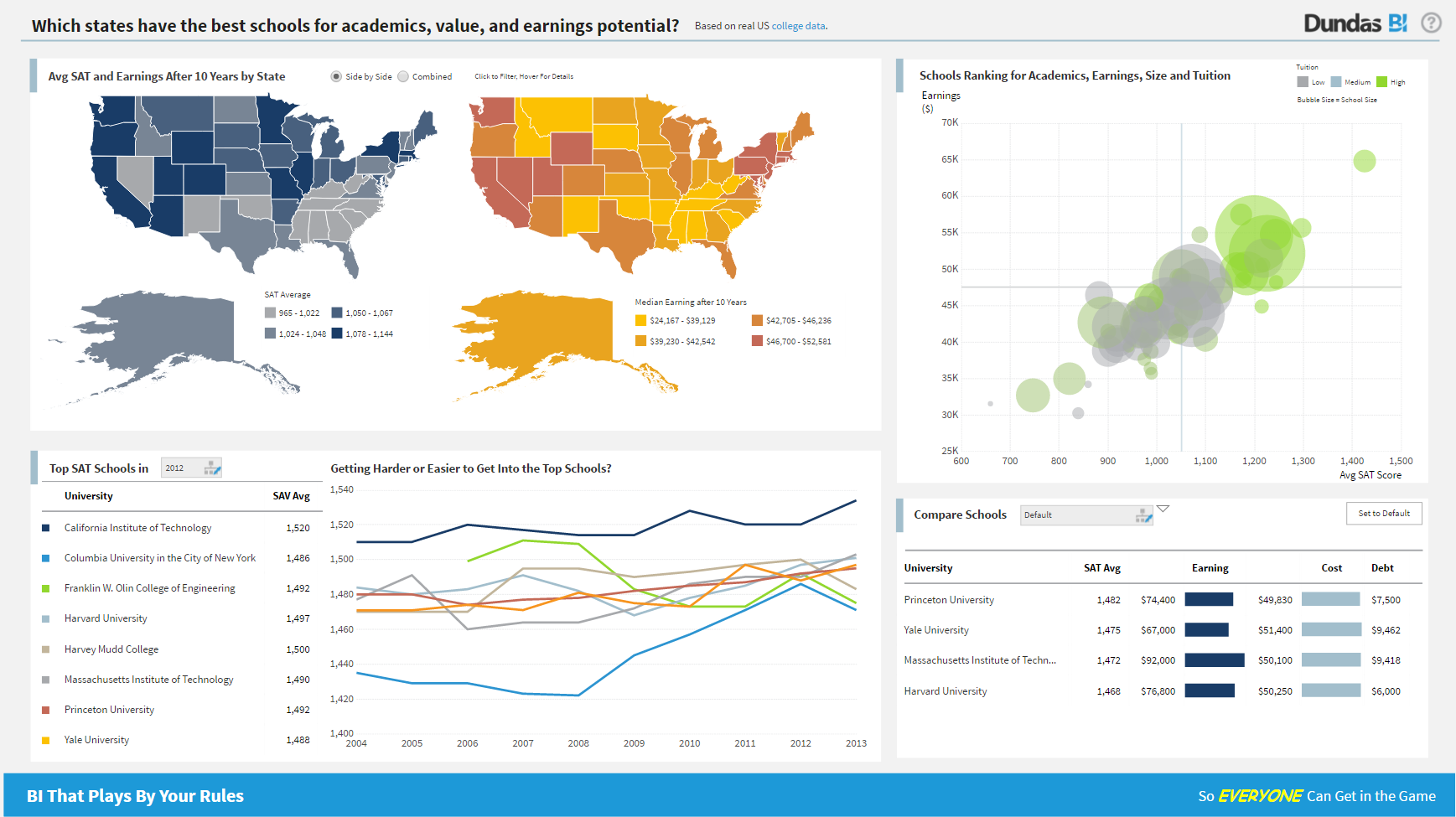
For all the scenarios I have so far worked on or I am currently working on, Dundas BI has proved to be more than adequate and apt to handle all of those. It is a very easy-to-use tool with quick shortcuts enabling you to prepare ad-hoc reports or dashboards in a matter of minutes.
In comparison to other tools such as GraphWiz or Circos, Gephi comes with an intuitive, easy-to-use interface that makes it easy to load your data, and quickly start building all sorts of different graphs. There's absolutely no code that needs to be written for either loading or modeling. And without downloading additional plug-ins, Gephi ships with quite a few standard graph models, as well as some "fun" extras such as the Sierpinski triangle, and a variety of force atlas types.
Most of the layout types (maybe all) are highly configurable, which can make for extremely customized and unique displays of your data. Again, none of this requires the user to write any code. That said, it is possible to script custom functionality for your models, or even update the Java source code yourself, if you feel like getting technical. Gephi builds are available on GitHub, and the developers encourage people to contribute ideas, improvements, and plug-ins.
There's a plug-in for Gephi that allows for streaming data to update your model. This essentially allows you to create near realtime graphs of your data in motion. This plug-in was by far the biggest reaston we invested time in the product; to create animated data visualizations without exhaustive hours in development.
Project organization from Development to Production, you get a production and development license but I think the best way to do it is with DEV and Prod project in the Production box. Use the development box for testing updates and really crazy things. With the Dev and Prod projects on the same box, you just publish from Dev to Prod and you are done. Users only have access to the Prod projects so no one can mess up what you are working on.
Security - If you have a hierarchy (subsidiaries, divisions, department, teams) and you want each group to see only their data, then Security hierarchies are for you!
Dependent filters! What's this you ask? Here is an example of how it can be used, in your company you have departments and who works for what department is in your database. You make a dashboard that has a department filter (only show these departments), a managers filter, and employee filter. Not every manager or employee is in multiple departments usually only one. With dependent filters you can say that the manager and employee filter are dependent on what is selected in the departments filter so when you go to filter them they only show the managers or employees that are part of that department, and you can even it do so employees are not only dependent on department but on manager as well. Then it gets even better as it can be done in reverse as well so when you select a manager then go to the department it only shows the departments he works for (there are better situations where this is more useful).
It is scriptable! From calculate columns, null replacements, button actions, load actions, hover over events there a way to do what you want.
They are constantly improving and listens to your suggestions.
I (and many others) have had to expand Gephi's memory manually by experimenting with the configuration file. I'm glad it's possible, but it should be easier.
Gephi sometimes crashes inexplicably and loses your work, so I have developed a habit of explicitly exporting versions of my graphs as csv's, but I think this should be handled automatically in Gephi.
Because it is prone to crash, ideally, Gephi would help the user manage his/her use, by estimating processing and memory for very large tasks and prompting the user to confirm their requests before executing. Instead, I just tend to avoid certain functions.
Not too many cons for how we use the application. It really is easy and powerful. Very powerful.
Licensing is one thing that could be looked into. It is simple, but a little confusing. For example, if I get a license today, but a new release comes out tomorrow, it seems that the license doesn't work with the new release. Maybe that is by design, but it would be nice to clearly understand.
While Gephi isn't perfect, it's a powerful tool for mathematical graph modelling that's hard to find in other products, particularly by way of its interface. It grants non-software developers access to a point-and-click way of creating accurate, beautiful visualizations that would normally take hours in other applications. The fact that it allows for live streaming data is also something that's hard to come by, at least for visualization software
Gephi is very intuitive and the fact that it shows its process helps the user understand what's going on. However, the animation features can really slow it down and there isn't a way to shut them off. Furthermore, the failures on saving mean you frequently have to start over. These problems disrupt the workflow and can be frustrating.
We are still in the implementation phase, but so far we are finding it to be easy to use and learn. The eLearning courses that they have made available for free, as well as User Forums and other training videos have made even difficult concepts easier to understand.
We have bi-weekly calls with our Success Manager, as well as access to support as needed. Any question that I have had, multiple people have been willing and able to jump on a call to talk me through it, or send an email with the solution
The interactivity in Gephi and the quality of the output figures are impressive. However, the selling point was the fact that we were able to link Gephi into our pipeline using Java's interface. Other products were less customizable and lacking of the sophistication Gephi provided without too much pain during the liking process.
Per dollar spent, it offers the widest range of features of the tools that we evaluated. It offers lots of options for how to configure your environment, though they are not always intuitive to figure out. Having an ETL layer was a must have for us, as well as the ability to host to secure HIPAA compliance. It is not a replacement for ad hoc reporting, but does a great job of creating parameterized reports and dashboards that look great.
I have only used the product for education purposes. I will not be the best person to provide details about ROI and business efficiency and customer service. I was personally very excited about the tool and am continuing my work on the tool.