GFI LanGuard is software used to manage and maintain end-point protection across a network. It provides visibility into all the elements in the network, helping to assess where there may be potential vulnerabilities, and enables the administrator to patch them. It is a patch management and network auditing solution.
N/A
ManageEngine Patch Manager Plus
Score 8.4 out of 10
N/A
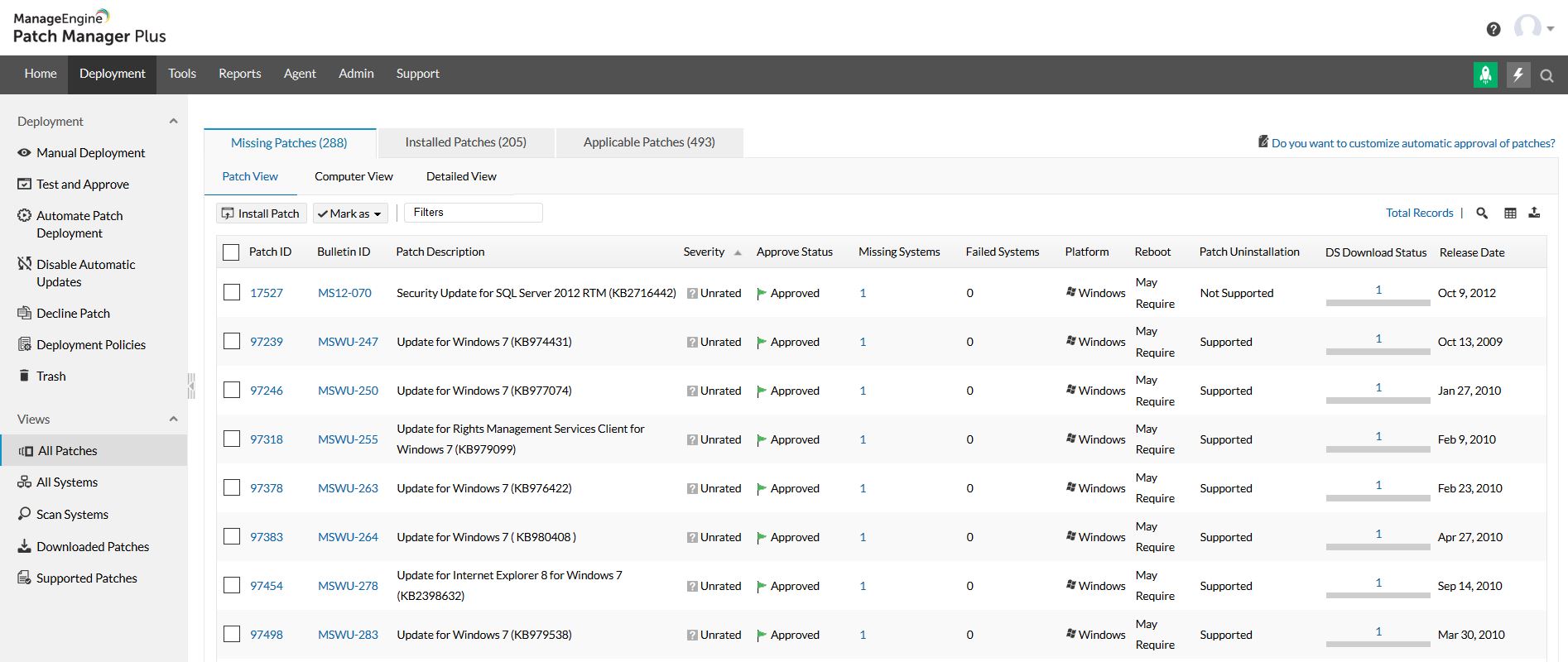
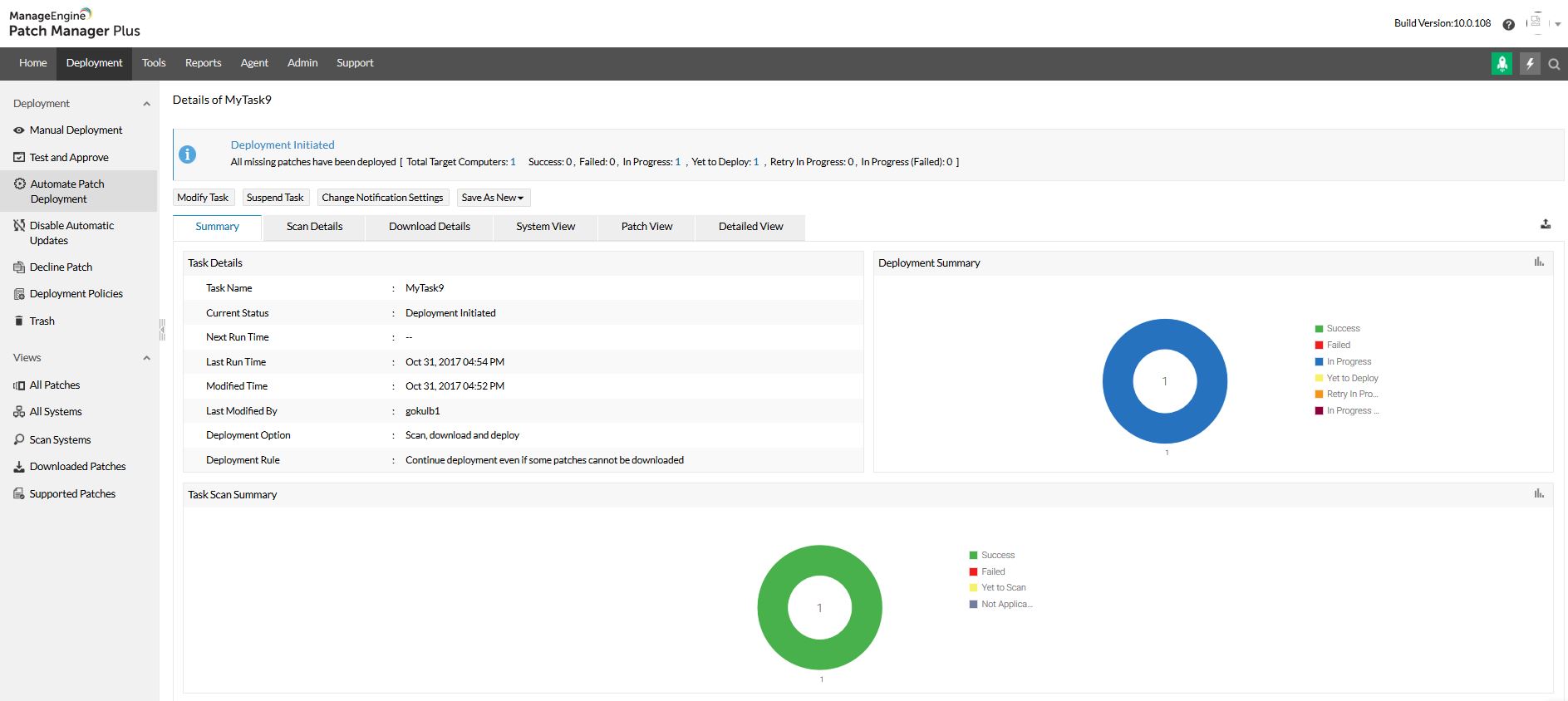
Patch Manager Plus is an automated patch management software that provides enterprises with a single interface for all patch management tasks. The vendor claims it works across platforms, helping users patch Windows, Mac, Linux & 300+ third-party applications. With Automated Patch Deployments, users can automate the entire process of patch management:…
$245
50 endpoints
Tenable Nessus
Score 8.8 out of 10
N/A
Tenable headquartered in Columbia offers Nessus, a vulnerability scanning and security assessment solution used to analyze an entity's security posture, vulnerability testing, and provide configuration assessments.
SolarWinds was not selected because it runs on top of
SCCM which in itself is problematic and unreliable. We need an application that
runs in standalone mode and does not rely on any other application. SolarWinds
ManageEngine Patch Manager Plus was easier to use, and you can basically set it and forget it. The performance is very good and we had way less failed patch than competing product.
-To track the vulnerability level of a windows network. -To push windows and other application updates from a central location. -Produce reports to highlight work being done to protect a network. In some organizations, you may have to prove for audit reasons you are enforcing policies put into place around cyber-security. This software can help you track work done on an ongoing basis for such purposes.
If you are managing a very large number of computers, I would say 1000+, the standard patching tools provided by Microsoft will fail to do their job properly. This is where you will benefit from ManageEngine PATCH MANAGER Plus, being agent-based it is fast, easy to manage, and reliable. If you require functionality more than just patching, like security auditing, you have to look elsewhere.
It is an excellent tool for scanning servers, workstations, and network devices to identify missing patches and misconfiguration; we regularly use it to confirm patch effectiveness after the update; it also helps us for preparing audits such as iso 27001, and regulatory requirements, it also helps us to identify open ports and services that violate security.
Nessus is best at performing vulnerability scans, in fact, it gives findings and moreover accurate findings of the assessments. It does not do penetration testing or exploit the vulnerabilities because it is concerned about scanning the systems/applications.
In fact, Nessus has multiple profiles/policies to perform different types of scans such as, scans oriented for PCI-DSS, malware scans, web application scans, bad shell shock detection scan to name a few.
Nessus has the ability to classify the vulnerabilities into risk-based categories from critical to even informational which I think is one of the things that separates Nessus from other vulnerability scanners.
It could be a bit of information overload which some things are shown can become noise. Maybe different levels of "security" for lack of a better term may be better where you have a summary vs detailed level when it comes to rating the vulnerability of the entire network.
I find I sometimes have issues with PCs on a different network accessed across a VPN where timeouts often occur with very large updates. This aspect can be improved.
The tool has lots of options for setting up before scanning any device, this methodology could be simplified further with default configuration for various devices predefined, anyhow we can use this technique by making use of policies.
For advanced users we cannot disable the plugins inside the plugin groups, we can enable the whole set of plugins at a time, for few hundreds its ok, but thousands of plugins are of waste of resource and time.
Nessus is best and easy to use application for Vulnerabilities finding and reporting, it has multiple platforms and wide scope covering almost all devices for security improvement so far, thus we are very likely to continue its services.
The overall usability for the application is great precisely for the ease of use the application provides, if i would go in a different organisation, i would suggest implementing ManageEngine Patch Manager Plus or Endpoint Central due to its features, and productivity.
Tenable Nessus is a great product and provides a lot of value, but it is difficult to set up and use and the amount of data it generates can be overwhelming. It does help us prioritize based on the severity of the detection, however there are sometimes mitigating factors that we have implemented that Nessus does not account for, which causes lots of noise in the reports.
I only tried to access there support once and it was a relatively pain-free process. They also have a lot of documentation available online which can be used to learn and tailor the software to suit your needs. It just takes time and effort to plan, execute and monitor going forward.
The support team at Patch Manager Plus has been awesome. Very responsive and knowledgeable. There are times when there is confusion between different tickets but there is still good service.
I haven't needed to contact support yet. But issues are easily solved with a quick internet search which means support and by extension, the larger community are involved and knowledgeable.
WSUS was the other alternative I considered but I believe GFI takes updates, reporting, and functionality to a different level for an enterprise/medium-size business environment.
We were talking to Action1 and Adaptiva about their solutions of patch management. The main factor of choosing ManageEngine was pricing, which was considerably lower compared to these tools. Also, for Action1, it didn't featured some important features (like Linux patching), and it looked like a solution that is getting started in the market, even being more expensive than Patch Manager Plus.
Sometimes when we identify a vulnerability with Nessus that has an exploit, we made a proof of concept with Metasploit in order to show to the IT managers the importance of the software/hardware hardening.
Certainty. It allows you to know where on your network needs attention.
Peace of mind. As security professionals, we can only put the necessary things in place to prevent malicious persons from exploiting a network. The software allows you to know whether or not your risk of exploitation is high or low. and if high what to do with it.
ManageEngine Patch Manager Plus provides an excellent return on investment. We were able to get our systems fully patched, which we'd never been able to complete before. This provided excellent security to our organization.
ManageEngine Patch Manager Plus saved us a lot of time as most of our patching was fully automated.
ManageEngine took any issues we found and looked for solutions to further improve their product.
Nessus certainly has a positive impact while me while performing my job, either as security research, or performing vulnerability assessments for clients. It gives a lot of information about the system/application after performing scans. The number of false positives is also less compared to other vulnerability scanners.
The professional edition is very useful as policy templates available in this edition are very handy and useful even to perform compliance scan like PCI DSS scan.
Also, the ability to export the scan results into reports in formats like HTML, PDF is very useful which could be for performing system/application reviews.