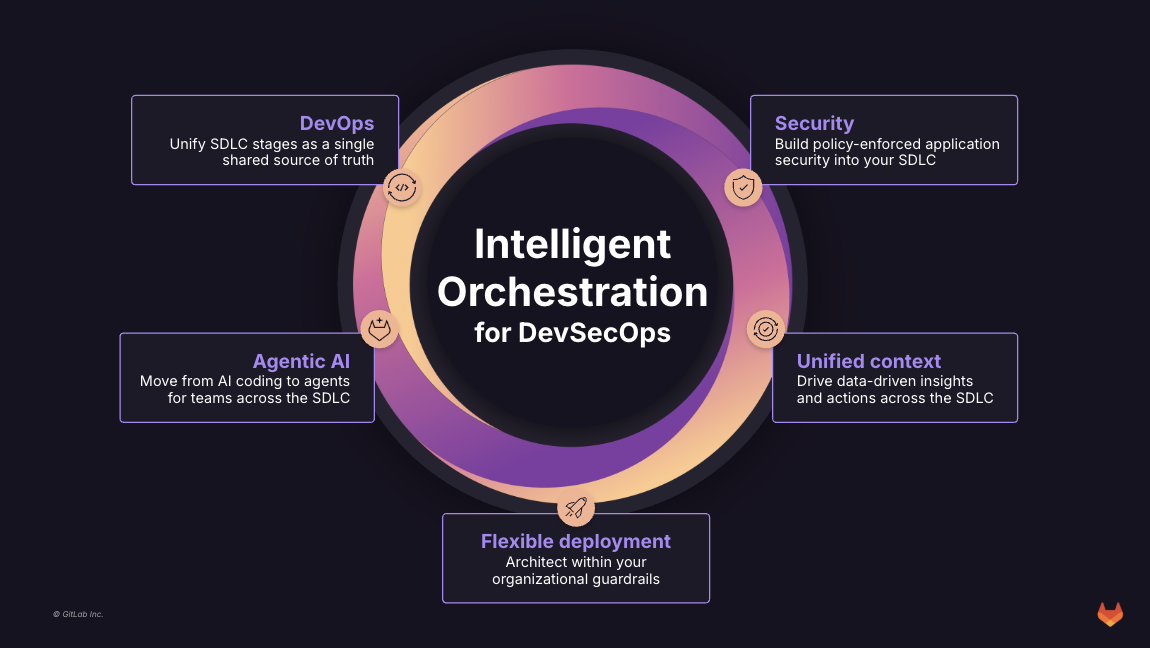
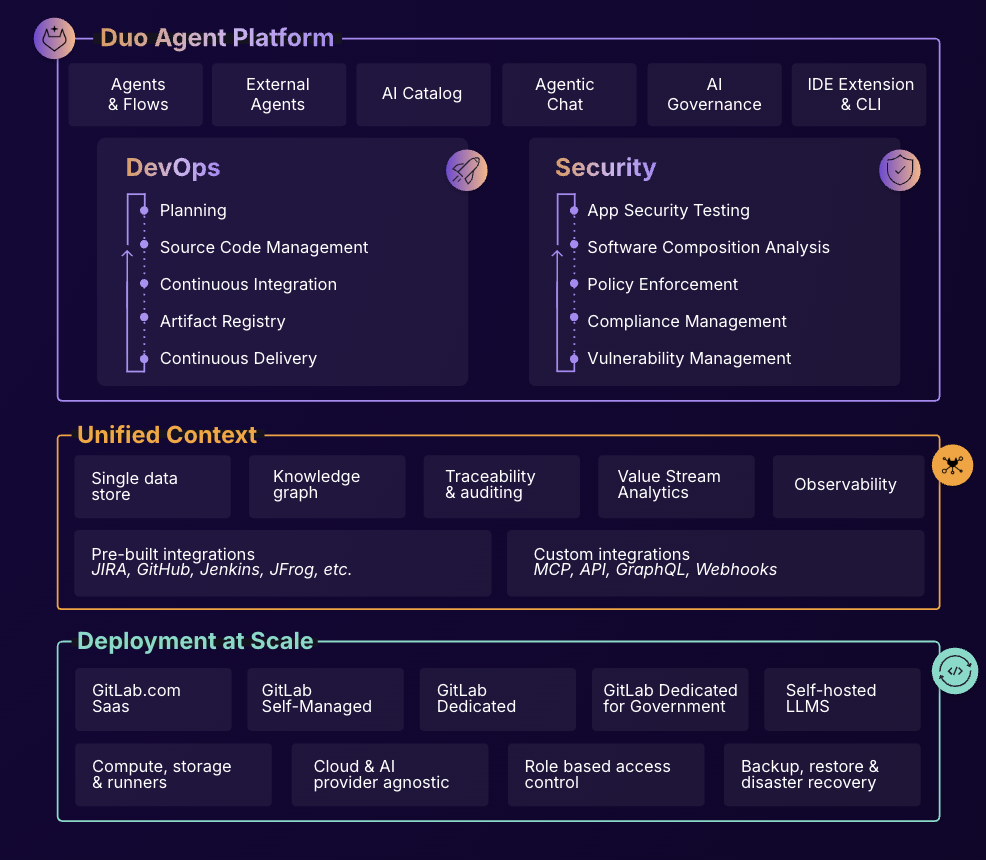
GitLab is an intelligent orchestration platform for DevSecOps, where software teams enable AI at every stage of the software lifecycle to ship faster. The platform enables teams to automate repetitive tasks across planning, building, securing, testing, deploying, and maintaining software.
$0
per month per user
Kubernetes
Score 9.0 out of 10
N/A
Kubernetes is an open-source container cluster manager.
N/A
SonarQube
Score 8.2 out of 10
N/A
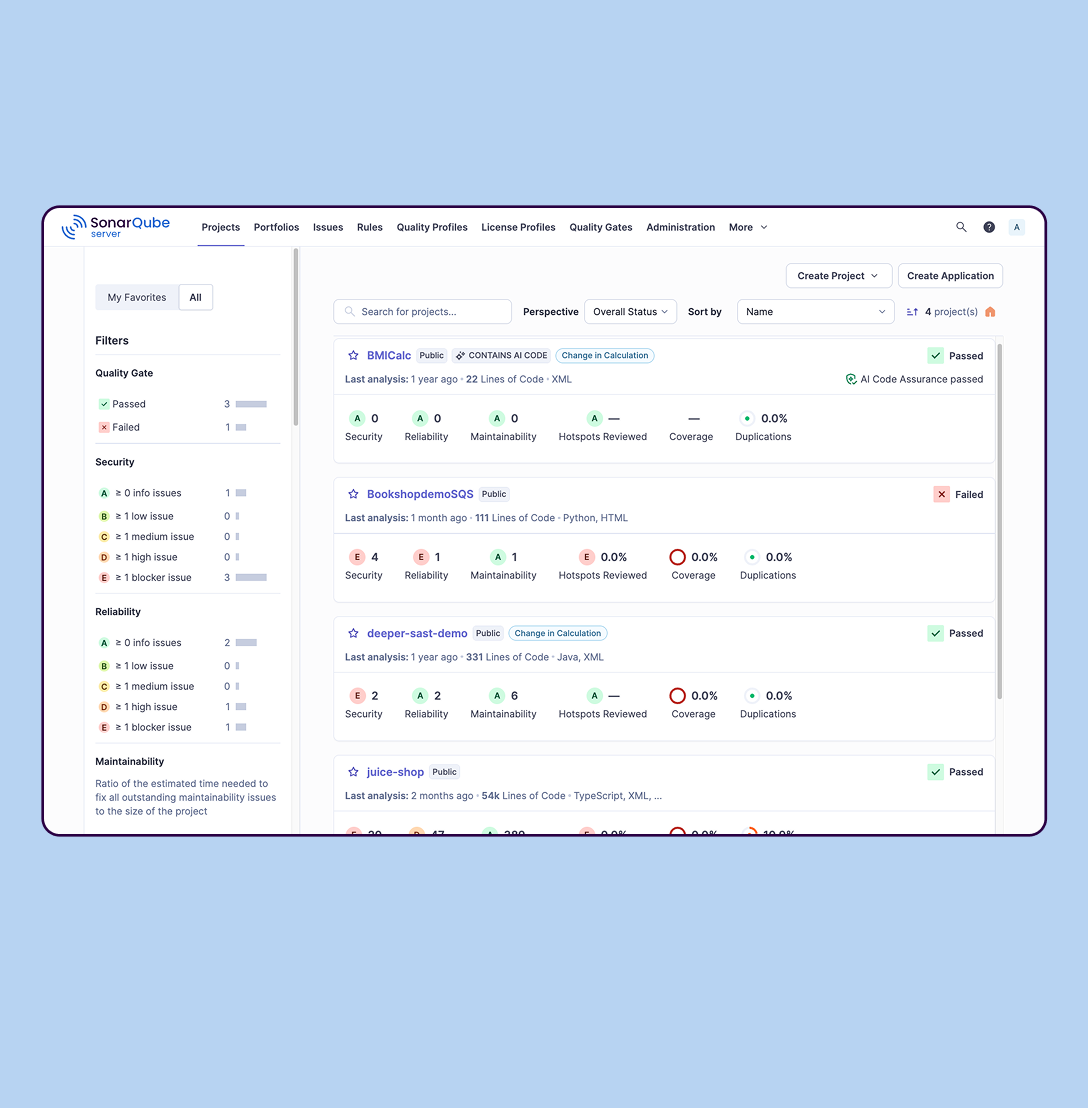
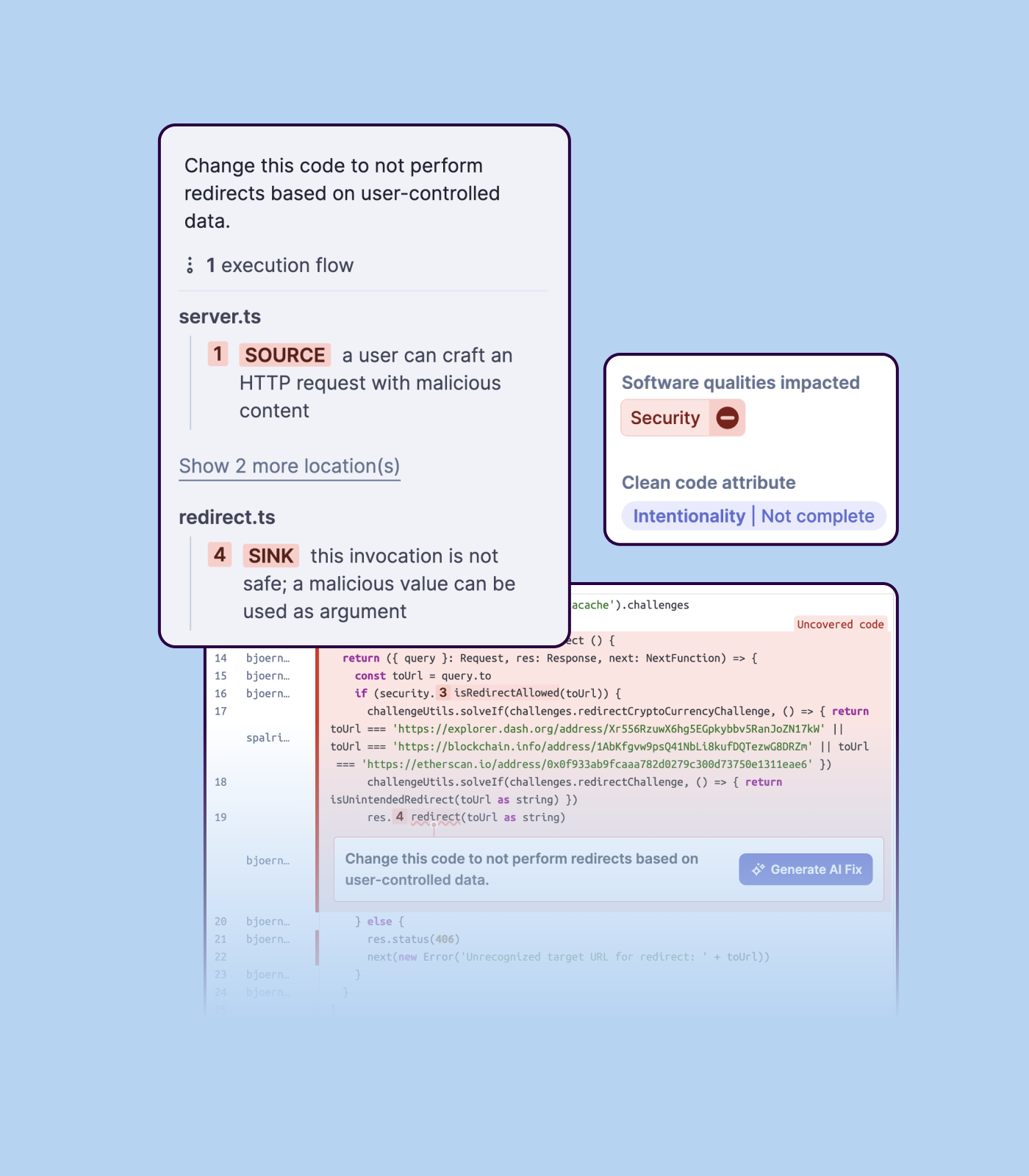
SonarQube is an automated code review solution, serving as the verification layer for code quality and SDLC security. SonarQube is used to ensure that code is secure, reliable, and maintainable. It is available through SaaS or self-managed deployment.
$0
Pricing
GitLab
Kubernetes
SonarQube
Editions & Modules
GitLab Free (self-managed)
$0
GitLab Free
$0
GitLab Premium
$29
per month per user
GitLab Premium (self-managed)
$29
per month per user
GitLab Ultimate
Contact Sales
GitLab Ultimate (self-managed)
Contact Sales
No answers on this topic
Cloud-based: Free
$0
Self-managed: Developer
Starting at $720 annually
per year per installation
Self-managed: Enterprise
Contact sales for pricing
per year per installation
Cloud-based: Enterprise
Contact sales for pricing
per year per installation
Cloud-based: Teams
Starting at $32 per month
per month per installation
Self-managed: Data Center
Contact sales for pricing
per year per installation
Offerings
Pricing Offerings
GitLab
Kubernetes
SonarQube
Free Trial
Yes
No
Yes
Free/Freemium Version
Yes
No
Yes
Premium Consulting/Integration Services
Yes
No
No
Entry-level Setup Fee
Optional
No setup fee
No setup fee
Additional Details
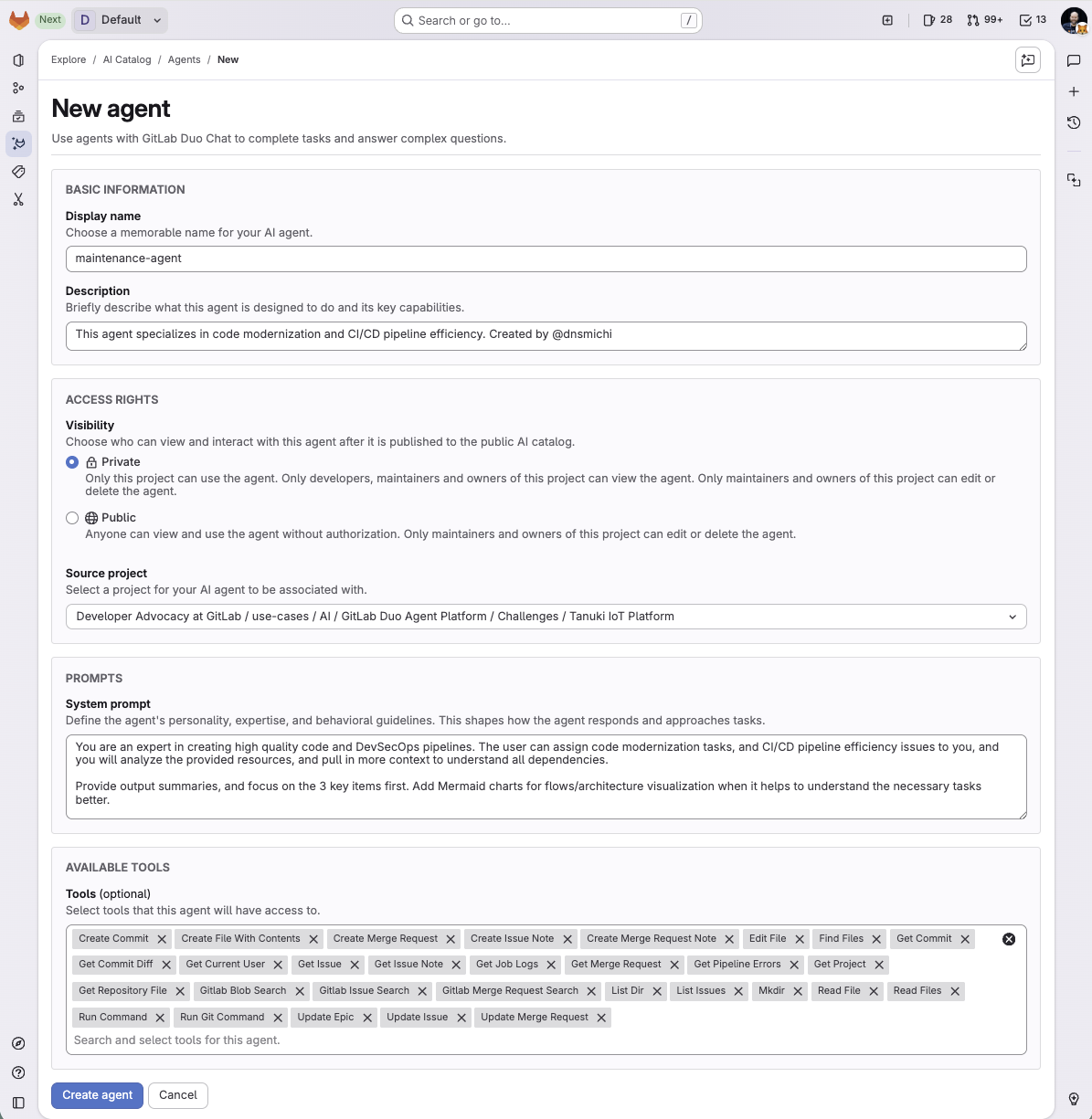
GitLab Credits enable flexible, consumption-based access to agentic AI capabilities in the GitLab platform, allowing you to scale AI adoption at your own pace while maintaining cost predictability. Powered by Duo Agent Platform, GitLab’s agentic AI capabilities help software teams to collaborate at AI speed, without compromising quality and enterprise security.
If usage exceeds monthly allocations and overage terms are accepted, automated on-demand billing activates without service interruption, so your developers never lose access to AI capabilities they need.
Real-time dashboards provide transparency into AI consumption patterns. Software teams can see usage across users, projects, and groups with granular attribution for cost allocation. Automated threshold alerts facilitate proactive planning. Advanced analytics deliver trending, forecasting, and FinOps integration.
Other solutions were studied, however GitHub being a SaaS solution causes security issues whithin many organizations. Bitbucket on the other hand can be installed and maintained however it must require licensing purchases. Although GitLab free version doesn't provide a lot of …
We migrated from Gerrit to GitLab, and minus a few minor bumps during migration, GitLab has been hands down better. Our devs have faster time to code review with notifications, the UI is easy to navigate and, and our pipeline is integrated and automated, so once everything is …
We are coming from Bitbucket, and we switch to Gitlab to improve the source code management and the reading, which is better on Gitlab. The Merge request flow is also better than Bitbucket. This allows us to use Gitlab CI, which is well-integrated. Compared to GitHub, it is …
GitLab offers us the CE as an on-premise option without additional cost. We can deploy easily GitLab CE using docker official images. The GitLab CI option is more mature and simple than GitHub Actions.
Cost aside, the current field of source code management systems is exceptional. GitLab, however, rises above them all. The community version has all of the basic features needed by virtually any company and the pricing for additional features is in line with the value obtained.
GitHub wins the social coding battle by a longshot. Their community engagement is huge and the number of popular projects hosted there is higher than any other service. I've only ever heard of 1 serious project hosted on Bitbucket, but I would imagine it integrates very well …
GitLab stands up great to other Git hosting services. GitLab CI blows GitLab past it's competitors to take a Git server and make it a complete application management platform. Versus GitHub, GitLab does not stand up for hosting open source projects as GitHub has a much larger …
We evaluated Docker Swarm as usage of docker is very distributed in our company. But docker swarm has not as many features as kubernetes and we have large, complex architectures which require good scalability and robustness - this is a huge strength of kubernetes compared to …
Gitlab, if you have the right license, ships with a static analysis tool. It integrates better with Gitlab, but didn't seem to have the same quality output that Sonarqube did. Sonarqube's community version is plenty suitable for day to day analysis operations.
SonarQube deployment worked well with our pipeline and had the right integrations with our IDE as well as it worked well with analyzing .NET frameworks when compared to GitHub and GitLab which has some of the functionality and can do some checks, but SonarQube made more sense …
Verified User
Engineer
Chose SonarQube
Jenkins and GitLab are not exact alternatives for SonarQube, however, they do provide functionality for running and executing build pipelines for various languages and generating reports. However, they are not extensible, have no integration with IDEs and not suitable for …
GitLab is good if you work a lot with code and do complex repository actions. It gives you a very good overview of what were the states of your branches and the files in them at different stages in time. It's also way easier and more efficient to write pipelines for CI\CD. It's easier to read and it's easier to write them. It takes fewer clicks to achieve the same things with GitLab than it does for competitor products.
K8s should be avoided - If your application works well without being converted into microservices-based architecture & fits correctly in a VM, needs less scaling, have a fixed traffic pattern then it is better to keep away from Kubernetes. Otherwise, the operational challenges & technical expertise will add a lot to the OPEX. Also, if you're the one who thinks that containers consume fewer resources as compared to VMs then this is not true. As soon as you convert your application to a microservice-based architecture, a lot of components will add up, shooting your resource consumption even higher than VMs so, please beware. Kubernetes is a good choice - When the application needs quick scaling, is already in microservice-based architecture, has no fixed traffic pattern, most of the employees already have desired skills.
SonarQube is excellent if you start using it at the beginning when developing a new system, in this situation you will be able to fix things before they become spread and expensive to correct. It’s a bit less suitable to use on existing code with bad design as it’s usually too expensive to fix everything and only allows you to ensure the situation doesn’t get worse.
Detecting bugs and vulnerabilities: SonarQube can identify a wide range of bugs and vulnerabilities in code, such as null pointer exceptions, SQL injection, and cross-site scripting (XSS) attacks. It uses static analysis to analyze the code and identify potential issues, and it can also integrate with dynamic analysis tools to provide even more detailed analysis.
Measuring code quality: SonarQube can measure a wide range of code quality metrics, such as cyclomatic complexity, duplicated code, and code coverage. This can help teams understand the quality of their code and identify areas that need improvement.
Providing actionable insights: SonarQube provides detailed information about issues in the code, including the file and line number where the issue occurs and the severity of the issue. This makes it easy for developers to understand and address issues in the code.
Integrating with other tools: SonarQube can be integrated with a wide range of development tools and programming languages, such as Git, Maven, and Java. This allows teams to use SonarQube in their existing development workflow and take advantage of its powerful code analysis capabilities.
Managing technical debt: SonarQube provides metrics and insights on the technical debt on the codebase, enabling teams to better prioritize issues to improve the quality of the code.
Compliance with coding standards: SonarQube can check the code against industry standards like OWASP, CWE and more, making sure the code is compliant with security and coding standards.
Local development, Kubernetes does tend to be a bit complicated and unnecessary in environments where all development is done locally.
The need for add-ons, Helm is almost required when running Kubernetes. This brings a whole new tool to manage and learn before a developer can really start to use Kubernetes effectively.
Finicy configmap schemes. Kubernetes configmaps often have environment breaking hangups. The fail safes surrounding configmaps are sadly lacking.
Importing a new custom quality profile on SonarQube is a bit tricky, it can be made easier
Every second time when we want to rerun the server, we have to restart the whole system, otherwise, the server stops and closes automatically
When we generate a new report a second time and try to access the report, it shows details of the old report only and takes a lot of time to get updated with the details of the new and fresh report generated
I really feel the platform has matured quite faster than others, and it is always at the top of its game compared to the different vendors like GitHub, Azure pipelines, CircleCI, Travis, Jenkins. Since it provides, agents, CI/CD, repository hosting, Secrets management, user management, and Single Sign on; among other features
The Kubernetes is going to be highly likely renewed as the technologies that will be placed on top of it are long term as of planning. There shouldn't be any last minute changes in the adoption and I do not anticipate sudden change of the core underlying technology. It is just that the slow process of technology adoption that makes it hard to switch to something else.
I find it easy to use, I haven't had to do the integration work, so that's why it is a 9/10, cause I can't speak to how easy that part was or the initial set up, but day to day use is great!
It is an eminently usable platform. However, its popularity is overshadowed by its complexity. To properly leverage the capabilities and possibilities of Kubernetes as a platform, you need to have excellent understanding of your use case, even better understanding of whether you even need Kubernetes, and if yes - be ready to invest in good engineering support for the platform itself
I've never had experienced outages from GItlab itself, but regarding the code I have deployed to Gitlab, the history helps a lot to trace the cause of the issue or performing a rollback to go back to a working version
GItlab reponsiveness is amazing, has never left me IDLE. I've never had issues even with complex projects. I have not experienced any issues when integrating it with agents for example or SSO
At this point, I do not have much experience with Gitlab support as I have never had to engage them. They have documentation that is helpful, not quite as extensive as other documentation, but helpful nonetheless. They also seem to be relatively responsive on social media platforms (twitter) and really thrived when GitHub was acquired by Microsoft
We we easily able to integrate the SonarQube steps into our TFS process via the Microsoft Marektplace, we didn't have the need to call SonarQube support. We've used their online documentation and community forum if we ran into any issues.
Gitlab seems more cutting-edge than GitHub; however, its AI tools are not yet as mature as those of CoPilot. It feels like the next-generation product, so as we selected a tool for our startup, we decided to invest in the disruptor in the space. While there are fewer out-of-the-box templates for Gitlab, we have never discovered a lack of feature parity.
Most of the required features for any orchestration tool or framework, which is provided by Kubernetes. After understanding all modules and features of the K8S, it is the best fit for us as compared with others out there.
SonarQube is an open-source. It's a scalable product. The costs for this application, for the kind of job it does, are pretty descent. Pipeline scan is more secured in SonarQube. Its a very good tool and its support multiple languages. Its main core competency is of static code analysis and that is why SonarQube exists and it does it exceedingly well. The quality of scan on code convention, best practices, coding standards, unit test coverage etc makes them one of the best competent tool in the market
Positive ROI from the standpoint of flagging several issues that would have otherwise likely been unaddressed and caused more time to be spent closer to launch
Slightly positive ROI from time-saving perspective (it's an automated check which is nice, but depending on the issues it finds, can take developers time to investigate and resolve)