Flutter is an open-source mobile application development framework created by Google. It is used to develop applications for Android and iOS, as well as being the primary method of creating applications for Google Fuchsia.
$0
Selenium
Score 8.4 out of 10
N/A
Selenium is open source software for browser automation, primarily used for functional, load, or performance testing of applications.
N/A
Tricentis Tosca
Score 8.9 out of 10
N/A
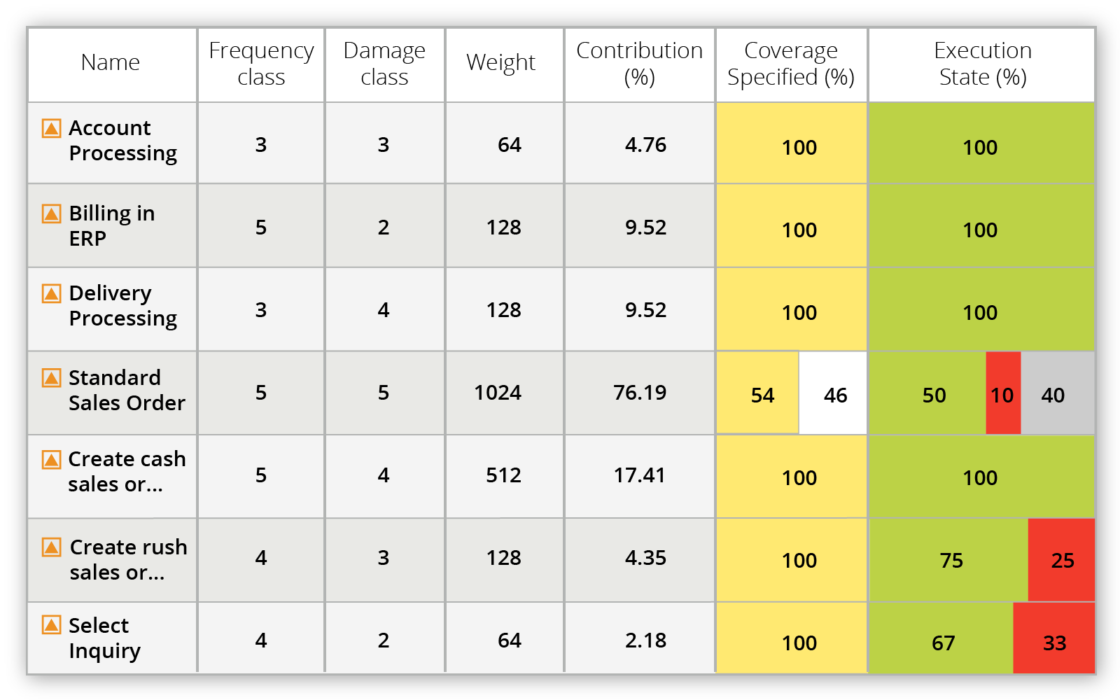
Tricentis Tosca provides an approach to test
automation that is AI-powered, codeless, and end-to-end so it can test
everything in a complex IT landscape, to ensure business processes
work flawlessly no matter where changes occurs.
Its 160+ technology support helps users test everything at
the UI, API and data layer, including virtually any enterprise, custom,
homegrown and mobile application.
With its model-based approach, Tosca enables business,
QA and IT teams to…
I have not used Dev Express Universal and Selenium Web Driver much besides in the demos that were provided to our company. We compared the demos and went with Google Flutter because it worked well and looked noticeably better than the other products. While I am unsure of the …
Customers are always spending less cost on tools and prefer open-source tools which leverage all applications Can be tailored your framework in selenium according to application Moreover CI/CD pipeline is easy in selenium compared to other tools Can be built custom test …
UFT is a paid tool from microfocus and able to automated alomsts all platforms but there is Fee for licensed versions software. TOSCA is also a paid tool from Tricentis which does not require coding skills from tester and implements mode based automation. where as selenium is …
I have really minimum exposure with QTP and ALM, barely 2 months or so, for this reason I would not like to comment on how Tosca stacks up against them, but something that I really like about Selenium is that it is really simple and easy to setup, doesn't require a heavy …
Even though Selenium is open source tool we have lot restriction in Selenium. Using Selenium we can automate only web based application. If we need to automate other application we work with other tools. Maintenance of Selenium code is complex when compare to Tricentis Tosca. …
Micro Focus UFT requires coding skills. Worksoft supports SAP very well but web app automation was challenging. Provar is only for Salesforce automation. Selenium required an automation engineer with Java knowledge and framework dependency. Tricentis Tosca did not require any …
UFT was mostly record and replay and Tricentis Tosca best fit our purpose as it was easier to create modules and make quick changes when needed. Overall easier and quicker to make changes to our existing test cases. therefore we haven't used UFT anymore.
As Tricentis Tosca is one of the first tools to implement the model based test automation, it is way ahead of the similar kind of tools. be it creating and innovating new strategies to overcome the existing hurdles faced during automation like, self healing feature is quite …
As our product required wide rage of testing start from web testing to desktop automation also, we gone through the feature provided by Tosca and decided it will be good fit for end to end automation. Even though from our team no one is aware of how to use the tools, the guide …
Tricentis Tosca provides a uniform interface for al testers and avoids the requirement for coding. Tricentis Tosca also offers test capabilities across the enterprise that other tools do not.
Mostly the ease of use from day one by introducing the no-code approach for teams with non-technical contributors. Also, the amount of technologies it covers is greater than other tools that are specialized in web-only or API, for example.
Flutter by Google is well suited where you have to make an app across multiple platforms like iOS, Android, Web, Desktop and you don't have the bandwidth to create multiple teams for the Native app. This makes sure you have a faster development and you don't have to worry about how your product will look across different platforms. It is also very smooth/fast in response, making it close to feel like a Native app, this makes it an easy pick for a Fintech product where speed matters. Flutter by Google also has a huge library of Components, which are well tested and developed by Google's Flutter by Google team itself, making the development even more fast since the majority of required components are already available.
When you have to test the UI and how it behaves when certain actions are performed, you need something that can automate the browsers. This is where Selenium comes to the rescue. If you have to test APIs and not the frontend (UI), I would recommend going with other libraries that support HTTP Requests. Selenium is good only when you have no choice but to run the steps on a browser.
For projects having huge set of test cases to be automated can be accommodated by Tricentis Tosca with proper folder structure and best practices implementations. Tosca will be less appropriate for organizations where the number of automation scripts are limited with hardly any scope of increasing the script count or the cost of automation will be more than the cost of having manual resources as Tosca is a licensed tool.
Occasionally updates to the Flutter SDK result in wide-sweeping changes that seem to not be thoroughly tested and considered. Flutter sometimes evolves too fast for its own good.
While the 3rd-party Flutter package ecosystem is vast and rich, 1st-party support for basic things (audio/video playback, battery information, Bluetooth services, etc.) are lacking. You are occasionally forced to rely on an open-source package for use-cases that other platforms have native support for.
Documentation, particularly around testing, is lacking. While there are some great docs, like the Dart Style Guide, many Flutter-focused support documents are lacking in quality and real-world usability.
Flutter allows you to architect an app however you want. While this is a great feature, it also adds complexity and leads to the current state of Flutter's state management, where there are 50+ options on how to organize your app, with very little official guidance or recommendations from the Flutter team. For a beginner, this can create decision paralysis.
Selenium is pretty user-friendly but sometimes tests tend to flake out. I'd say roughly one out of twenty tests yields a false positive.
Selenium software cannot read images. This is a minor negative because a free plug-in is available from alternate sources.
Slowness may be a minor factor with Selenium, though this is an issue with basically any testing software since waiting on a site to execute JavaScript requires the browser to wait for a particular action.
Documentation - struggled multiple times with features not explained very well, or not explained at all
The only support is on Tricentis Forums, where, sometimes, based on 'luck' - you will open a support case, and wait few days until you get the chance to speak with someone from Tricentis and show case your issue
We love this product mainly because of its high customization abilities and the ease of use. Moreover, its free and can be learned easily through online communities and videos. The tests are more consistent and reliable as compared to Manual tests. It has enabled us to test a large number of features all in one go, which would have impossible through manual tests. The reports generated at the end of the tests are really helpful for the QA and the development teams to get a fair view of the application.
Tricentis Tosca has consistently delivered value through its model‑based, low‑code automation, strong SAP ECC/S/4HANA and Fiori support, and the ability to reuse test assets across regression, upgrades, and transformation projects. Its coverage across SAP, Web, APIs, and desktop within a single platform reduces tool sprawl and maintenance effort, while features like risk‑based testing, CI/CD integration, and business‑readable tests align well with our quality and release goals
Flutter by Google is very easy to start with. The initial setup they provide is very helpful and easy to understand. The default project setup is also good and can be deployed to production without changing much. Flutter by Google provides a huge library of components, which are created and tested by their own team, making the development of application much faster and robust. Flutter by Google also has a huge community support where we can find components built by the community and we can contribute our own components as well, which helps in faster dev time. Applications developed using Flutter by Google are very smooth, almost feels like native, which helps in creating good impression on customers/clients.
For those who are unfamiliar with coding, there is a bit of a learning curve. There is plenty of helpful documentation and resources but it can take a little time to get the software up and running. Once you get the hang of how Selenium works, and what it can do, you realize how many things you can use it for, and how many processes you can automate.
It can be a challenge for new users who have never used an automation tool. For example, it is hard to understand the layout of the screen and where to find how to update the data. The interface can be overwhelming at first.
The Selenium app has a pretty fat community of users. For the problems we are experiencing, we are primarily receiving support from these communities. In addition, there is widespread service support. Instant support is given to the problems we experience when we need Online support. We and our team are happy to provide this support, especially before important deployment processes
Tricentis team was very supportive. Support is expensive but they helped us at many level. Setting up timeline, implementation, precise questions on automation challenges. We had an account manager and technical people we could as to talk to. Support was generally timely and helping. They often proposed to come on site to help us which would cost more but could be helpful
It would be better if the support is betterIt would be better if the support is betterIt would be better if the support is betterIt would be better if the support is betterIt would be better if the support is betterIt would be better if the support is betterIt would be better if the support is betterIt would be better if the support is betterIt would be better if the support is betterif the support is betterIt would be better if the support is betterIt would be better if the support is betterif the support is betterIt would be better if the support is betterIt would be better if the support is betterif the support is betterIt would be better if the support is betterIt would be better if the support is betterif the support is betterIt would be better if the support is betterIt would be better if the support is betterif the support is betterIt would be better if the support is betterIt would be better if the support is betterif the support is betterIt would be better if the support is betterIt would be better if the support is betterif the support is betterIt would be better if the support is betterIt would be better if the support is betterif the support is betterIt would be better if the support is betterIt would be better if the support is betterif the support is betterIt would be better if the support is betterIt would be better if the support is betterif the support is betterIt would be better if the support is betterIt would be better if the support is betterif the support is betterIt would be better if the support is betterIt would be better if the support is betterif the support is betterIt would be better if the support is betterIt would be better if the support is betterif the support is betterIt would be better if the support is betterIt would be better if the support is betterif the support is betterIt would be better if the support is betterIt would be better if the support is betterif the support is betterIt would be better if the support is betterIt would be better if the support is betterif the support is betterIt would be better if the support is betterIt would be better if the support is betterif the support is betterIt would be better if the support is betterIt would be better if the support is betterif the support is betterIt would be better if the support is betterIt would be better if the support is betterif the support is betterIt would be better if the support is betterIt would be better if the support is better
okIt would be better if the support is betterIt would be better if the support is betterIt would be better if the support is betterIt would be better if the support is betterIt would be better if the support is betterIt would be better if the support is betterIt would be better if the support is betterIt would be better if the support is betterIt would be better if the support is betterIt would be better if the support is better
We did everything we needed to use it. Now we can execute our tests on different operational systems and browsers running few tests simultaneously. We also implemented Appium framework to execute our tests on mobile devices, such as iPhones, iPads, Android phones and tablets. We use SauceLabs for our test execution and Jenkins for continuous integration.
I have experience with react and React Native. I would say that the idea behind all those frameworks are quite similar. However, I found the javascript-based frameworks a bit more accessible as you could utilise your javascript knowledge. Here, Flutter works with its own language. This has advantages and disadvantages sometimes. I found the community around javascript frameworks bigger and therefore sometimes more helpful. However, Flutter does a good job here as well. I think the main argument for Flutter is its usability for less experienced developers. If you do not have knowledge in javascript or other programming languages then I think it is much easier to start with Flutter than with another framework like react. I think the package that you get form scratch is better than in the other frameworks were you have to set up and learn a lot more before you can start.
At the time of adoption, there were not many other alternatives that were even close to being competitive when it comes to browser testing. As far as I know now to this day, there is still little competition to Selenium for what it does. Any other browser-based testing still utilises Selenium to interact with the browser.
Tricentis Tosca is codeless and therefore easier to use. It's a great tool for people that would start doing automation and have no coding background. It seems like it has the same capabilities as other test automation suites but I felt it lacked a bit of capabilities on the test management suite such as defects test suites organizations etc
The rapid development capabilities of Flutter allow us to build apps we could not have previously considered commercially viable, opening new revenue streams.
Free and open licensing made adoption very easy (ie. free/low cost!).
In comparison to Qt, our time spent arguing with build tools and perfecting development environments has decreased substantially.
It really had a very good impact on our ROI. We were able to automate most of the apps and layers with in it and get a very short execution time which led to increased releases with in short span of time.
Time to market really improved and efficiency of developing scripts was not too bad.
With built in test dashboards, it was easy to pull metrics and share the insights with management.