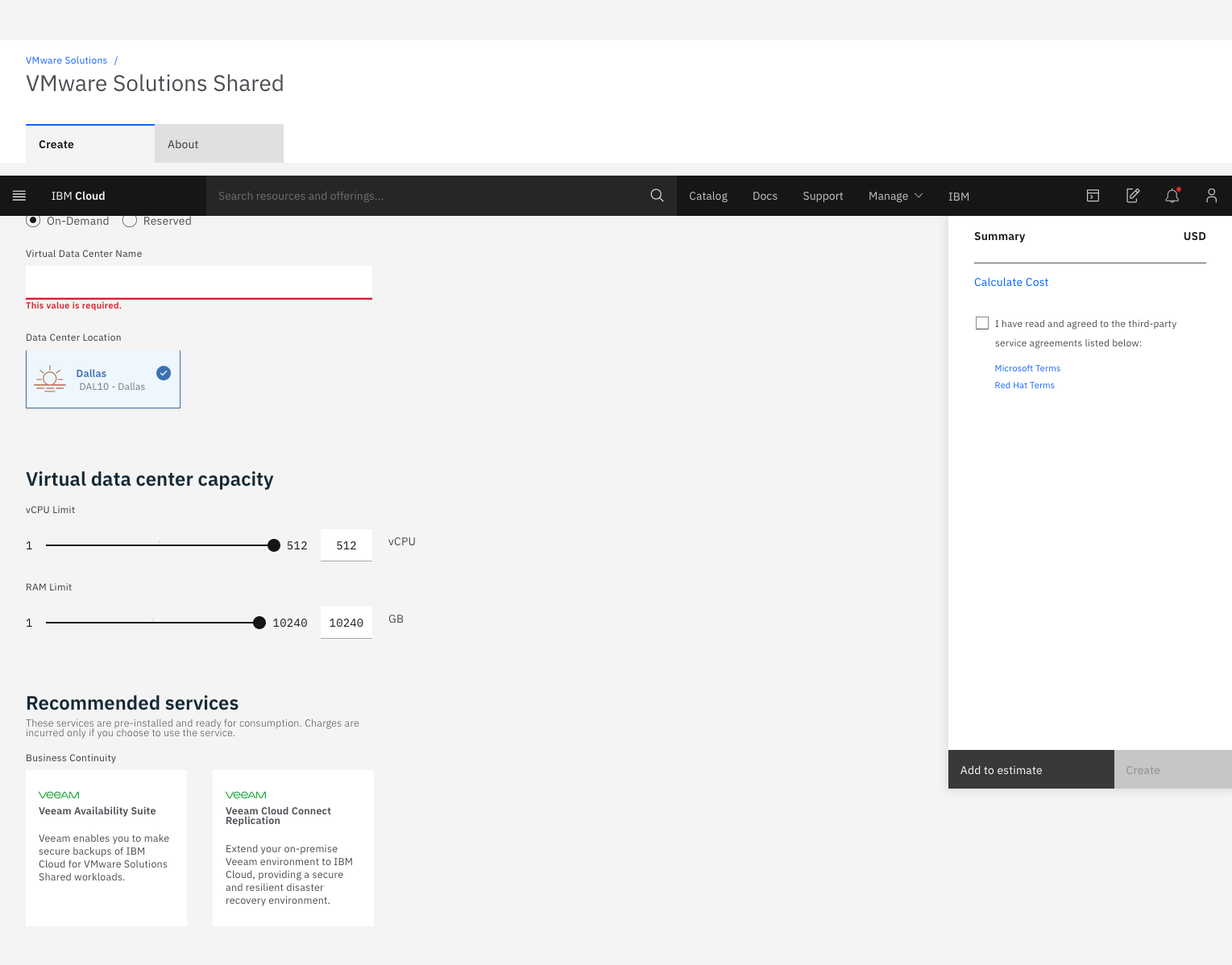
IBM Cloud for VMware
Solutions is designed to make cloud adoption easier, allowing the user to optimize the
value of existing on-premises infrastructure, while leveraging the
same tools, technologies and skills in the cloud. The solution provides rapid scalability,
deployment in 35+ global data centers and access to disaster
recovery, backup, security and compliance solutions from an array of ecosystem
partners. To address varying workload needs, IBM Cloud…
$0
IBM Cloud Object Storage Cross-Regional Smart Tier 1 GB (hourly)
Oracle Linux
Score8.3 out of 10
N/A
Oracle Linux, which is application binary compatible with Red Hat Enterprise Linux, is free to download, use, and share. There is no license cost, no need for a contract, and no usage audits. 24/7 enterprise-grade support is available for business critical environments. A single support offering includes virtualization, management, HA, and cloud native computing tools such as Kubernetes and Kata Containers, along with the Linux operating system. The vendor states that as the only Linux…
$0
per month
Pricing
IBM Cloud for VMware Solutions
Oracle Linux
Editions & Modules
Add-on
$0
IBM Cloud Object Storage Cross-Regional Smart Tier 1 GB (hourly)
On-demand
$0
0.25 IOPs 1 GB
Reserved (monthly or 730 hours)
$0
0.25 IOPs 1 GB (Per gigabyte of storage (hourly))
Add-on
$0
IBM Cloud Block Storage 1 GB (hourly)
On-demand
$0.01
Per vCPU (hourly)
On-demand
$0.09
Per gigabyte of network and bandwidth egress (monthly)
Reserved (monthly or 730 hours)
$0.09
Per gigabyte of network and bandwidth egress (monthly)
VMware Cloud Foundation for Disaster Recovery environment, when the client needs to deploy a pay-as-you-go service or if they need to migrate SAP workloads, you can use VMware Cloud Foundation for Classic and VPC. We are the unique SAP-Certified VMware cloud service provider.
A de minimis incentive was given to thank the reviewer for their time. The incentive was not used to bias or drive a particular response, nor was the incentive contingent on a positive endorsement. More Info
Oracle Linux is a very good and useful combination of the stability of Rhel and support for Oracle Databases. Our organisation uses an application and a database combo that we offer to the client but after the inclusion of Oracle Linux into our infrastructure, the provision and the operation cost are reduced significantly. So I would recommend using Oracle Linux when you are using multiple on-premises DB servers and want to move to a more secure, organised, and fast operating system.
A de minimis incentive was given to thank the reviewer for their time. The incentive was not used to bias or drive a particular response, nor was the incentive contingent on a positive endorsement. More Info
The presentation is first rate. Our on-prem climate was continually experiencing slack and general languor. With IBM running everything, it's much smoother.
Start another group as little as one ESXi worker or scale a current bunch.
A de minimis incentive was given to thank the reviewer for their time. The incentive was not used to bias or drive a particular response, nor was the incentive contingent on a positive endorsement. TR verified that a representative sample of customers was invited. More Info
We use Oracle Linux distro for every customer. The OS is very easy and absolutely free to develop/host and update our customers' apps and data across the globe. I personally use it in my lab to practice and test some personal stuff
We have Oracle Linux database, WebLogic, and e-business suite hosted on Oracle Linux. It is used across our whole organization in running critical applications. It is robust, easy to manage and administer, with rock-solid stability and very minimal server reboots or performance issues. I would highly recommend Oracle Linux over other operating systems.
Oracle Linux is trusted in high-volume, transactional, mission-critical production IT environments.
Oracle’s Linux support is relied upon for applications that require continuous or near-continuous availability
Application performance in general was enhanced as a result of the migration to Oracle Linux from Red Hat Enterprise Linux.
Oracle Linux-based VMs are used in our case for hosting a spark-based cluster for processing big data-based workloads. Those VMs have better security configurations and are patched. It has built-in installed packages which come in handy for a developer to start the development activity for the project.
We are using Oracle Linux as our primary Linux distribution deployed for our customers, but also for testing purposes on multiple test and UAT environments. Currently, it is used mainly by our department. We aim to provide commercial technical support for customers for our products, and thanks to the Oracle Linux Support program which covers Oracle Linux, we are getting assistance if needed.
I work across many different types of organizations. In some cases, Oracle Linux is being used for all database servers across the entire organization. In some cases, it is being selectively rolled out to replace legacy Unix systems. Plus in a few isolated cases, I've helped to replace Windows database servers with Oracle Linux. The common theme across all these different types of organizations is that they want the best Linux for running Oracle, which is pre-tuned and optimized as well as well supported by the database vendor. Oracle Linux wins hands down on these points.
A de minimis incentive was given to thank the reviewer for their time. The incentive was not used to bias or drive a particular response, nor was the incentive contingent on a positive endorsement. More Info
A de minimis incentive was given to thank the reviewer for their time. The incentive was not used to bias or drive a particular response, nor was the incentive contingent on a positive endorsement. TR verified that a representative sample of customers was invited. More Info
A de minimis incentive was given to thank the reviewer for their time. The incentive was not used to bias or drive a particular response, nor was the incentive contingent on a positive endorsement. TR verified that a representative sample of customers was invited. More Info
It is easy to use and setting it up is simple. The only con is that the pricing is a little bit high as well as documentation is a little low; so we had to do some personal learning to be able to fully utilize the product, or hop on the phone with someone.
A de minimis incentive was given to thank the reviewer for their time. The incentive was not used to bias or drive a particular response, nor was the incentive contingent on a positive endorsement. TR verified that a representative sample of customers was invited. More Info
Overall, just a great experience here. No one in my opinion gets a perfect 10/10 rating (no one is ever perfect), so 9/10 is probably as good as it gets! From initial planning to post implementation support, the IBM Cloud and professional services has been there for my group as much as we have needed them. Great job!
A de minimis incentive was given to thank the reviewer for their time. The incentive was not used to bias or drive a particular response, nor was the incentive contingent on a positive endorsement. More Info
One of the most robust Linux distributions is Redhat, its forks have given rise to infinite business models and distributions that have defined the market. Oracle Linux, obviously developed by the tech giant Oracle, is constantly releasing a flexible and incredibly stable product while adding its own bunch of new features. Among the most notable is the "Unbreakable Enterprise Kernel" (UEK).
A de minimis incentive was given to thank the reviewer for their time. The incentive was not used to bias or drive a particular response, nor was the incentive contingent on a positive endorsement. TR verified that a representative sample of customers was invited. More Info
IBM professional services helped us plan and implement the project with great success. They guided the project from planning, scoping, pre-implementation, testing, roll-out, then production and post-production support. We were very impressed with their knowledge of VMware and really appreciated their desire to make our project a success. I would highly recommend them!
A de minimis incentive was given to thank the reviewer for their time. The incentive was not used to bias or drive a particular response, nor was the incentive contingent on a positive endorsement. More Info
IBM Cloud for VMware Solutions stacks up against them, we fully agree there are so many features in IBM cloud for VMware Solutions that make it unique and different. The system provides us hypervisor security level and the system even has live backup and storage capacity of data. This system provides us with accuracy that helps us to reduce errors and vulnerability.
A de minimis incentive was given to thank the reviewer for their time. The incentive was not used to bias or drive a particular response, nor was the incentive contingent on a positive endorsement. More Info
The Oracle Linux definitely comes on the top when it comes down to being easily available as its platform-independent. This is where the masses lie as we have moved to a hybrid work environment where keeping everyone on the same devices is no more required. Linux stands out as it allows the industry workers to implement BYOD in all environments. Software as a service is truly done by Linux. I don’t want to switch to other platforms anymore.
A de minimis incentive was given to thank the reviewer for their time. The incentive was not used to bias or drive a particular response, nor was the incentive contingent on a positive endorsement. TR verified that a representative sample of customers was invited. More Info
It has a positive impact on the cost required to maintain our vSphere environment by allowing us to get rid of our vsphere hardware and not worry about maintenance either.
There have been very few negatives, but one would definitely be the open-ended cost associated with cloud products in general.
A de minimis incentive was given to thank the reviewer for their time. The incentive was not used to bias or drive a particular response, nor was the incentive contingent on a positive endorsement. TR verified that a representative sample of customers was invited. More Info
A de minimis incentive was given to thank the reviewer for their time. The incentive was not used to bias or drive a particular response, nor was the incentive contingent on a positive endorsement. More Info