IBM MQ (formerly WebSphere MQ and MQSeries) is messaging middleware.
N/A
NGINX
Score9.1 out of 10
Mid-Size Companies (51-1,000 employees)
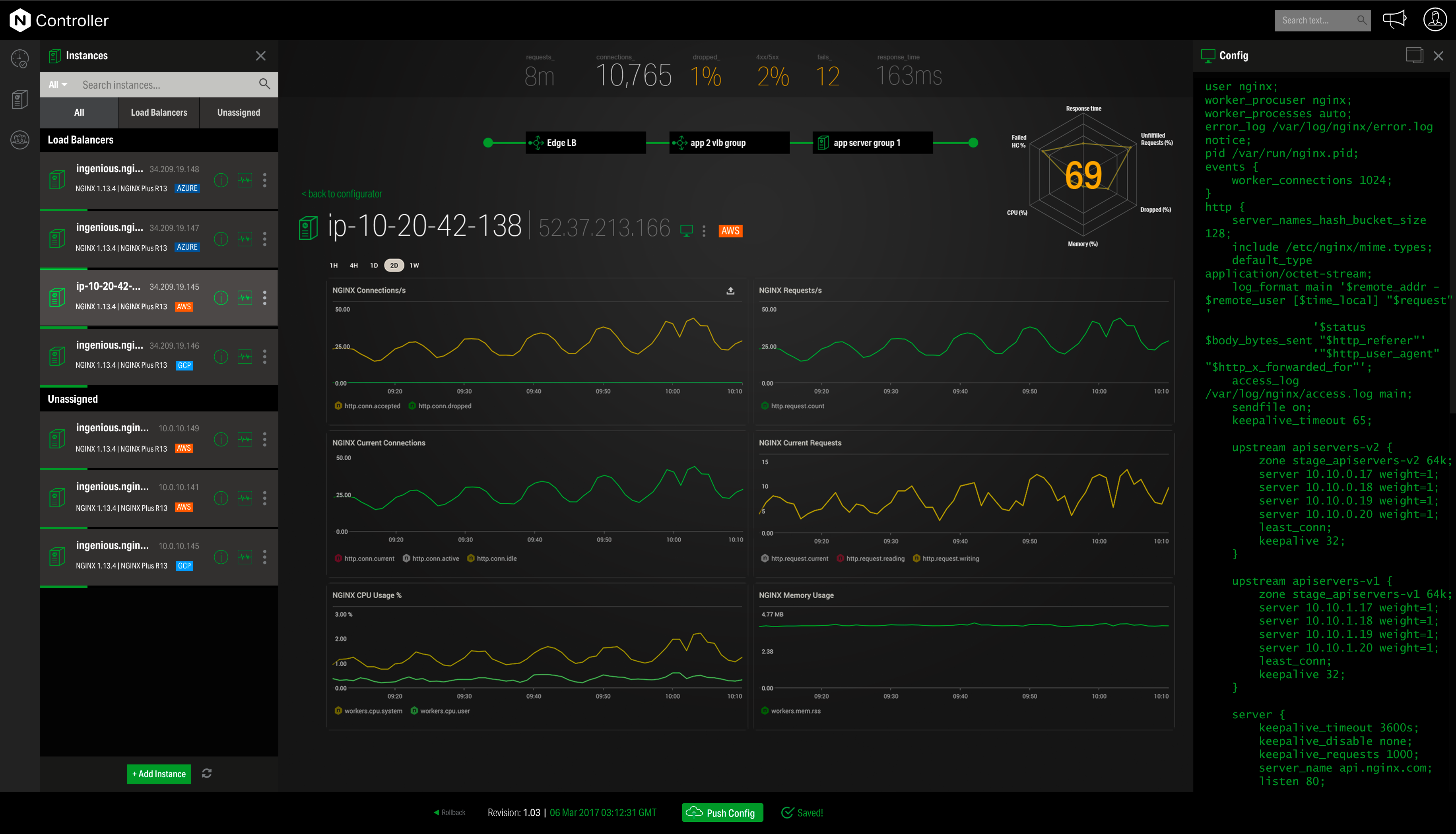
NGINX, a business unit of F5 Networks, powers over 65% of the world's busiest websites and web applications. NGINX started out as an open source web server and reverse proxy, built to be faster and more efficient than Apache. Over the years, NGINX has built a suite of infrastructure software products o tackle some of the biggest challenges in managing high-transaction applications. NGINX offers a suite of products to form the core of what organizations need to create…
In the context of Internet of Things (IoT) applications, IBM MQ plays a pivotal role in managing the substantial data streams emanating from interconnected devices. Its primary function is to guarantee the dependable transmission and processing of data, catering to a diverse range of IoT use cases, including but not limited to smart city initiatives, healthcare monitoring systems, and industrial automation solutions. In the telecommunications sector, IBM MQ is employed for message routing, call detail record (CDR) processing, and network management to ensure real-time data exchange and fault tolerance. When managing the supply chain and logistics, IBM MQ is used to ensure timely and accurate communication between different entities, including suppliers, warehouses, and transportation providers. IBM MQ can be cost-prohibitive for smaller organizations due to licensing and maintenance costs. In such cases, open-source or lightweight messaging solutions may be more appropriate. For scenarios requiring extremely low-latency, real-time data exchange, and high throughput, other messaging technologies, like Apache Kafka, may be more suitable due to their specialized design for such use cases.
A de minimis incentive was given to thank the reviewer for their time. The incentive was not used to bias or drive a particular response, nor was the incentive contingent on a positive endorsement. More Info
Nginx is well-suited for any web server scenarios, such as web applications, backend or reverse proxy for both application and HTTP requests, and distribution. It is less appropriate for Windows-based applications that run directly on a Windows Server host. In any case, it is very easy to manage, through separate conf files for each application or site you want to host with it.
A de minimis incentive was given to thank the reviewer for their time. The incentive was not used to bias or drive a particular response, nor was the incentive contingent on a positive endorsement. TR verified that a representative sample of customers was invited. More Info
The documentation is very clear,It is understandable and the support helps to configure it in the best way.
Server guidelines make it possible to get the most out of work management. It's broad, we can work with different operating systems, I really recommend using linux.
It is highly compatible with systems, brockers, applications, and data accumulation programs, it is possible to configure everything so that after the installation of programs, they can communicate with each other and then throw data to an external program that accumulates it and represents in clear details of steps to follow and make business decisions.
A de minimis incentive was given to thank the reviewer for their time. The incentive was not used to bias or drive a particular response, nor was the incentive contingent on a positive endorsement. More Info
A de minimis incentive was given to thank the reviewer for their time. The incentive was not used to bias or drive a particular response, nor was the incentive contingent on a positive endorsement. More Info
There is limitation on number of svrconn connections you can have to MQ on the mainframe which has been an major issue for us. This has been an issue for us for over 4 years and still no fix although I am aware IBM have been working on a solution over the last year.
When upgrading to MQ V9.3 on our MQ appliances there is no fall-back option. This was the same for MQ V9.2 upgrade from MQ V9.0. For production upgrades this I believe is not acceptable.
AMS is not supplied as part of the standard mainframe MQ licence. You need an extra licence. IBM tell customers how important security and protecting data is yet they still want to charge for this software. The cost of MQ on the mainframe is not cheap so I would expect AMS to be part of the base product.
A de minimis incentive was given to thank the reviewer for their time. The incentive was not used to bias or drive a particular response, nor was the incentive contingent on a positive endorsement. More Info
Customer support can be strangely condescending, perhaps it's a language issue?
I find it a little weird how the release versions used for Nginx+ aren't the same as for open source version. It can be very confusing to determine the cross-compatibility of modules, etc., because of this.
It seems like some (most?) modules on their own site are ancient and no longer supported, so their documentation in this area needs work.
It's difficult to navigate between nginx.com commercial site and customer support. They need to be integrated together.
I'd love to see more work done on nginx+ monitoring without requiring logging every request. I understand that many statistics can only be derived from logs, but plenty should work without that. Logging is not an option in many environments.
A de minimis incentive was given to thank the reviewer for their time. The incentive was not used to bias or drive a particular response, nor was the incentive contingent on a positive endorsement. More Info
I give it a nine because it has significantly improved my team's data reliability and operational efficiency. Its great security features give us peace of mind, knowing our sensitive data is well protected. While the setup might initially be complex, I believe the long-term benefits far outweigh this hurdle.
A de minimis incentive was given to thank the reviewer for their time. The incentive was not used to bias or drive a particular response, nor was the incentive contingent on a positive endorsement. More Info
This tool is really easy to use and configure. Consumes very less system resources. It is highly modular and configurable. You can easily use it with other tools like certbot for SSLs. You can configure basic security with configuration and headers
A de minimis incentive was given to thank the reviewer for their time. The incentive was not used to bias or drive a particular response, nor was the incentive contingent on a positive endorsement. TR verified that a representative sample of customers was invited. More Info
The messages are delivered instantly with this software and it integrates with our technology stack, in terms of availability we only had one failure when we were doing some testing and integration with third parties, the features of this software make it always available and its deployment is easy for the company, it does not generate expenses due to failures
A de minimis incentive was given to thank the reviewer for their time. The incentive was not used to bias or drive a particular response, nor was the incentive contingent on a positive endorsement. More Info
There are very specific things that must be elevated to more specialized areas of support, but the common support is very agile when receiving questions or when we leave concerns in real time. I recommend the support of the program in this regard.
A de minimis incentive was given to thank the reviewer for their time. The incentive was not used to bias or drive a particular response, nor was the incentive contingent on a positive endorsement. More Info
Community support is great, and they've also had a presence at conferences. Overall, there is no shortage of documentation and community support. We're currently using it to serve up some WordPress sites, and configuring NGINX for this purpose is well documented.
A de minimis incentive was given to thank the reviewer for their time. The incentive was not used to bias or drive a particular response, nor was the incentive contingent on a positive endorsement. More Info
We found IBM MQ very easy to get started and quick to learn by the new users with a short learning curve and seamlessly integrates with IBM products, and quick to perform self-service analytics and make informed business decisions. IBM MQ is also very straightforward in creating simple and best reports, which are very profitable and productive.
A de minimis incentive was given to thank the reviewer for their time. The incentive was not used to bias or drive a particular response, nor was the incentive contingent on a positive endorsement. More Info
I have found that [NGINX] seems to perform better throughout the years with less issues although I've used Apache more. I would definitely recommend [NGINX] for any high volume site and I've seen this to usually be the case from most provided web hosts who will pick [NGINX] over alternatives
A de minimis incentive was given to thank the reviewer for their time. The incentive was not used to bias or drive a particular response, nor was the incentive contingent on a positive endorsement. More Info
A de minimis incentive was given to thank the reviewer for their time. The incentive was not used to bias or drive a particular response, nor was the incentive contingent on a positive endorsement. TR verified that a representative sample of customers was invited. More Info
By using Nginx, we can host multiple web services on a single server, keeping our infrastructure costs lower.
Nginx maintains our HTTPS connections, allowing us to keep our promise to our customers that their data is safe in transit.
Due to Nginx's extremely low failure rate, our web addresses always return something meaningful, even when individual services go down. In sense, this means we are "always online" and allows us to maintain brand and support our customers even in the face of catastrophe.
A de minimis incentive was given to thank the reviewer for their time. The incentive was not used to bias or drive a particular response, nor was the incentive contingent on a positive endorsement. More Info