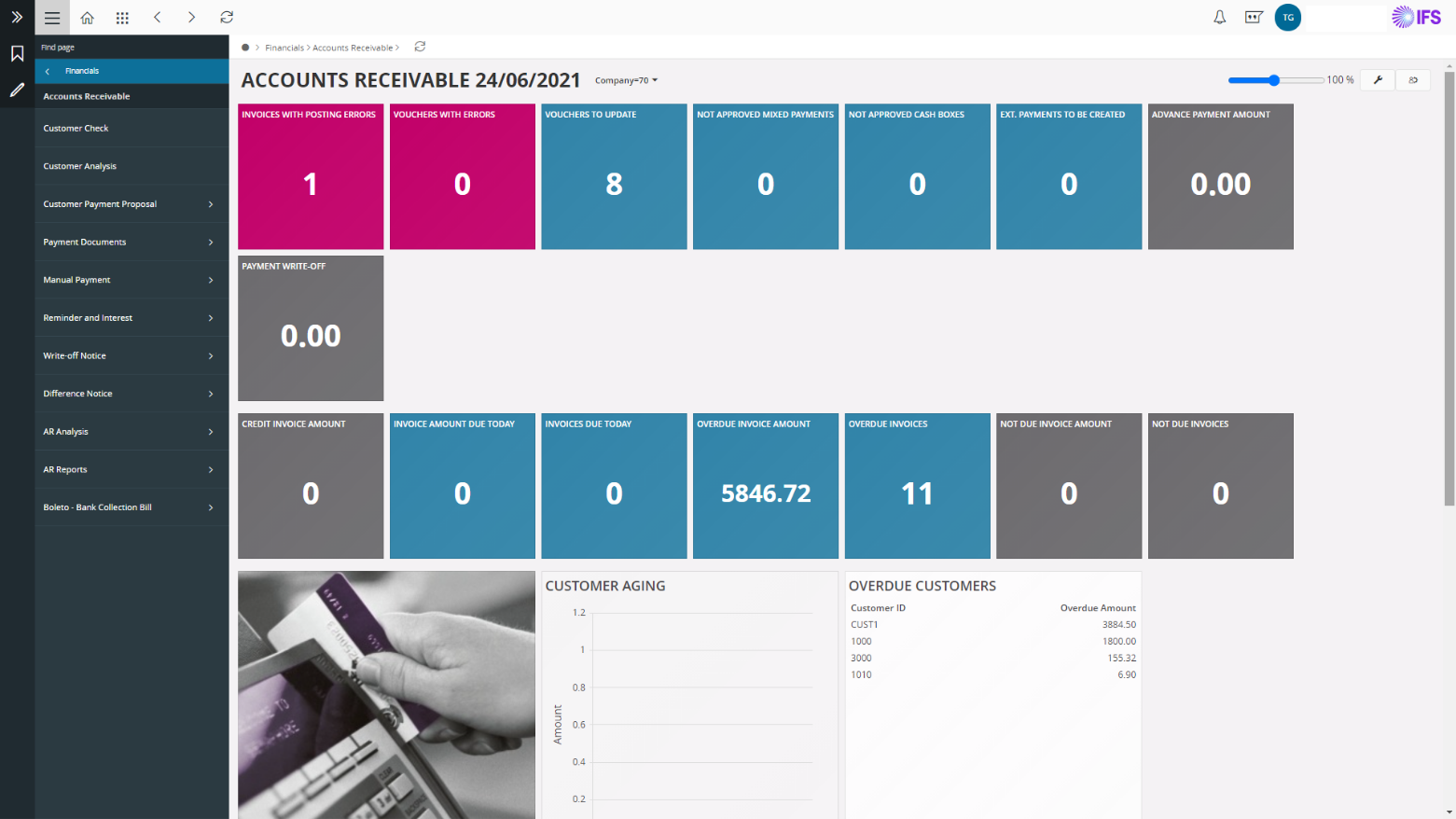
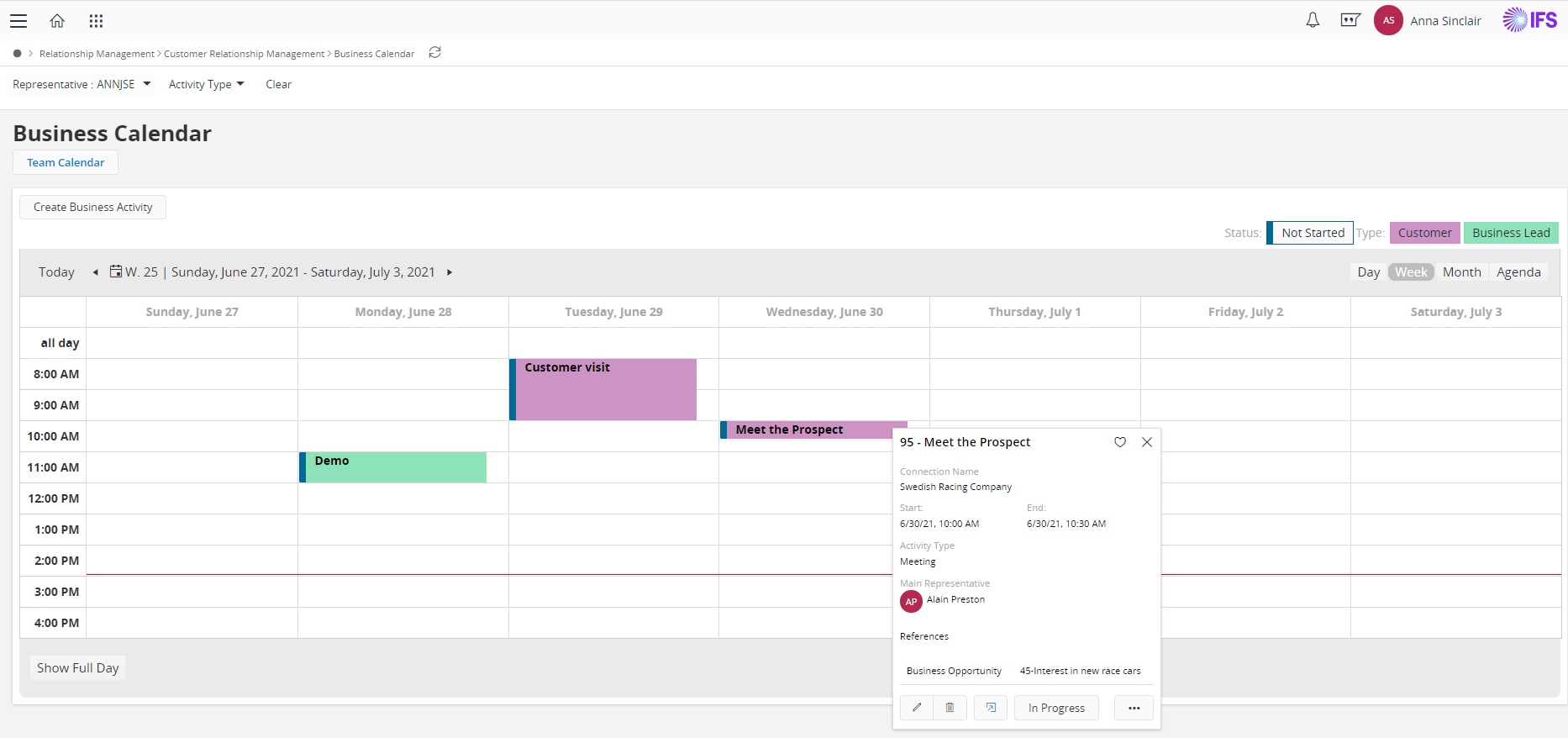
IFS Applications is presented by the vendor as an agile application suite that offers enterprise resource planning (ERP), enterprise asset management (EAM) and enterprise project management, handling 4 core processes: Service & Asset Management Full Enterprise Asset Management (EAM), Maintenance Repair and Overhaul (MRO) and Field Service Management (FSM) Manufacturing Enterprise Resource Planning (ERP) with support for process manufacturing, discrete manufacturing…
N/A
Sage 100cloud
Score 7.4 out of 10
Mid-Size Companies (51-1,000 employees)
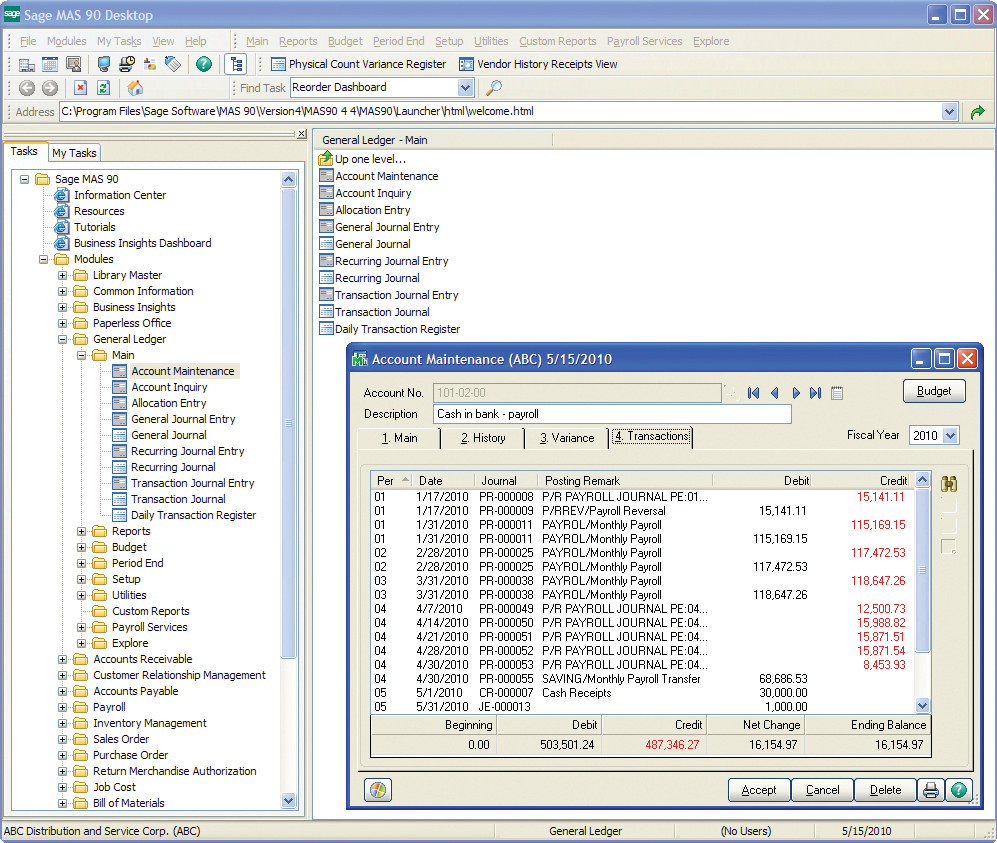
Sage 100 (or Sage 100cloud is a business management software offering a broad range of modules designed to meet the many needs of virtually any business. It encompasses financial operations and accounting, payroll, business intelligence, CRM, eBusiness, manufacturing and distribution.
IFS Applications have a very UI rich interface compared to other systems. IFS Applications can be easily and quickly learned with the very good documentation, e learning portals and other learning platforms. The technical implementation of the IFS Applications is very …
IFS Applications is based on Agile Technology which allows organizations to reconfigure user interface as per user requirements and make it user-friendly. Other applications are lagging on many fronts like User Interface, Online help document availability, Implementation …
Microsoft AX, QAD (in continuation of our previous ERP), Sage X3 was an out of the box ERP that was part of initial RFP.
We have chosen IFS based on the compromise between costs & budget, functionality, technical features, and feedback from similar customers that gave their …
We have used Foundation and it did not work out well, so we selected Sage 100 because the implementation and functionality was much better. We didn't have to keep coming up with workarounds or complications on Sage 100. Also the data security is better.
The system i used prior was custom built & was named "UV" - It was a very base level system that allowed users to navigate by typing prompts / number codes. While it did what it needed to do, It wasn't efficient as you'd be referencing your code book directory all day to find …
In my 15 years at this company, we have only used Sage100. Prior to purchasing Sage100, JobBoss was partially used; however, JobBoss did not integrate well with the general ledger, accounts payable and inventory of Sage100. Sage100 offers seamless integration of those …
Sage 100cloud has taken some time to get used to. It is not a user-friendly as some of the other software, but you can get the hang of it by using it enough. It provides a lot of accounting, inventory and customer data management for our company.
I didn't choose Sage 100 ERP -- it was already in use when I started at the organization over five years ago. It has the same types of pros and cons as other big hulking software suites meant to power the infrastructure of corporations. It's slow, tough to customize, and …
Sage 100 is much more robust and has an impeccable audit trail when compared to Quickbooks. Sage 100 also provides real time inventory management and manufacturing capabilities not provided in QB.
For the cost of the software and implementation, we knew we were getting a more robust software that we could grow with. Other software offerings would have had to be piece-meal solutions and created more difficulty integrating.
Verified User
Anonymous
Chose Sage 100cloud
Have not recently evaluated other systems. This was in use when I arrived. We have found no reason to change. It provides the information we need.
Sage 100 is far more user-friendly, easier smoother installation than Epicor. More robust and versatile than Quick Books. Does not require the technical overhead needed to run MD Great Plains.
I have used Blackbaud and MIP. Blackbaud is excellent for private schools and universities due to their tuition module. MIP is a strong nonprofit software product. Sage 100 ERP meets the organization's needs and made the transition less costly.
I didn't select Sage and wouldn't have selected it if given the opportunity. It was here when I came on board. We are currently in the process of migrating to Financial Edge.
The last 20 years I worked as a Sage consultant implementing Sage 100 for customers. Other systems I dealt with were: Quickbooks, MS Great Plains, Expandable, Accpac (now sage). Downgrades from Oracle and SAP
All three products are very good, but at some point reach their limits and Sage 100 ERP becomes a very good, easy to use, cost effective solutions. It is also more secure than QuickBooks or Sage 50.
I'm a VAR for multiple ERP packages and for the money Sage 100 can't be beat for distribution. For project accounting and advanced manufacturing I would go with another solution.
I've reviewed Accpac, Syspro, SAP Business 1 and Platinum. Sage is far easier to use and setup than Syspro and SAP Business 1. Generally speaking, most accounting software does the same thing, at the end of the day, how easy is it to modify data inside the system and review to …
Not every Enterprise Resource Planning (ERP) System does not cover all the industry verticals and all the functionalities and requirements for a specific industry as built-in features. Although IFS Applications does not completely cover all the requirements and all the industry verticals, it can be implemented for any industrial company with minimum configurations and customization, which is very good when implementing an ERP system. Since it supports web and mobile versions of the application as well, the users ind it easy to use.
For small and medium business in the distribution and light manufacturing space, Sage 100 is probably the best bang for your buck. As a very scaleable system, you can modify the system to meet the needs of a growing business without making gross changes to the core of the system
I would put this out to bid, if I were at the same organization. There have been a lot of improvements and changes in enterprise software and my preference would be to find a good web-based or cloud-based tool. Lower overall cost of ownership and improved efficiency would be my target criteria for a rebid of this.
In overall, the companies get many advantages, where we can forget most of the things which can be considered for room for improvement. The user interface is good. It supports mobile versions an has several mobile applications for specific areas with Android, IOS and Windows versions. It allows several deployment options such as remote hosting, IFS Cloud hosting and on-premise hosting of the servers. IFS Applications can be easily and safely integrated with other systems.
Overall Sage 100 has been pretty user friendly. If we have a question on anything, we are able to contact our implementation rep who helps us right away. Some of the Sage Field Operations may not be as intuitive for our field personnel to use. I wish the reports ran faster so that we could run and put together many reports quickly at once.
We have been unable to get answers to our questions, solutions to our problems, and they don't seem interested in working in the construction industry.
We use a local software technology partner to help support our Sage100 needs. We do not need much assistance with Sage100. There are very few issues or questions.
We had an advantage in implementing the tool in that our director of Ops had been part of the team implementing the ERP for other users so we knew what to expect and were able to avoid a lot of the challenges people sometimes face with implementations. However, the process still took far longer than desired.
Microsoft AX, QAD (in continuation of our previous ERP), Sage X3 was an out of the box ERP that was part of initial RFP. We have chosen IFS based on the compromise between costs & budget, functionality, technical features, and feedback from similar customers that gave their feedback. The project manager team and qualification level of technical or consultant teams were differentiating factors too. Finally IFS application was named in the Gartner’s mid-market ERP Magic Quadrant, along with SAP, and helped us to finalize our choice
We have used Foundation and it did not work out well, so we selected Sage 100 because the implementation and functionality was much better. We didn't have to keep coming up with workarounds or complications on Sage 100. Also the data security is better.
Sage 100 has allowed us to better serve & manage our customers since we integrated it into our system in 1996. Since then, we have seen a lot of changes but, the consistent, simple layout has kept us re-newing our contract year after year.
Ordering inventory has been easier than ever since we integrated inventory tracking. No more ordering too much or too little.