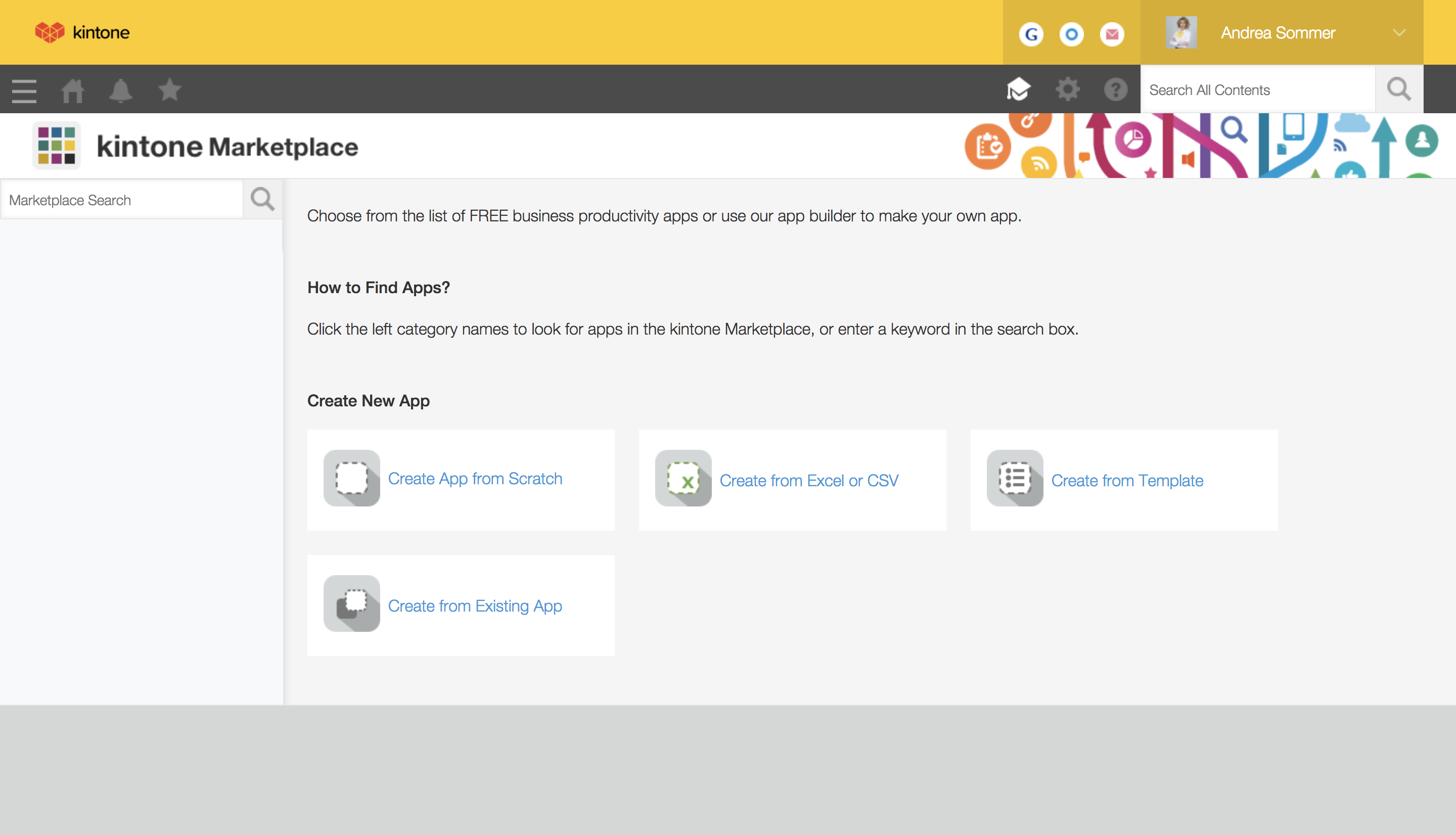
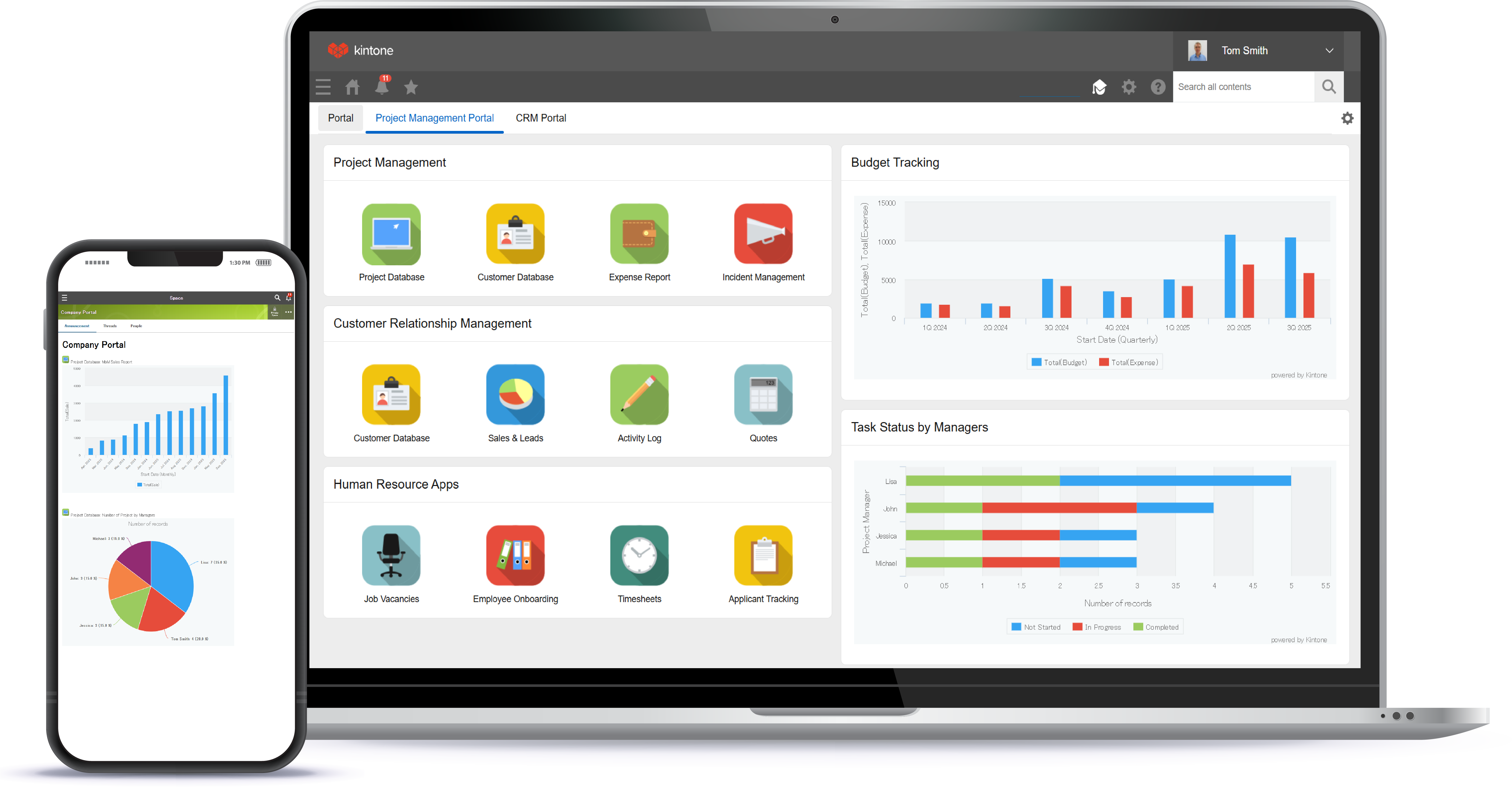
Kintone is a customizable digital workplace platform used to manage data, tasks, and communication. The no-code drag-and-drop interface can be used to create custom applications.
$24
per month per user
Mitratech TAP Workflow Automation
Score 7.5 out of 10
N/A
TAP Workflow Automation is a business process automation solution, enabling clients to digitize any workflow. The solution aims to improve efficiency, productivity, standardization, and compliance, as well as drive cost savings and time-to-value. TAP's drag-and-drop UI lets users build and deploy workflows without coding or IT involvement. TAP's open API enables clients to integrate into existing tools to drive automation across the organization.
N/A
Pricing
Kintone
Mitratech TAP Workflow Automation
Editions & Modules
Professional Subscription
$24
per month per user
No answers on this topic
Offerings
Pricing Offerings
Kintone
Mitratech TAP Workflow Automation
Free Trial
Yes
No
Free/Freemium Version
No
No
Premium Consulting/Integration Services
No
No
Entry-level Setup Fee
Optional
No setup fee
Additional Details
Minimum requirement of 5 users. Kintone offers a free prototype to build with using existing process.
Kintone is more customizable, which allowed our small organization to create exactly what we needed. The other platforms we evaluated were really designed for larger organizations with more need for customer facing tools.
I don't know if this is the right Salesforce platform we used, but it was way too clunky and not built for the metrics we actually wanted to collect. Kintone doesn't have all the bells and whistles of Salesforce, but I don't really need them. For our small organization's needs, …
Kintone is more customisable. Platforms like Zendesk and Monday were much more than we needed, yet also lacked things we wanted. Access, which we used for years, was customisable, but also required us to maintain servers on site and tended to be slow. Kintone was the perfect …
We tested Pipedrive with the free 30-day trial. We did not like the standard layout. It was not customizable to our liking, and it could not perform the functions we were looking for in our daily business workflow.
We transferred our data records from google sheets to Kintone. While they aren't very comparable, the amount of tools and analysis that Kintone allowed us to do were far superior to Google Sheets.
Again, I came along after the implementation of Kintone. Kintone does provide plenty of customization and personalization within the program without the ability to code HTML.
Kintone is the easiest product to create from and the cost is the lowest I believe. In addition, reconfigurability and extendability are great. If you look for a low code tool, you can try Kintone. But as same as another low code tool, don't expect too much.
It's more flexible and better looking than its competitors. But the main reason is that after extensive searches for a product that would support our requirements, Kintone was the only one that claimed to be able to do so. After building the project, it works as expected. We …
Kintone is the best value for the dollar amount. It is also based on JavaScript (as far as the more in-depth customizations go) so you don’t have to learn a new language. Quickbase was extremely expensive for what it offered and FileMaker Pro required learning their custom …
We spent 6 months working with programmers and customer service representatives from ActiveCampaign to try to customize ActiveCampaign for our needs. ActiveCampaign employees finally told us that our use-case was too complicated for their system since it was not designed to do …
Kintone won out based on a few factors. MS Access can be a good alternative, but you can have trouble with sharing the data when needed. We like the mobile app that Kintone provides as well. Compared to Trello, the price of Kintone was better, considering the differences in …
These systems have always lacked customization which is really where Kintone shines. That being said, Salesforce did allow a certain level of customization on a more grand scale for a giant company I worked. for.
Salesforce was very difficult to navigate and I couldn't figure out how to use it. Their interface is not very user-friendly. I contacted someone for help and they gave me a very typical business presentation, which was not useful. I figured out how to use Kintone immediately, …
Monday.com — I used this in my previous job and loved it for tracking stages and tasks (and I color-code everything), but at the time it was more clunky on raw data. It may have improved in this since then? Kintone is strong on data and I still color-code everything! …
Kintone allowed me to test its product more fully than other platforms. Scalable pricing was an incentive, as was the ability to create apps to perform diverse functions, like scheduling and project management. Kintone's help documentation enabled me to really play around with …
We selected Kintone because it was the best combination of price and function. We needed something that could grow and scale with the organization, and that included looking at future prices. We didn't want to invest in something if we would be priced out five new users later. …
Autodesk selected TAP because of its ability to handle more complex workflows. We vetted a lot of "light" automation solutions but wanted a tool that was flexible enough to handle our more extensive use cases.
I was not part of the evaluation/purchasing process for ThinkSmart. I can say it's a very unique tool in what it provides and has much potential to become very robust. I'm very excited to provide feedback/suggestions so both ThinkSmart & our company can grow together! At my …
I recommend Kintone for companies that need the ability to customize standalone applications or to provide a 'hub' to employees as a jumping-off point. I also recommend Kintone for any company that is drowning in spreadsheets, or is using 10 apps for 10 different purposes - you can consolidate everything into one place. Kintone, I think, needs a larger team for customization as your company grows. If you are a small office of 20 people, using it out of the box will likely be just fine for your needs. If you're working with 200 people out of an office, it'd likely be good to have someone with a bit of CSS, Java, and API experience in order to maximize what you get out of it - though you won't need that if you're keeping it simple.
I think TAP is well suited for legal operations teams and processes that have been undergone lean process improvement. Moments when we have run into trouble with the tool has stemmed from our own internal struggle with how we want to run our processes. This is not the fault of the tool, but our failure to properly vet the process beforehand. As we begin to automate more processes, we have the ability to properly lean them out beforehand to make them more efficient. If you have a process that is inefficient, do not try to overcome it with automation. This tool is well suited for scenarios in which you require upfront data capture, routing, approvals and/or e-signature. It is also great for centralizing your data.
I feel that Kintone is not well enough known yet. This means that other apps/APIs are not necessarily easy to connect with Kintone. Yes, you can use Zapier though for interfacing with other apps.
It would be great if it could give more customized options to change the look and format of certain things. You can make price quote apps, for example, but have to rely on 3rd party apps or programming skills to customize the look and fields.
If you make a table as an input field, it cannot connect to other internal Kintone apps for lookups and such.
I think there is more potential to make more customized data graphs.
We have been quite happy with our use of Kintone thus far. We looked at several options before choosing Kintone and believe it had the best value and best features, while allowing for complete customization, rather than being locked into preformatted apps that may not address exactly what we need or be more than what we need.
Kintone is extremely user friendly and self explanatory. Very little knowledge is needed to build or use the apps. Kintone has a very robust help section to guide you through anything you might need assistance with while building out apps. The process of building apps is basically drag and drop, making it easy for anyone to create what they need.
I am very happy with Kintone and support it fully. I think that it is a great place for any company that wants to create a platform for better management. It is easy to use and pretty affordable. It is straightforward and has many tools that can be used by anyone. There are many helpful tutorials available too to guide users
Everyone has their own tastes of things and way they want to work. Asking them to adapt to the changes with the new tools or apps is always difficult. We would want to start with a very small but best example within the organization, which in our case was that the employees will not be bothered by the bosses by being asked to find the documents, status of the progresses, or major things/requests/projects.
I don't know if this is the right Salesforce platform we used, but it was way too clunky and not built for the metrics we actually wanted to collect. Kintone doesn't have all the bells and whistles of Salesforce, but I don't really need them. For our small organization's needs, we needed something a little smaller and a little more versatile.
I was not part of the evaluation/purchasing process for ThinkSmart. I can say it's a very unique tool in what it provides and has much potential to become very robust. I'm very excited to provide feedback/suggestions so both ThinkSmart & our company can grow together! At my previous company, we used Hiperos as a vendor risk management tool and it was very clunky and difficult to use/maintain from both an admin & end user perspective.
The tool hasn't rolled out yet so we cannot speculate the positive/negative impacts quite yet. However, I know it'll free up a lot of time for risk subject matter experts to gather vendor risk data for critical/high-risk vendors. From a negative standpoint, it may significantly delay the procurement process for purchases if due diligence is triggered and/or there's pushback from vendors.