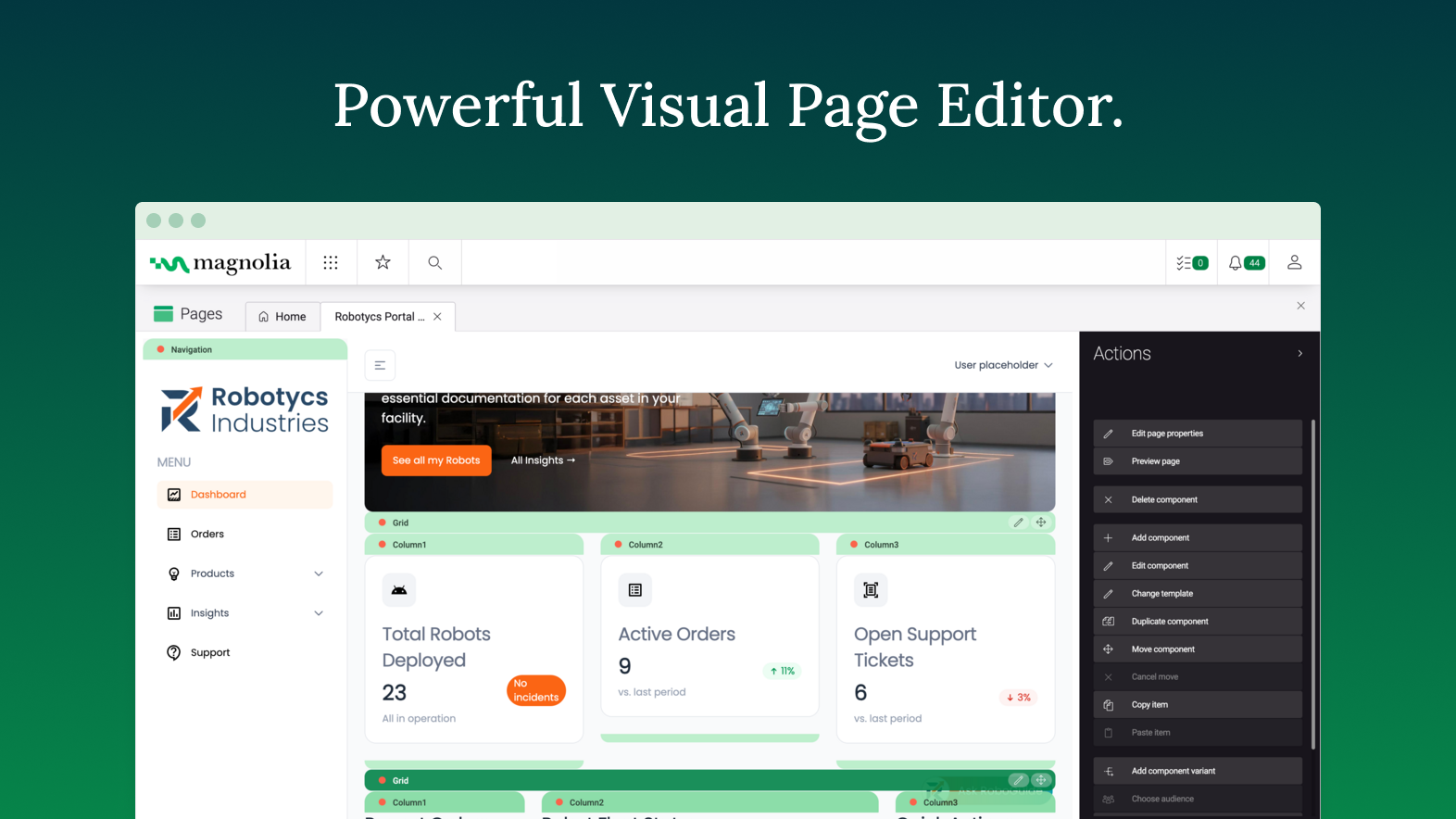
Founded in Switzerland in 1997, Magnolia is a CMS used to build composable digital experiences. Magnolia helps create fully integrated customer experiences and speeds up digital delivery of content. Magnolia boasts 480 enterprise customers, thousands of Community Edition deployments, and more than 200 certified Magnolia Partners around the world. They further state that their enterprise customers include Sanofi, Generali, the Atlassian, The New York Times, Harley Davidson, and Union…
$3,500
per month
Netlify CMS
Score 9.0 out of 10
N/A
Netlify CMS is an open source Git-based CMS for static site generators. it runs 100% in a browser.
N/A
SiteExecutive (discontinued)
Score 9.0 out of 10
N/A
SiteExecutive was a content management system (CMS) from Systems Alliance available for local-hosting or as a SaaS, that has been discontinued and is no longer available for sale.
N/A
Pricing
Magnolia
Netlify CMS
SiteExecutive (discontinued)
Editions & Modules
DX Core
$3500
per month
DX Cloud
$6000
per month
No answers on this topic
No answers on this topic
Offerings
Pricing Offerings
Magnolia
Netlify CMS
SiteExecutive (discontinued)
Free Trial
Yes
No
No
Free/Freemium Version
No
Yes
No
Premium Consulting/Integration Services
Yes
No
No
Entry-level Setup Fee
No setup fee
No setup fee
No setup fee
Additional Details
—
—
—
More Pricing Information
Community Pulse
Magnolia
Netlify CMS
SiteExecutive (discontinued)
Features
Magnolia
Netlify CMS
SiteExecutive (discontinued)
Security
Comparison of Security features of Product A and Product B
Magnolia
8.0
69 Ratings
2% below category average
Netlify CMS
-
Ratings
SiteExecutive (discontinued)
7.2
2 Ratings
13% below category average
Role-based user permissions
8.069 Ratings
00 Ratings
7.22 Ratings
Platform & Infrastructure
Comparison of Platform & Infrastructure features of Product A and Product B
Magnolia
8.1
68 Ratings
4% above category average
Netlify CMS
6.0
1 Ratings
25% below category average
SiteExecutive (discontinued)
-
Ratings
API
8.561 Ratings
6.01 Ratings
00 Ratings
Internationalization / multi-language
7.661 Ratings
00 Ratings
00 Ratings
Web Content Creation
Comparison of Web Content Creation features of Product A and Product B
Magnolia
8.0
74 Ratings
3% above category average
Netlify CMS
6.1
1 Ratings
24% below category average
SiteExecutive (discontinued)
7.9
2 Ratings
1% above category average
WYSIWYG editor
8.565 Ratings
9.01 Ratings
6.12 Ratings
Code quality / cleanliness
8.465 Ratings
9.01 Ratings
9.01 Ratings
Admin section
8.070 Ratings
7.01 Ratings
6.01 Ratings
Page templates
8.972 Ratings
3.01 Ratings
7.92 Ratings
Library of website themes
7.01 Ratings
1.01 Ratings
00 Ratings
Mobile optimization / responsive design
8.563 Ratings
5.01 Ratings
8.01 Ratings
Publishing workflow
7.573 Ratings
9.01 Ratings
10.02 Ratings
Form generator
6.958 Ratings
00 Ratings
8.12 Ratings
Web Content Management
Comparison of Web Content Management features of Product A and Product B
Magnolia is a very capable DXP, that provides client with lots of flexibility in composing its own stack. While the core of the platform is a content management system, the open architecture of Magnolia DXP allows it to connect to any platform, allowing client to extend the capabilities. One scenario would be a centralized content hub - where through a single platform, content authors can choose which channel to distribute what content. For example, long form content for consumers viewing on a laptop, short form content for those using a mobile browser. This allow the client to personalized the experience based on channels. Another scenarios would be leveraging on GenAI - using Magnolia's built-in connector to ChatGPT. If that is not the service that one desire, you can always connect to another AI service such as Google Gemini. With GenAI, connected, content author can use AI as co-pilot to help them scale up their content production.
Netlify CMS is well suited when you have very less frequent updates to your content, maybe once a day and very few people need to access your data. You can connect it to Netlify, GitHub, or any platform and have multiple people access it and do as many updates as you wish, but the process is not well-defined and you need to build your own system for that. It is well suited for projects you need to pull off with very low cost, it is essentially free as the software is open source and free to use, and all you need to do is set up your schema correctly and find a deployment pipeline where you can build your static site/API to redeploy whenever the content changes. I personally used a GitHub Login -> Netlify CMS -> next app consumer of content -> GitHub pipelines to run next SSG -> GitHub Pages to deploy the built static site. It might not be appropriate for large teams where users themselves need no-code tools to modify the schema of the content.
We recently put our alumni magazine online so viewers can read it digitally. SiteExecutive has been great for this project as it allowed us to easily create new templates and styling options specifically suited for our purposes.
Speed of development - time to delivery from zero to MVP was excellent
Ease of use - the authoring experience is very easy to build and train
PAAS/SAAS - the managed service platform removed the traditional overhead of running in-house technologies, meaning we could focus on value add, with less time spent keeping the lights on.
SiteExecutive provides a simple basic and convenient interface for creating and updating webpages.
Easy way to create web forms, set up a confirmation webpage, and send a confirmation email.
Integration with YouTube allows us to quickly embed the most recent videos to our website automactically as well as choose specific videos by date or title.
The documentation provides samples that are often out of context, and difficult to know where the provided example code should be implemented. More tutorials providing the full project or step-by-step instructions on how to implement subject material would help greatly. Baeldung is a resource I would consider the gold standard in how this is done in other spaces.
The use of JCR and Nodes makes object serialization/deserialization painful. Jackson compatibility or similar would be a welcome enhancement to the developer experience. Maybe leveraging code-gen from light modules to build model classes when possible could help accomplish this.
Modifying the home layout from light modules is frustrating. It seems that any configuration overrides made merge with the default rather than overwriting, which makes for a difficult combination of guess-and-check while referencing the documentation to see what should be in each row/column when making changes.
Including "mark all as read" or "delete all" in the notifications app would be a great quality of life improvement. It seems that by default, users have to individually select messages and operate them.
We've shown it to a number of users both clients and our own team and despite initial apprehensions, they "get it" very quickly. It's intuitive and friendly and quick to perform daily tasks. We once had a client tell us "Using Magnolia makes me smile" which says it all for us.
I gave [it] 7/10 only because of the loading time of pages. Otherwise, I think it deserves an 8. Normally this is not an issue per [se] but considering the rating matrix and as I have been asked to honestly write about it. Yes, the page loading times could be improved.
You always get an answer based on your SLA. But you always get a solution. That's the successfactor in this case. To often i was frustrated about people in a company without even a clue what there product is about or how to solve a problem. Magnolia's Support Team does a very good job and try to help you in most of the cases
I've used several CMSs like AEM and EpiServer, and comparatively, they all excel at different things. Magnolia is the best to develop for/against. Episerver has the best/most fluid UI in terms of content editing, and the overall admin experience AEM is just all around sucks.
We really can't compare it to full-fledged CMS software, like WordPress, which has a lot of community and support with widgets, plugins, and whatnot. It's not built for that, but you can compare it to Contentful, Ghost, Strapi, etc., which provide similar functionality to a headless CMS with custom schema options, but even among them, it still lacks a lot of functionality, ease of use, and support. But Netlify CMS pros would be of the opinion that compared to other platforms where most schemas need to use their own tools and frameworks, it's very cost-effective. Something new called TinaCMS has come up to compete with Netlify CMS by covering most of its shortcomings, but it's something new being built by the same team that built Forestry CMS and comes with many modern features, yet currently only supports NextJS SSG.
WordPress is another CMS that I've used within a professional setting. Despite the cost difference, SiteExecutive is well worth the investment. Its functionality is much, much greater (they can't really be compared on the same level) and I have more freedom for customization and creating EXACTLY what I need.
Magnolia has brought about positive impacts. For instance, we need not outsource web design and marketing services because thanks to this software, we can handle most work inhouse
The software is affordable with no compromises on capabilities and therefore it is gives us value for money.
External constituents are able to clearly see our mission, goals, and programs (i.e: we are successfully attracting potential students and their families)
Faculty and staff are able to be directly involved in how their department is represented