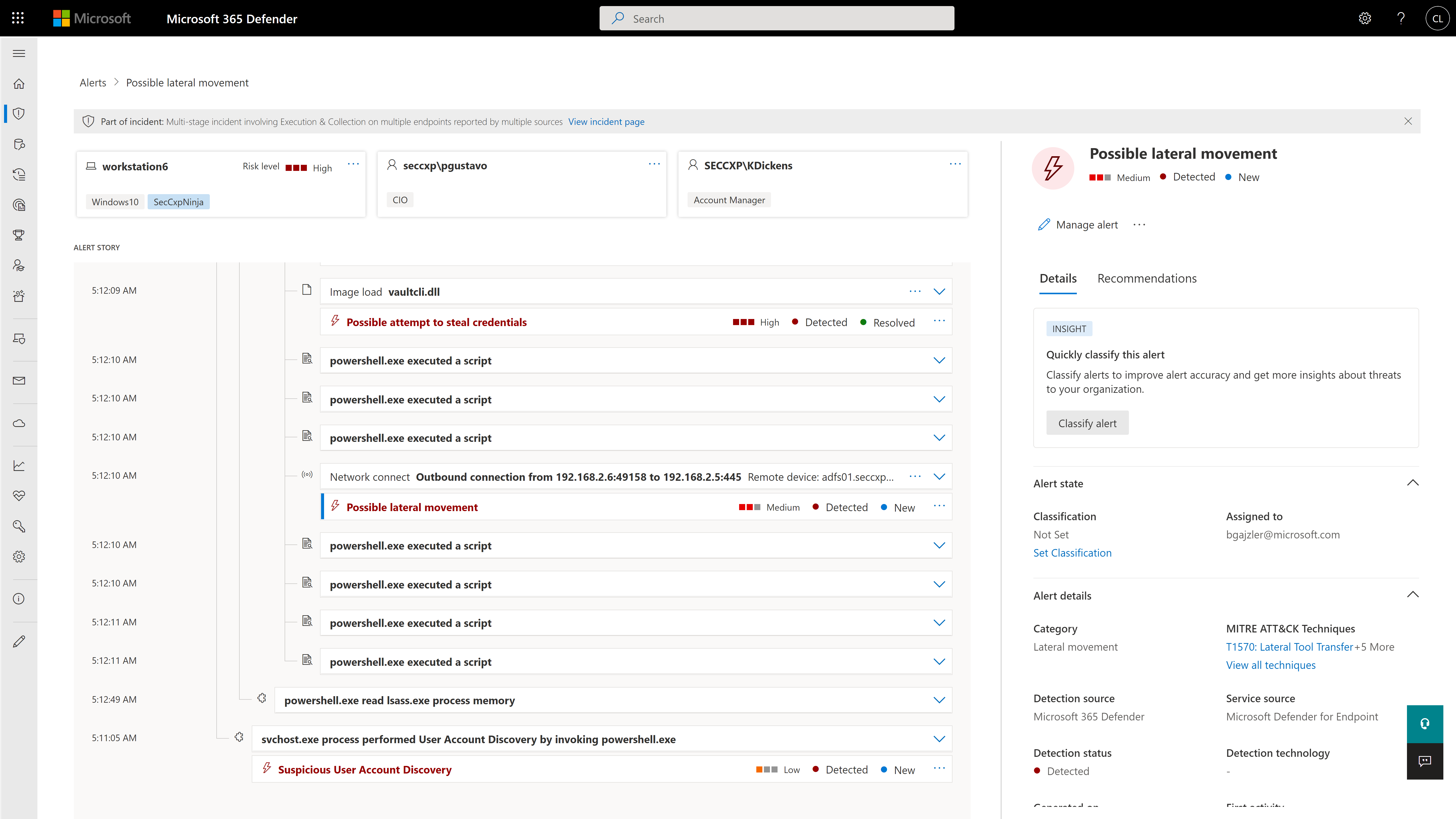
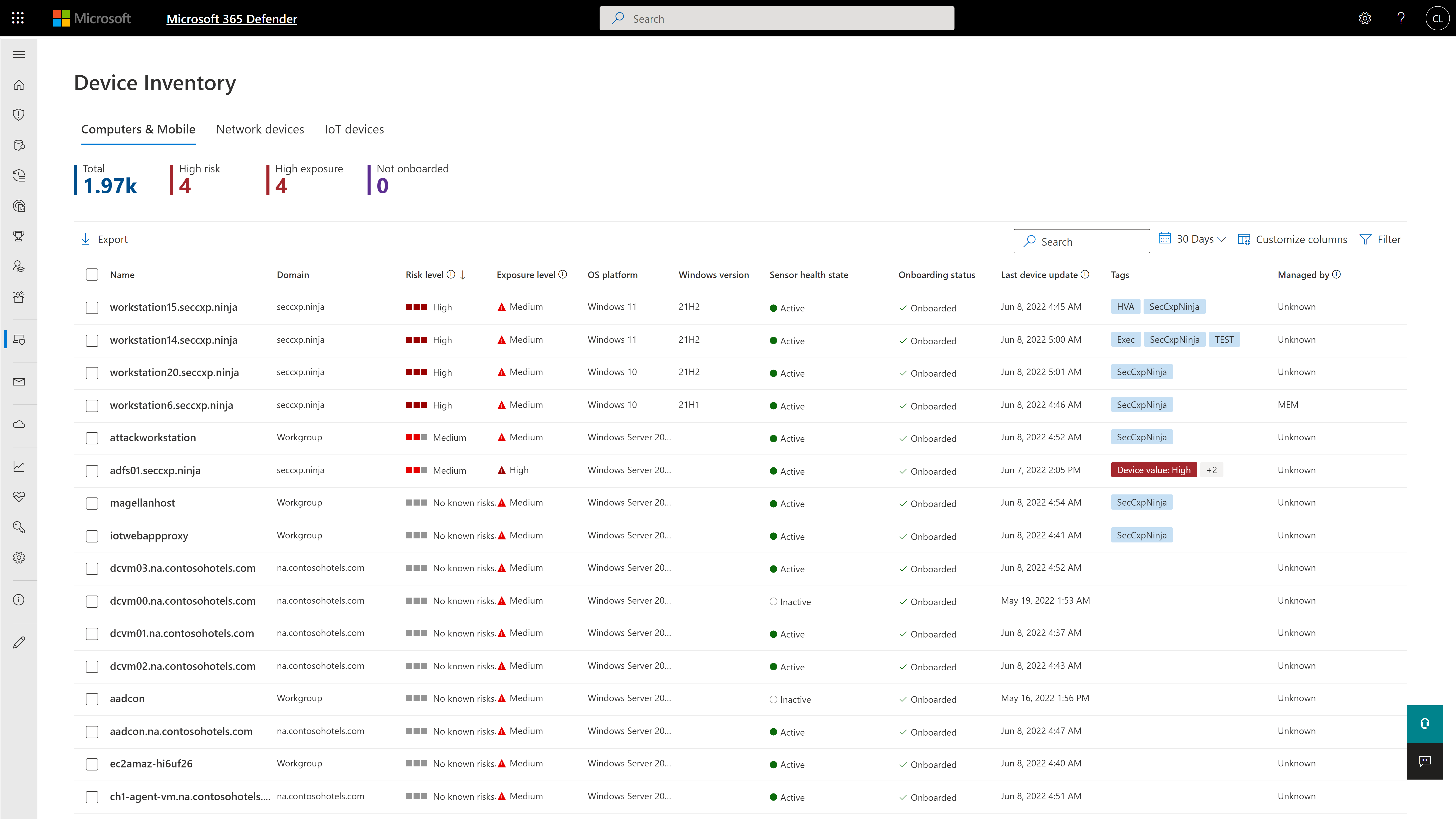
Microsoft Defender for Endpoint (formerly Microsoft Defender ATP) is a holistic, cloud delivered endpoint security solution that includes risk-based vulnerability management and assessment, attack surface reduction, behavioral based and cloud-powered next generation protection, endpoint detection and response (EDR), automatic investigation and remediation, managed hunting services, rich APIs, and unified security management.
$2.50
per user/per month
Microsoft Sentinel
Score 8.6 out of 10
N/A
Microsoft Sentinel (formerly Azure Sentinel) is designed as a birds-eye view across the enterprise. It is presented as a security information and event management (SIEM) solution for proactive threat detection, investigation, and response.
$2.46
per GB ingested
Splunk Enterprise
Score 8.5 out of 10
N/A
Splunk is software for searching, monitoring, and analyzing machine-generated big data, via a web-style interface. It captures, indexes and correlates real-time data in a searchable repository from which it can generate graphs, reports, alerts, dashboards and visualizations.
Microsoft Defender for Endpoint consistently showed better user experiences during scans due to the reduced amount of resources used on each system compared to our previous endpoint protection solutions. However, the main reason we chose Microsoft Defender for Endpoint is …
Microsoft Defender for Endpoint is more advantageous in our windows heavy infrastructure and it was unparalled in the ease of integration with windows endpoints. Security breaches, system crashes and outages with other competitors like Crowdstrike made it easier for us to go …
Defender works better for my org. This may depend on your ecosystem, however for me, Defender is a clear winner. I like Defender's ability to utilize multiple sensors and data points to detect possible breaches. I like the built-in EDR functionality. I do not need to purchase a …
Prior to using Sentinel, we were using Splunk specifically Splunk Enterprise Security and Splunk Cloud, so their on-prem and their cloud-based products. We switched originally for cost reasons, specifically cost control, but I have found that the ability to create reports, the …
These are all the Microsoft products. We have used Splunk. And again, I would say Microsoft Sentinel stacks up because it's a native tool that is more like an ecosystem. It's not a standalone tool. It's like if you're in the Microsoft stack, Microsoft Sentinel will stack up …
Microsoft Sentinel feels on another different level from these solutions , all in the cloud . No need for troubleshooting , deployment or upgrades. Constant updates from the vendor and good support
Microsoft Sentinel excels in cloud-native scalability, Microsoft ecosystem integration, and AI-driven threat detection with UEBA and Fusion rules, offering faster deployment and lower costs (48% cheaper per Forrester) than Splunk, QRadar, Exabeam, SentinelOne, Securonix, and …
Splunk, Google, SecOps. I look at how it stacks up based on the fact that it's the primary solution that we sell. So I think it stacks up really well. Why do we select it? Well, we selected it primarily because we're a very large Microsoft partner. The technology is very good …
Well before there was Microsoft Sentinel, you had other competing products like ArcSight or Splunk, et cetera. I think they have their own qualities, but the Microsoft integration story is really why we're using it.
Elastic seems to have a much better interface for log search and is able to filter out noise. Microsoft Sentinel also appears to generate a lot of false positives.
As mentioned, the product was part of the purchase of several Microsoft Suites that we did earlier last year and with 200 licenses included, we can exclude those from the other SIEM and SOAR product, it just work well with the Microsoft's environment that we partially have Is …
ArcSight is an on-prem solution that has a different approach than Sentinel.
In a basis this product is more complex to maintain and deploy. The query functionality in Sentinel is more powerful and easier to maintain. ArcSight has a much slower performance and an interface that …
Microsoft Sentinel really goes the extra mile when it comes to an SIEM that slowly improves toward a proper SOAR, this may be the best selling point of the entire solution. Highly scalable, cloud-based, and nearly perfect when dealing with Microsoft-based infrastructures, …
As the vast majority of our users have Windows machine and uses all 365 cloud features, we finally decided not to implement any 3rd party security solutions on desktops/laptops in order to keep our infrastructure simple. In this case, Microsoft Sentinel is the best way to …
While both are market-leading SIEM platforms, they cater to different environments and organization priorities. The choice often comes down to a company's existing infrastructure, integration needs, and long-term security strategy. Deployment and architecture - Splunk offeres …
I can definitely tell you where it’s more suited, because we haven’t come across any less appropriate scenarios. But definitely in regard to how we centrally manage our user space and our endpoints, it’s been beneficial from an API perspective and is really transferable, with strong collaboration with our Azure stack. It works very well.
It's certainly well-suited in environments that rely heavily on Microsoft products, and it's well-suited for environments where you have other business drivers to go to the E5 license. If I were to say where I would not and why, I only gave it a seven on the recommendation, that answer would probably vary if you already owned E5 or not. It's extremely expensive. And if there are other alternatives, if you don't have any other driving reason to go to E5, I would coach you not to go to Microsoft Sentinel. But if you're there, it's a fantastic property. It's certainly part of the cost argument for moving to E5, but it's only a part. It can't by itself justify the move to E5.
It's well suited for what I do, which is network security operations. And that's for anything from troubleshooting incidents, troubleshooting performance, troubleshooting for the purpose of a compliance and auditing. It's not best suited for users who are new in terms of they're new to the product and they have expectations that probably Splunk cannot meet.
Definitely on the threat action and response. We didn't have a stress-response option before, but the dependent brand point provided it instantly. Also, it's doing UVA and machine learning, which we didn't have before. So it's definitely providing more sophisticated threat-detection capabilities than we had before.
It's the scale. Having built-in detections and vulnerabilities and the ability to see into the traffic flows is absolutely key. Look at it from my perspective as network security. We want to see what's going on east, west, between all the kinds of subscriptions and the tenants. We don't have that. We don't have that with any other product. Microsoft Sentinel gives us that kind of visibility.
The only thing is sometimes, because Microsoft has so many platforms, it gets a little confusing, like am I in the security platform? Am I in Purview? Where am I at right now? Because there's so many sites that are kind of doing a lot of the same thing, and so that does get a little confusing from time to time, but outside of that, it's a pretty good product.
An area for improvement is how case management is surfaced within the Microsoft Sentinel experience, as clearer integration into Sentinel workflows would reduce context switching and improve incident handling.
There is an opportunity to further expand agentic, autonomous investigation and response capabilities.
Cost add-ons for Security features is nickel and diming the process to keep pace with cybercrime. Limited Education budgets require us to be more pro-active in finding cost-effective measures to protect our devices, staff and students. Defender is a strong, well-featured product that is pricing itself out of the education market
We are using Splunk extensively in our projects and we have recently upgraded to Splunk version 6.0 which is quite efficient and giving expected results. We keep track of updates and new features Splunk introduces periodically and try to introduce those features in our day to day activities for improvement in our reporting system and other tasks.
Microsoft Defender for Endpoint is a great EDR to have that works quickly and silently in the background and it integrates well with other Microsoft services. As an IT manager, I can appreciate that I do not get bombarded by alerts for every small detail. On the flipside, the management site can use some work in being more clear and should be more streamlined so I'm not clicking through multiple pages to figure out what happened
Because, as I said, it still lacks a lot of things, like many playbooks outside the Copilot integrations and the actual remediation. For example, for Microsoft Sentinel and SAP, I would want to see Copilot doing a lot of remediations in Microsoft Sentinel at SAPN, like executing the transaction code, maybe creating certain increases, or remediating stuff like that, which is all customized.
You can literally throw in a single word into Splunk and it will pull back all instances of that word across all of your logs for the time span you select (provided you have permission to see that data). We have several users who have taken a few of the free courses from Splunk that are able to pull data out of it everyday with little help at all.
Microsoft Defender for Endpoint chugs along just fine no matter what we throw at it and what systems it's running on. It doesn't take up a lot of resources either, so that's welcomed.
The first time I tried to onboard my macOS endpoints to MDE I struggled for quite a bit. I had to reach out to Microsoft's MDE support team. The tech was very helpful in walking me through the steps during a screen share session
Microsoft support is one of the highest rated on the market. It has global and multilingual support. Calls can be made over the phone and the solution is virtually instantaneous with the help of Microsoft engineers. It's great!
Splunk maintains a well resourced support system that has been consistent since we purchased the product. They help out in a timely manner and provide expert level information as needed. We typically open cases online and communicate when possible via e-mail and are able to resolve most issues with that method.
The online course was simple clear and described the main capabilities of the solution. There is also an initial module that can be done for free so anyone can familiarize themselves with the functionality of this solution. On the other hand, however, there could be more free online courses. Maybe even with a certificate, this would broaden the group of people who are familiar with the platform while increasing familiarity with the solution itself.
Deployment was handled by our team here and everything went pretty smoothly. We did have a few hiccups in our test group, but that only took a bit to get ironed out.
Previously, we've used Sophos. We've used, way back when, McAfee, Norton, Symantec, all those. And we finally settled on Microsoft Defender for Endpoint. We're a Microsoft technology stack shop. So obviously it was natural. It's built into Windows, so we're not adding additional agents. Some of the other vendors and their agents, for a while, would compete with CPU usage. And so it actually slowed down the machines. Because Microsoft Defender for Endpoint is built into the Windows product, Microsoft is going to ensure that it does not affect the other productivity tools that a user may use.
Microsoft Sentinel excels in cloud-native scalability, Microsoft ecosystem integration, and AI-driven threat detection with UEBA and Fusion rules, offering faster deployment and lower costs (48% cheaper per Forrester) than Splunk, QRadar, Exabeam, SentinelOne, Securonix, and Wazuh. It lags in third-party integrations and syslog parsing. Organizations choose Microsoft Sentinel for its cost-effectiveness, automation, and Microsoft synergy, especially in Azure-heavy environments, though Splunk and Exabeam lead in flexibility and UEBA, respectively.
I didn't get to fully evaluate Logstash as our corporation was already using Logstash, but both seemed like viable solutions to the problem that we were having. I wanted to evaluate Logstash some more, both did seem like they would work for the business needs that we had, we went with splunk as many teams were already using it.
As any cybersecurity product, this has to be more with risk to avoid loss in case of a ransomware that more than relate to a productivity increase. Maybe the impact could be that instead of having people that are checking 24/7 the dashboard, you could implement Sentinel and have less people checking that or people with less expertise. So the saving will be a minor but will be a saving in the cost of your team.
I don't have any numbers to share but Splunk has positively served as a 24/7 monitoring tool that has saved hours of work by self-detecting, saving statistics and alerting problems in the system or from external interfaces as soon as they happen.
Splunk dashboards does a solid job in collecting, analyzing data and creating reports that contain an entire day's activity and then automatically sent out to the business.
Splunk is very easy to learn and very useful to any program or business application.