Modern Requirements4DevOps is a fully-featured Requirements Management tool built into Azure DevOps. By partnering with Microsoft, Modern Requirements is able to offer a fully integrated solution within Azure DevOps, TFS, and VSTS. The Modern Requirements solution provides the ability to: Create documentation without leaving an Azure DevOps project Construct Diagrams, Mockups, and Use Case models that the user can connect requirements directly to Build…
N/A
Arena PLM and QMS
Score8.5 out of 10
N/A
Arena by PTC is a cloud-based PLM and QMS platform. Arena helps product companies that rely on distributed teams and global supply chains to develop products, ensure regulatory compliance, and respond to customer demands.
N/A
Pricing
Modern Requirements4DevOps
Arena PLM and QMS
Editions & Modules
No answers on this topic
Arena PLM Launch
Contact Sales
Arena PLM Enterprise
Contact Sales
Arena QMS
Contact Sales
Arena QMS Enterprise
Contact Sales
Offerings
Pricing Offerings
Modern Requirements4DevOps
Arena PLM and QMS
Free Trial
Yes
Yes
Free/Freemium Version
No
No
Premium Consulting/Integration Services
Yes
Yes
Entry-level Setup Fee
No setup fee
Required
Additional Details
—
Arena's cloud-based PLM and QMS solutions include role-based subscriptions to meet diverse team needs. Their fixed-fee QuickStart™ implementations supports rapid deployment.
We tried the Modern Requirements4DevOps AddIn to see if it brings a added value to our development. I have to say that I would distinguish between types of projects in which it is beneficial and in which it is probably "over engineering". Certainly, bigger development projects with higher complexity are more suitable than small and not really complex projects. However, for the bigger projects Modern Requirements4DevOps definitely helps to deal with the complexity as it adds way more contextualisation to the various entities. It really helps to understand which requirements led to which action in a diagram or task during development. It helps to control the complexity and inform all team members along the project.
A de minimis incentive was given to thank the reviewer for their time. The incentive was not used to bias or drive a particular response, nor was the incentive contingent on a positive endorsement. More Info
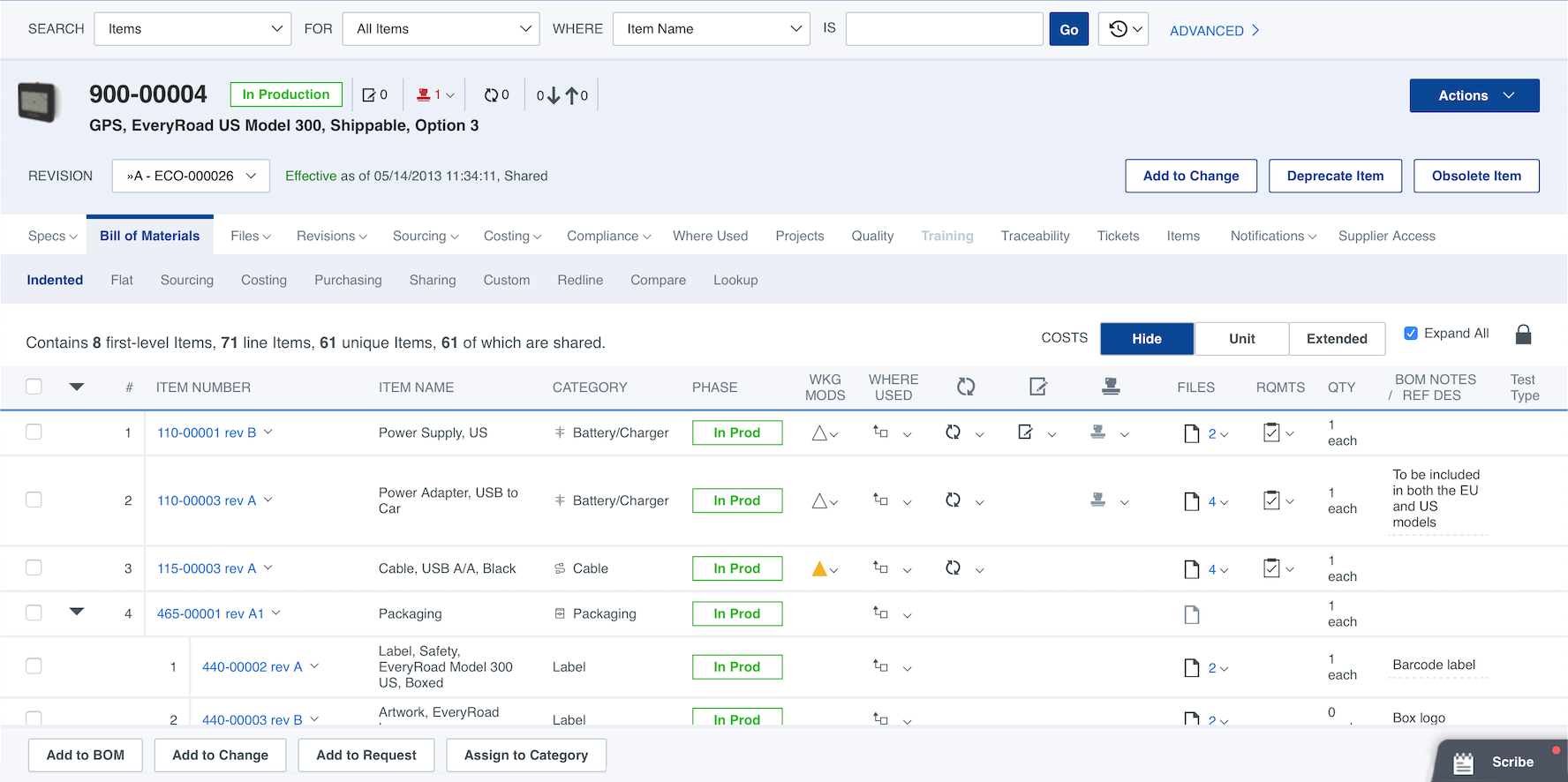
Arena PLM is well suited for part number, BOM and file management. Processing changes (ECNs, ACOs, DCO's, etc.) in Arena is very easy to do and provides great visibility on the status of submitted requests. The ability to communicate with Suppliers and grant them access to files in Arena is extremely helpful. Arena does not appear to be the best suited system for managing software
A de minimis incentive was given to thank the reviewer for their time. The incentive was not used to bias or drive a particular response, nor was the incentive contingent on a positive endorsement. TR verified that a representative sample of customers was invited. More Info
A de minimis incentive was given to thank the reviewer for their time. The incentive was not used to bias or drive a particular response, nor was the incentive contingent on a positive endorsement. More Info
It provides easy, 'login-anywhere' internet cloud-based access to fundamental PLM functions.
It provides secure access control for employees & vendors (but you pay per person for access licenses).
Data is effectively 'always backed up' in the internet-cloud.
There is an option to attach thumbnail graphics representative of each item and create a Bill of Materials view that also displays the graphics to help provide item recognition for BOM readers.
A de minimis incentive was given to thank the reviewer for their time. The incentive was not used to bias or drive a particular response, nor was the incentive contingent on a positive endorsement. More Info
In my opinion, the Help Pages clearly do not realize that a picture is worth a 1,000 words; need illustrations and screenshots!
I think the 'Save' button when editing Quality Processes needs to "float" on the active page, not lurking at the bottom.
In my experience, the Arena PLM and QMS Training programs need to be revamped to include "real-world" examples and working through examples, not simply reading through a training manual.
A de minimis incentive was given to thank the reviewer for their time. The incentive was not used to bias or drive a particular response, nor was the incentive contingent on a positive endorsement. TR verified that a representative sample of customers was invited. More Info
We have so much time and effort invested into Arena. The history of approvals, revisions, etc. are necessary for many of our customers. We also have entire device histories recorded. Having to re-create that on another platform would be a feat requiring years of effort. But mostly, Arena just works. It's transformed our business into a much more streamlined system, resulting in a massive cost and time savings.
A de minimis incentive was given to thank the reviewer for their time. The incentive was not used to bias or drive a particular response, nor was the incentive contingent on a positive endorsement. TR verified that a representative sample of customers was invited. More Info
Arena has improved their UI over the years that I've used it to make it more user friendly. Additionally, there is a lot of redundancy within Arena (multiple ways to achieve the same end), which makes it easier to learn.
A de minimis incentive was given to thank the reviewer for their time. The incentive was not used to bias or drive a particular response, nor was the incentive contingent on a positive endorsement. More Info
Seems like when I need to access our workspace for an emergency situation, this is when maintenance is scheduled, just the luck of the draw, I guess, and I just wait until the maintenance is complete, and then can proceed
A de minimis incentive was given to thank the reviewer for their time. The incentive was not used to bias or drive a particular response, nor was the incentive contingent on a positive endorsement. More Info
A de minimis incentive was given to thank the reviewer for their time. The incentive was not used to bias or drive a particular response, nor was the incentive contingent on a positive endorsement. TR verified that a representative sample of customers was invited. More Info
Upon initial observation, Arena Solution appears to possess a rather intricate nature, yet this complexity was effectively navigated during the initial configuration phase with the invaluable assistance of an expert well-versed in Arena, a factor that greatly contributed to our comprehensive mastery and autonomous handling of Arena Solutions thereafter.
A de minimis incentive was given to thank the reviewer for their time. The incentive was not used to bias or drive a particular response, nor was the incentive contingent on a positive endorsement. TR verified that a representative sample of customers was invited. More Info
The On line training was easy to understand and was very efficient for most of our users. We used the training tools to make sure we use all of the features to their fullest and correctly! After a few weeks mos of our users were very proficient with ARENA PLM and were able to work on their own and use mos of the sections and PLM capablilities.
A de minimis incentive was given to thank the reviewer for their time. The incentive was not used to bias or drive a particular response, nor was the incentive contingent on a positive endorsement. TR verified that a representative sample of customers was invited. More Info
A de minimis incentive was given to thank the reviewer for their time. The incentive was not used to bias or drive a particular response, nor was the incentive contingent on a positive endorsement. More Info
Modern Requirements4DevOps is an AddIn for Azure DevOps Server (Microsoft Azure DevOps) and extends the native features of Azure DevOps in the area of Requirements Engineering, Requirements Management and Reporting. Azure DevOps already contains tons of valuable features. However, for bigger and more complex projects Modern Requirements4DevOps extends Azure DevOps by further features. Thus we used both products alongside.
A de minimis incentive was given to thank the reviewer for their time. The incentive was not used to bias or drive a particular response, nor was the incentive contingent on a positive endorsement. More Info
Arena is much better than QAD in terms of BOMs and ECOs and Revision Control. We use Arena concurrently with SAP and they integrate very well together, which is nice. The integration team was really helpful in making sure that the SAP to Arena functionality runs smoothly, and when there are any issues, they are very responsive to help make changes to fix the problem that might be there.
A de minimis incentive was given to thank the reviewer for their time. The incentive was not used to bias or drive a particular response, nor was the incentive contingent on a positive endorsement. More Info
Arena is easy to customize and therefore easy to scale. Different user groups with access restrictions can be easily created and new training plans can be created to support different user bases. Suppliers can also easily be added or items can be shared with them
A de minimis incentive was given to thank the reviewer for their time. The incentive was not used to bias or drive a particular response, nor was the incentive contingent on a positive endorsement. More Info
Better communication --> thus less misunderstandings
More Transparency about requirements --> adds context and helps to build a common understanding
Traceability of Requirements --> we used the baseline also to look into the history of requirements to understand how certain requirements have changed
A de minimis incentive was given to thank the reviewer for their time. The incentive was not used to bias or drive a particular response, nor was the incentive contingent on a positive endorsement. More Info
Decreased the company's time to market for release of its second generation flagship product.
Decreased the turn around on non-conformance reports (NCRs), supplier corrective action reports (SCARs), and corrective and preventative actions (CAPAs).
Better organized the company's process maps, DHF, and other regulatory related information so that major audits are completed faster and with fewer findings.
A de minimis incentive was given to thank the reviewer for their time. The incentive was not used to bias or drive a particular response, nor was the incentive contingent on a positive endorsement. More Info