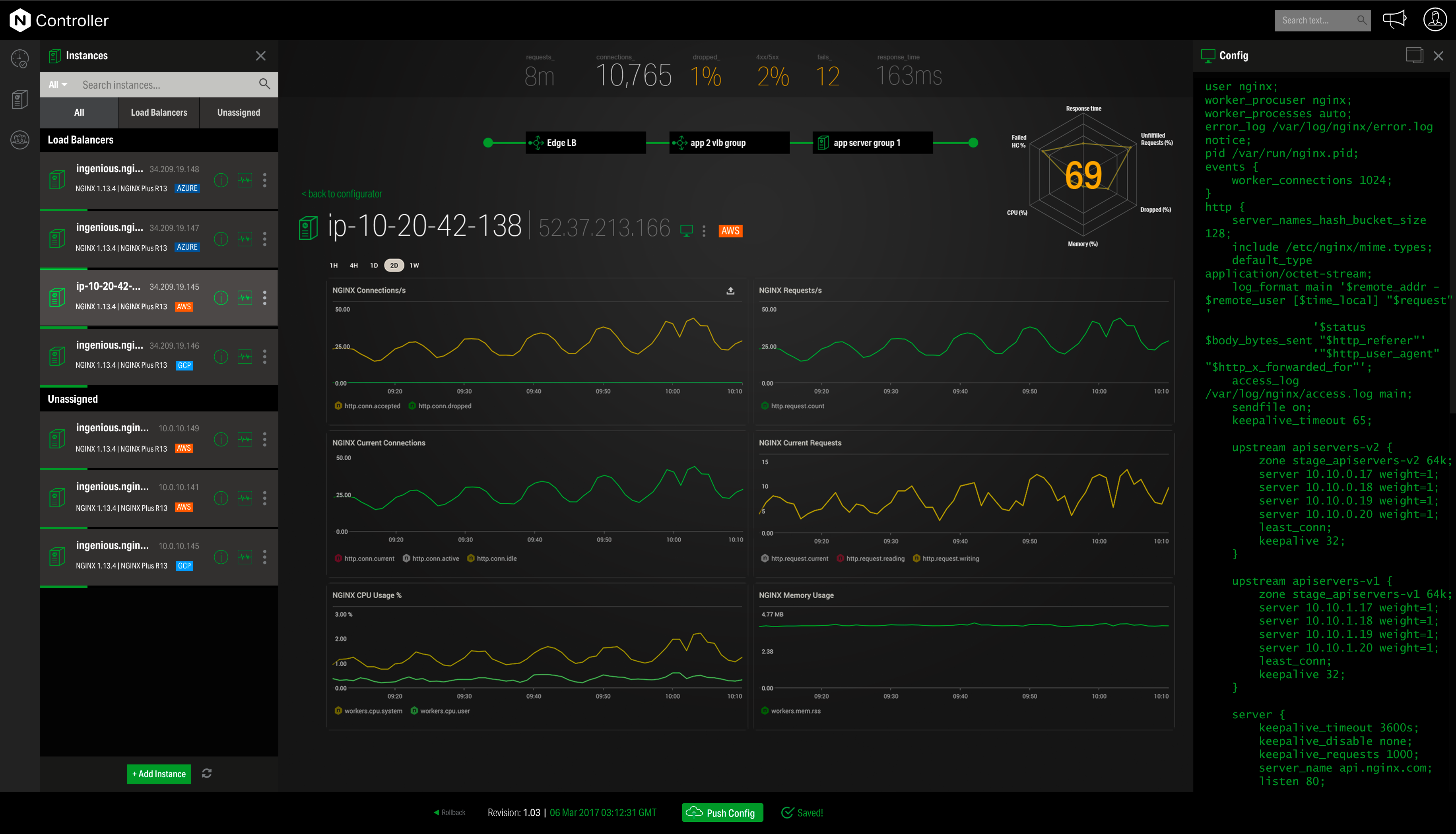
NGINX, a business unit of F5 Networks, powers over 65% of the world's busiest websites and web applications. NGINX started out as an open source web server and reverse proxy, built to be faster and more efficient than Apache. Over the years, NGINX has built a suite of infrastructure software products o tackle some of the biggest challenges in managing high-transaction applications. NGINX offers a suite of products to form the core of what organizations need to create…
N/A
Oracle Integration (OIC)
Score8 out of 10
N/A
The Oracle Integration Cloud Service is an iPaaS providing prebuilt integration flows between applications, including other Oracle products. The Integration Cloud Service is scaled for enterprises, with prebuilt codeless adapters for on-premises and SaaS systems and low-code automation capabilities.
Nginx is well-suited for any web server scenarios, such as web applications, backend or reverse proxy for both application and HTTP requests, and distribution. It is less appropriate for Windows-based applications that run directly on a Windows Server host. In any case, it is very easy to manage, through separate conf files for each application or site you want to host with it.
A de minimis incentive was given to thank the reviewer for their time. The incentive was not used to bias or drive a particular response, nor was the incentive contingent on a positive endorsement. TR verified that a representative sample of customers was invited. More Info
Oracle Process Cloud is suited for medium-sized companies and up who want to create applications that can automate tasks without the need of recruiting more software developers. With a couple hours of training, any member of the organization's business team will be well-equipped with all of the knowledge that is needed to use Oracle Process Cloud effectively. If your IT team is large and able to take upon the task of making the given application, then something like Oracle BPM is a better solution.
A de minimis incentive was given to thank the reviewer for their time. The incentive was not used to bias or drive a particular response, nor was the incentive contingent on a positive endorsement. More Info
A de minimis incentive was given to thank the reviewer for their time. The incentive was not used to bias or drive a particular response, nor was the incentive contingent on a positive endorsement. More Info
New enhanced activities that are targeted to reduce the integration pain. For example, file stage activity reduces the pain of chunking the input file while sending and mapping the data to the target application. Stage activity takes care of it automatically for the customer. Similarly, recommendation on the mapper is a huge plus for people looking for common integration.
There are around 50 adapters available including dedicated out of the box application adapters and generic technologies adapters on OICS. The best part of these application adapters is that they are designed considering LOB users. Most of the time integration implementor does not require, application knowledge to perform the integration. OICS has some of Oracle Cloud applications adapters which make integration much easier may not be available in other integration platforms.
Inbuilt diagnostic dashboard and error hospital makes this product lucrative. OICS also comes with integrated Process Cloud and Visual Builder at the same cost. the customer can have seamless integration with Apiary and SSI on demand.
A de minimis incentive was given to thank the reviewer for their time. The incentive was not used to bias or drive a particular response, nor was the incentive contingent on a positive endorsement. More Info
Customer support can be strangely condescending, perhaps it's a language issue?
I find it a little weird how the release versions used for Nginx+ aren't the same as for open source version. It can be very confusing to determine the cross-compatibility of modules, etc., because of this.
It seems like some (most?) modules on their own site are ancient and no longer supported, so their documentation in this area needs work.
It's difficult to navigate between nginx.com commercial site and customer support. They need to be integrated together.
I'd love to see more work done on nginx+ monitoring without requiring logging every request. I understand that many statistics can only be derived from logs, but plenty should work without that. Logging is not an option in many environments.
Currently, it is not retaining the logs for more than 3 days, which it needs to address.
We also need some functionality inside the interface to re-push the same transaction again so that it will be helpful while testing and fixing the issue.
Also, some log errors are not giving the correct details. Oracle needs to rectify those.
A de minimis incentive was given to thank the reviewer for their time. The incentive was not used to bias or drive a particular response, nor was the incentive contingent on a positive endorsement. More Info
A de minimis incentive was given to thank the reviewer for their time. The incentive was not used to bias or drive a particular response, nor was the incentive contingent on a positive endorsement. More Info
This tool is really easy to use and configure. Consumes very less system resources. It is highly modular and configurable. You can easily use it with other tools like certbot for SSLs. You can configure basic security with configuration and headers
A de minimis incentive was given to thank the reviewer for their time. The incentive was not used to bias or drive a particular response, nor was the incentive contingent on a positive endorsement. TR verified that a representative sample of customers was invited. More Info
Community support is great, and they've also had a presence at conferences. Overall, there is no shortage of documentation and community support. We're currently using it to serve up some WordPress sites, and configuring NGINX for this purpose is well documented.
A de minimis incentive was given to thank the reviewer for their time. The incentive was not used to bias or drive a particular response, nor was the incentive contingent on a positive endorsement. More Info
A de minimis incentive was given to thank the reviewer for their time. The incentive was not used to bias or drive a particular response, nor was the incentive contingent on a positive endorsement. More Info
I have found that [NGINX] seems to perform better throughout the years with less issues although I've used Apache more. I would definitely recommend [NGINX] for any high volume site and I've seen this to usually be the case from most provided web hosts who will pick [NGINX] over alternatives
A de minimis incentive was given to thank the reviewer for their time. The incentive was not used to bias or drive a particular response, nor was the incentive contingent on a positive endorsement. More Info
The nearest thing I have used to OIC is UiPath, as it is often used as a tool to integrate software together. However, it is much more suited to legacy software which have little to no API endpoints. If the infrastructure already exists I understand why people use RPA for integration, however for when API's are easily accessible and you're using Oracle tools, OIC is better.
A de minimis incentive was given to thank the reviewer for their time. The incentive was not used to bias or drive a particular response, nor was the incentive contingent on a positive endorsement. More Info
By using Nginx, we can host multiple web services on a single server, keeping our infrastructure costs lower.
Nginx maintains our HTTPS connections, allowing us to keep our promise to our customers that their data is safe in transit.
Due to Nginx's extremely low failure rate, our web addresses always return something meaningful, even when individual services go down. In sense, this means we are "always online" and allows us to maintain brand and support our customers even in the face of catastrophe.
A de minimis incentive was given to thank the reviewer for their time. The incentive was not used to bias or drive a particular response, nor was the incentive contingent on a positive endorsement. More Info
The modern and advanced analytical abilities in Oracle Process Cloud are also a missing element that should be catered to.
This tool is used greatly for IT departments at a lower level with some very basic and limited access for general employees only.
Oracle Process Cloud has many advantages like it offers some very great and scalable solutions.
I find Oracle Process Cloud pretty straightforward and easy as compared to the different options available. Lastly, I think that as it is just one platform, managing the Oracle Process Cloud is pretty easy too.
A de minimis incentive was given to thank the reviewer for their time. The incentive was not used to bias or drive a particular response, nor was the incentive contingent on a positive endorsement. TR verified that a representative sample of customers was invited. More Info