Oracle Cloud Infrastructure (OCI) is Oracles's infrastructure-as-a-service (IaaS) platform which combines the utility of public cloud with the granular control, security, and predictability of on-premises infrastructure.
N/A
Oracle Exadata
Score 9.8 out of 10
N/A
Oracle Exadata is an enterprise database platform that runs Oracle Database workloads of any scale and criticality with high performance, availability, and security. Exadata’s scale-out design employs optimizations that let transaction processing, analytics, machine learning, and mixed workloads run faster. Consolidating diverse Oracle Database workloads on Exadata platforms in enterprise data centers, Oracle Cloud Infrastructure (OCI), and multicloud environments helps organizations increase…
$2.90
Per Unit
Teradata Vantage
Score 8.1 out of 10
N/A
Teradata Vantage is presented as a modern analytics cloud platform that unifies everything—data lakes, data warehouses, analytics, and new data sources and types. Supports hybrid multi-cloud environments and priced for flexibility, Vantage delivers unlimited intelligence to build the future of business.
Users can deploy Vantage on public clouds (such as AWS, Azure, and GCP), hybrid multi-cloud environments, on-premises with Teradata IntelliFlex, or on commodity hardware with VMware.
Microsoft Azure Cloud does not provide the native Oracle Database service with features like RAC, ASM Exadata, etc. Hence, we decided to use the Oracle Cloud for the database platform instead of Azure. Also, Microsoft and Azure came to an agreement to work together where Azure …
IBM POWER System is a general purpose hardware optimize to runs various software with high-performance resource intensive operations. On the other hand, Oracle Exadata Database Machine is specifically engineered to run Oracle Database software efficiently, this combination of …
We selected it just from a performance perspective, and that the ROI with the Oracle Exadata Database Machine is bigger than other machines. You can run with it for at least 5 years.
Oracle Exadata is an excellent product. Performs mass data processing with similar capability compared to Teradata. Some features Exadata has lack for Teradata Vantage, such as archive generation, consistent reading and writing (simultaneously), RMAN backing up online …
We did not really evaluate various cloud offerings and opted for on-premise database platform. Compared to Oracle and SQL Server, Teradata fared well with respect to performance
As per our usage Oracle Cloud Infrastructure for almost 6 years hosting 500 + customers I can say its well suited application for any small scale to larger scale application as it can handle that capacity and provide more reliable cloud service only if you need any messaging service like pub/sub or sqs better to consider other services.
Oracle Exadata is well-suited for environments where massive performance for Oracle databases is required. Storage indexes reduce the unnecessary I/O. Smart Flash Cache accelerates random reads/writes.
Our OLTP application demands very high concurrency. Multi-node Exadata provides high availability and zero downtime during DB patching. It comes with lots of built-in automations, so it reduces many routine tasks for sysadmins, like network, storage, and VM configuration, and it also reduces many Oracle DBA tasks, like Oracle software installation, patching, and upgrades.
Teradata Vantage is well suited for large scale ETL pipelines like the ones we developed for anti money laundering risk matrices. It handles heavy joins, aggregations, and transformations on transactional data efficiently. We generate alert variables, adjust for inflation, and monitor establishments monthly with it, all integrated with Python and Control-M for a centralised automation across the company. For less appropriate, I would say that heavy resource demands might slow down experimentation for iterative work.
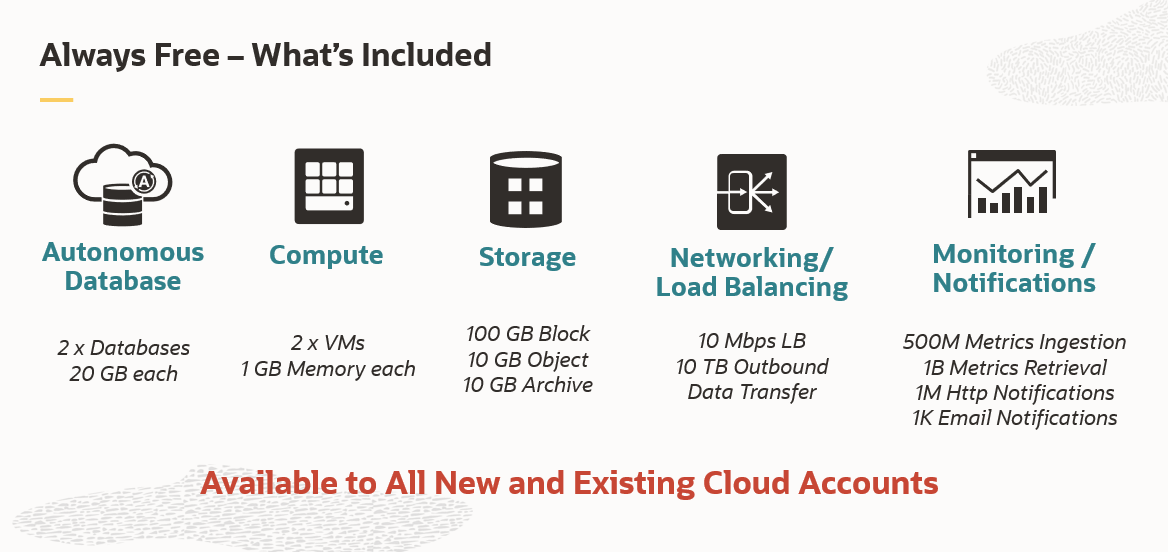
Oracle Cloud Infrastructure has a generous free tier, moreso than other hyperscalers, with an always-free tier that guarantees certain products are always free
Oracle Cloud Infrastructure allows you to size VMs with differing combinations of CPU and RAM, which is contrary to other hyperscalers that have specific pre-defined combinations only
Oracle Database : Deliver industry-leading security, high availability and scalability with Oracle Database, which has been significantly enhanced to take advantage of the Oracle Exadata Storage Servers.
Exadata Smart Scan : Improve query performance by offloading intensive query processing and data mining scoring to scalable intelligent storage servers.
Smart Flash Cache : Transparently cache 'hot' read and write data to fast solid-state storage, improving query response times and throughput. Exadata systems use the latest PCI flash technology rather than flash disks. PCI flash delivers ultra-high performance by placing flash directly on the high speed PCI bus rather than behind slow disk controllers.
Hybrid Columnar Compression : Reduce the size of data warehousing tables by 10x, and archive tables by 50x, to improve performance and lower storage costs for primary, standby, and backup databases. Query high, query low, archive high and archive low.
Infiniband Network : Connect multiple Oracle Exadata Database Machines using the InfiniBand fabric to form a larger single system image configuration. Each InfiniBand link provides 40 Gigabits of bandwidth–many times higher than traditional storage or server networks.
Petabyte Scalability : Easily scale data warehouse to support enterprise data growth.
Navigating the UI takes lots of getting used to. It reminds me of older GCP (just to get used to where everything is).
Permission for different things always seemed to be more difficult than it really needed to be. Once you got them set up you were good but updating anything or creating new permissions for just about anything took longer than I thought it should.
Based on how the buttons were laid out, it was pretty easy to delete all of your DNS records, and backing them up was not as intuitive as I'd like with the UI, but it was easy to do using a script.
The process of patching and upgrade of Exadata server components could be improved with a goal to minimize the overall effort, make it fully automated and transparent.
Improved guidelines and possibly more sophisticated tools for sizing of new Exadata servers for migration from old legacy hardware.
Teradata is an excellent option but only for a massive amount of data warehousing or analysis. If your data is not that big then it could be a misfit for your company and cost you a lot. The cost associated is quite extensive as compared to some other alternative RDBMS systems available in the market.
Migration of data from Teradata to some other RDBMS systems is quite painful as the transition is not that smooth and you need to follow many steps and even if one of them fails. You need to start from the beginning almost.
Last but not least the UI is pretty outdated and needs a revamp. Though it is simple, it needs to be presented in a much better way and more advanced options need to bee presented on the front page itself.
Reliability: Very dependable and stable OCI services have been for the business operations.Performance: The speed and efficiency of OCI in meeting their computing and storage needs.Scalability: The ease and effectiveness of scaling resources up or down to accommodate changing demands.Security: The robustness and effectiveness of OCI's security features in protecting their data and applications.
Teradata is a mature RDBMS system that expands its functionality towards the current cloud capabilities like object storage and flexible compute scale.
The services & products in Oracle Cloud Infrastructure needs more improvement to beat other Cloud service providers. The price is good & Security processes are good. We are requiring to put more effort in supporting this Oracle Cloud Infrastructure than other Cloud service providers. Probably better ways are there but is not super easy to find or not super available
I am comparing Exadata with the Oracle RAC database experience. In addition to Oracle RAC features, Exadata provides automatic performance optimization through Smart Scan and storage indexes. Deep integration with the Oracle ecosystem and tight coupling with Oracle Enterprise Manager for monitoring and management. Some downsides of Exadata are: a steep learning curve, concepts like cell offloading, IORM, and flash cache behavior aren’t intuitive initially. Operating Exadata requires specialized DBA skills.
Teradata Vantage allows us to create a scalable infrastructure to support our strategic initiatives. The dedicated compute power ensures reliable performance with isolated workloads and dedicated resources, optimizing workflows for faster, more efficient data transfers. The compute clusters support ETL processes and OSF’s developers and data science team with the flexibility to create self-service analytics, to spin up/down at any time, driving better performance and minimizing costs.
Yeah sometimes we had to face unplanned outages due to underlying infrastructure issues, so not every time,e but once in a while we face issues with availability. But the good thing is we have redundancy with DR setup and multi region so we can manage.
From the start, I was surprised by response times and image quality accessing windows VMs with RDP. GCP, Azure and -many offerings in AWS- don't perform this speed. Also, that's evident in the quality of Infrastructure Management Team, because I just received one warning regarding a region failure, what confirms that's a mature platform.
Overall it is amazing, there is always room for improvement. We have weekly updates that tend to slow the program used more and more. We had to change some reports within Oracle because the others wouldn’t load. This is tied to our payroll and the delays are causing many time constraint issues and panic. We have to create a new report when one breaks. Otherwise awesome!
We have meetings at the beginning with the technical team to explain our requirements to them and they were really putting in a lot of effort to come up with a solution which will address all our needs. They implemented the software and also trained a few of our resources on the same too. We can get in touch with them now as well whenever we run into a roadblock but it's very less now.
We used Microsoft Azure and Docker earlier and faced some difficulties like Microsoft Azure and Docker. Occasionally, the generation of large images can delay deployment. It is also necessary for me to admit that Microsoft Azure and Docker have a somewhat steep learning curve. Proper paperwork needs to be there. Docker has issues with performance on a number of platforms. On the other hand, OCI is easy to deploy and easy to understand.
Oracle Exadata Database Machine had the best performance overall hands down. It clearly beat the competition and we were seeing 1000X improvement on SAP HANA. Oracle Exadata Database Machine beat that without us refactoring our code. To achieve that in HANA, we had to refactor the code somewhat. Now this was for our limited POC of 5 use cases. Given the large number of stored procedures we had in Sybase, we need to capture more production metrics but we are seeing incredible performance.
Teradata is way ahead of its competitor because of its unique features of ensuring data privacy and data never gets corrupted even in worst case scenario. In most cases, the data corruption is a major issue if left unused and it leads to important data being wiped off which in ideal case should be stored for 3 years
was not part of initial purchase team. Anyways, i think unit pricing and billing frequency is good compared to other Cloud service providers, when it comes to Cloud Capital expenditure & Operational expenditure. Would be more interested in exploring more options where customers can get more cost relaxations on trying out new cloud services in Oracle Cloud Infrastructure for example a new App or a feature
We have hosted around 500 + customers on this cloud so till day not faced any major issues, so we can use it for any kind of products and it can hold the load and easily scale based on need.
Services & Infra wise is ok to use & host applications & services. Security wise also good for a Cloud service provider. It is a interesting area to explore & using it for day to day needs can be further improvised in future probably. Modern day Services like AI and Machine learning could be improved
Single support from a single vendor with both machine and database from Oracle, which is costing us less.
With Exadata, we need less technical manpower and less technical support. A business transaction with the integrated and centralized database helps us focus on other business needs.
We don't need to buy additional licenses and Hardware for the next 3 to 5 years.
Moving to Teradata in the Cloud-enabled a level of agility that previously didn't exist in the organization. It also enabled a level of analytic competency that was not achievable using other options on the aggressive timeline that was required. We didn't want to settle for reinventing a wheel when we had a super tuned performance capable beast readily available in Teradata. Teradata lets us focus on our business rather than spending money and effort trying to design software or database foundations features on an open source or lower performance platform.