Oracle Cloud Infrastructure (OCI) is Oracles's infrastructure-as-a-service (IaaS) platform which combines the utility of public cloud with the granular control, security, and predictability of on-premises infrastructure.
N/A
Oracle WebLogic Server
Score 7.0 out of 10
N/A
Oracle WebLogic Server is a unified and extensible platform for developing, deploying and running enterprise applications, such as Java, for on-premises and in the cloud. WebLogic Server offers a scalable implementation of Java Enterprise Edition (EE) and Jakarta EE.
Oracle Cloud infrastructure is better for another Cloud provider in Oracle Database technology because Only Oracle Cloud infrastructure provides Real High availability solutions, this is very important, in order to reduce Service Disruptions. Oracle Provides Oracle Zero …
Red Hat JBoss EAP is good and open source. We chose Oracle WebLogic because we are using Oracle products like Oracle Enterprise Manager and it's very easy to integrate WebLogic with it. Also, for our mission critical applications, we wanted an application server with great …
Oracle Weblogic Application Server gains its reputation from the performance, easy of maintenance, to be compared with the competitor solutions. However, Weblogic is "all-in-on" solution, sometimes it is too fat for some business needs that only requires part of the full …
Compared to the alternatives, Weblogic is on the heavier side and requires more configuration to get it running. Instance startup time is also relatively long, but this could be due to the application size deployed on the server. Licensing cost for WebLogic would also be higher …
WebLogic is clearly more powerful than Tomcat, but it's also better than JBoss, since it gives more configuration options, and the administration console is absolutely the best I've ever seen. On the other side, for small applications Tomcat is more lightweight, and more …
Chose Red Hat JBoss Enterprise Application Platform
JBoss does practically everything Apache Tomcat and Weblogic does in terms of our requirements, but JBoss is more suited for larger enterprise J2EE apps compared to Tomcat. Boot time is not as quick as Tomcat, but still relatively fast for our deployments. The system can also …
As per our usage Oracle Cloud Infrastructure for almost 6 years hosting 500 + customers I can say its well suited application for any small scale to larger scale application as it can handle that capacity and provide more reliable cloud service only if you need any messaging service like pub/sub or sqs better to consider other services.
If you need to have complex options in place you can count on Weblogic to be a robust Applicational Server you can rely on. But you would need to keep an eye on maintaining the framework updated quite frequently to avoid security breaches and subsequent severe situations. If you don't have other infrastructure for test purposes, I wouldn't advise you on having devs and QA installing this heavy application in their local machines, there are other lightweight solutions that would be a better fit for that.
JBoss EAP is subscription based/open source platform. It's very reliable and great for deploying high transaction Java based enterprise applications. It integrates well with third party components like mod_cluster and supports popular Java EE web-based frameworks such as Spring, Angular JS, jQuery Mobile, and Google Web Toolkit.
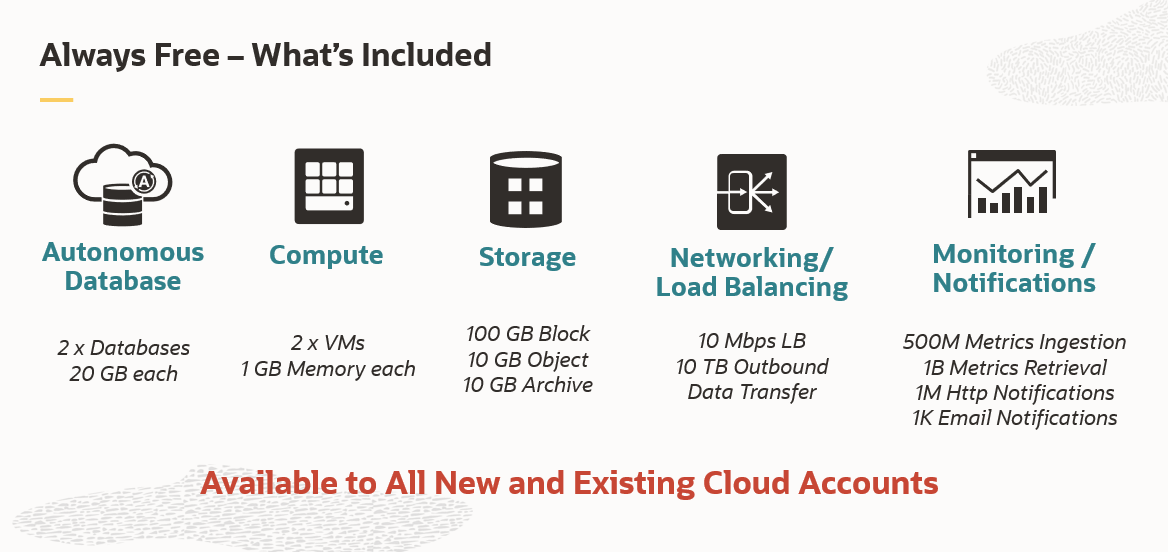
Oracle Cloud Infrastructure has a generous free tier, moreso than other hyperscalers, with an always-free tier that guarantees certain products are always free
Oracle Cloud Infrastructure allows you to size VMs with differing combinations of CPU and RAM, which is contrary to other hyperscalers that have specific pre-defined combinations only
The brand relation between Java and WebLogic Application Server usually provides a quicker access to programming features and their availability for the applications deployed.
The access to centralized configuration both from console and command line WLST eases the implementation of changes major or not in an organized and expedite way.
The maturity of the product is also visible in the available tools provided by the product itself, for both monitoring of resources and alerting for availability and thresholds
MOD_CLUSTER integration. JBoss EAP integrates pretty well with mod_cluster. This is an intelligent load balancer especially useful in highly clustered environments.
Supports enterprise-grade features such as high availability clustering, distributed caching, messaging etc.
Supports deployment in on-premise, virtual and hybrid cloud environments.
Navigating the UI takes lots of getting used to. It reminds me of older GCP (just to get used to where everything is).
Permission for different things always seemed to be more difficult than it really needed to be. Once you got them set up you were good but updating anything or creating new permissions for just about anything took longer than I thought it should.
Based on how the buttons were laid out, it was pretty easy to delete all of your DNS records, and backing them up was not as intuitive as I'd like with the UI, but it was easy to do using a script.
Debugging issues has been difficult sometimes, the documentation is too dense and finding the the root cause for an specific issue takes time.
The Oracle WebLogic Server console UI feels old and gives a sense of lack of innovation even though it provides so much functionality.
I'm not sure if Oracle WebLogic Server supports more modern frameworks, but it feels more like a Java EE specific, maybe there's an opportunity there to appeal to newer application platforms
Reliability: Very dependable and stable OCI services have been for the business operations.Performance: The speed and efficiency of OCI in meeting their computing and storage needs.Scalability: The ease and effectiveness of scaling resources up or down to accommodate changing demands.Security: The robustness and effectiveness of OCI's security features in protecting their data and applications.
The services & products in Oracle Cloud Infrastructure needs more improvement to beat other Cloud service providers. The price is good & Security processes are good. We are requiring to put more effort in supporting this Oracle Cloud Infrastructure than other Cloud service providers. Probably better ways are there but is not super easy to find or not super available
Oracle WebLogic Server has so many features that sometimes it's hard to find the right place to setup things, I think the dated user interface does not help with that either. This has a direct impact when deciding to use it as your application server, you'd need to have the right people and invest the time needed to master it. If you're application justifies it then it will definitely be a great choice in the long run.
Yeah sometimes we had to face unplanned outages due to underlying infrastructure issues, so not every time,e but once in a while we face issues with availability. But the good thing is we have redundancy with DR setup and multi region so we can manage.
From the start, I was surprised by response times and image quality accessing windows VMs with RDP. GCP, Azure and -many offerings in AWS- don't perform this speed. Also, that's evident in the quality of Infrastructure Management Team, because I just received one warning regarding a region failure, what confirms that's a mature platform.
JBoss EAP is lightweight and doesn't really consumes much physical resources. It's high performing and suites well for high transaction Java enterprise applications. The out of box performance settings are not really great and you will have to configure the settings to suite your environment to leverage it's full benefits.
Overall it is amazing, there is always room for improvement. We have weekly updates that tend to slow the program used more and more. We had to change some reports within Oracle because the others wouldn’t load. This is tied to our payroll and the delays are causing many time constraint issues and panic. We have to create a new report when one breaks. Otherwise awesome!
We used Microsoft Azure and Docker earlier and faced some difficulties like Microsoft Azure and Docker. Occasionally, the generation of large images can delay deployment. It is also necessary for me to admit that Microsoft Azure and Docker have a somewhat steep learning curve. Proper paperwork needs to be there. Docker has issues with performance on a number of platforms. On the other hand, OCI is easy to deploy and easy to understand.
I believe the Oracle WebLogic Suite is probably a better all encompassing suite of development tools for the IT department. [It] is probably a bit more expensive than other competitors like Apache Tomcat or NGINX, but is worth the investment if you consider the savings from time to get code into production.
was not part of initial purchase team. Anyways, i think unit pricing and billing frequency is good compared to other Cloud service providers, when it comes to Cloud Capital expenditure & Operational expenditure. Would be more interested in exploring more options where customers can get more cost relaxations on trying out new cloud services in Oracle Cloud Infrastructure for example a new App or a feature
We have hosted around 500 + customers on this cloud so till day not faced any major issues, so we can use it for any kind of products and it can hold the load and easily scale based on need.
Services & Infra wise is ok to use & host applications & services. Security wise also good for a Cloud service provider. It is a interesting area to explore & using it for day to day needs can be further improvised in future probably. Modern day Services like AI and Machine learning could be improved
WebLogic Application Server definitely had a positive ROI since all the applications are deployed on a single platform and making maintenance extremely cost effective.
Since all major cloud vendors support and maintain WebLogic, it gives us an opportunity to explore possibilities to move the organizational infrastructure on to the cloud without too much effort.
Jboss EAP is easy to deploy and configure. This lead to lower cost and faster delivery.
Even though we have large number of machines running JBoss, we have only two Jboss Administrators. It doesn't requires too much administration and maintenance on daily basis and reduces number of administrators required for large implementations.