Oracle Database, currently in edition 23ai, is a converged, multimodel database management system. It is designed to simplify development for AI, microservices, graph, document, spatial, and relational applications.
$0.05
per hour
SAP Master Data Governance
Score8 out of 10
N/A
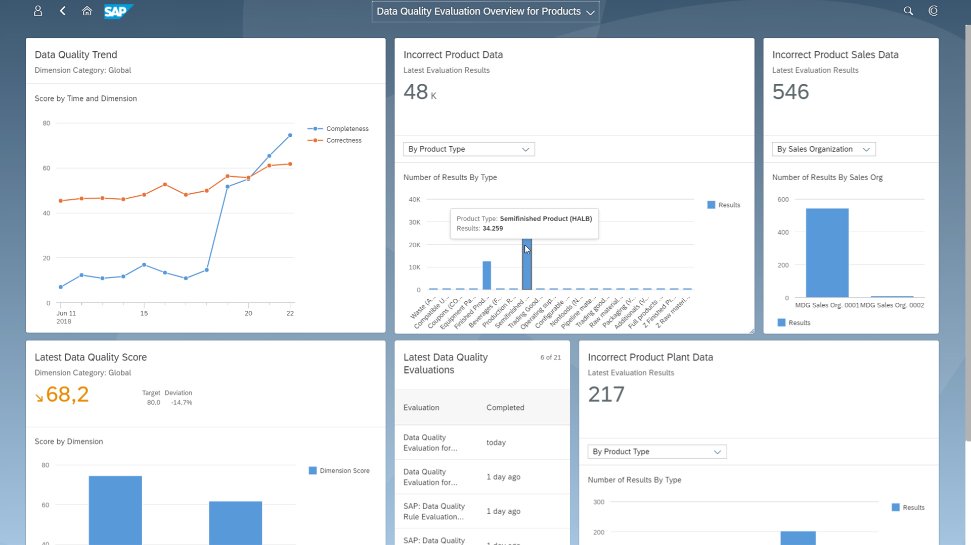
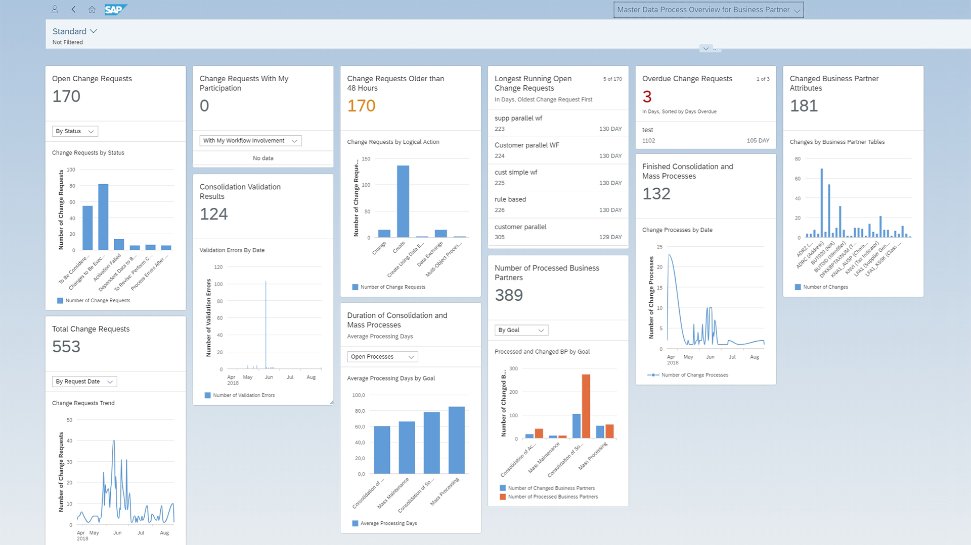
SAP Master Data Governance is a master data management solution that helps users to implement a cohesive and harmonized master data management strategy across all master data domains. It is presented as a solution that simplifies enterprise data management, increases data accuracy, and that facilitates consolidation, central governance and data quality management. The SAP Master Data Governance, cloud edition, a…
We migrated from NoSQL to an Oracle database. One of the reasons was robust backup and recovery options available in the Oracle database, which provide zero data loss. A transactional database like Oracle is a better fit for our use case than NoSQL. On a large scale, deployment was evaluated as a cheaper option than the NoSQL engine. This conclusion came even after considering Oracle license is expensive.
A de minimis incentive was given to thank the reviewer for their time. The incentive was not used to bias or drive a particular response, nor was the incentive contingent on a positive endorsement. More Info
The best use case of SAP Master Data Governance is centrally consolidating your organizational data so you can make sense of it and make business decisions using that data. We live in a world where data can be all over the place, and making sense of it is a skill of its own.
A de minimis incentive was given to thank the reviewer for their time. The incentive was not used to bias or drive a particular response, nor was the incentive contingent on a positive endorsement. More Info
A de minimis incentive was given to thank the reviewer for their time. The incentive was not used to bias or drive a particular response, nor was the incentive contingent on a positive endorsement. More Info
Data conversation and Data uploading into SAP S/4 HANA system using SAP Master Data Governance during SAP implementation phase.
Centrally Data governance to have visibility of data in different systems with integration to SAP Master Data Governance, including SAP S/4, SAP EWM and SAP Ariba.
Data Management and Data correction using MDM through SAP Master Data Governance for Materials, which is subjected to approval before finally using in the S/4.
A de minimis incentive was given to thank the reviewer for their time. The incentive was not used to bias or drive a particular response, nor was the incentive contingent on a positive endorsement. More Info
A de minimis incentive was given to thank the reviewer for their time. The incentive was not used to bias or drive a particular response, nor was the incentive contingent on a positive endorsement. More Info
We've had to design our own unique or alternative solutions to satisfy our business objectives because plugins don't always perform well with the main product.
It can be sluggish at times and lacks functionality offered by rival MDM packages, as well as limited resources and documentation for certain areas such as hierarchy.
A de minimis incentive was given to thank the reviewer for their time. The incentive was not used to bias or drive a particular response, nor was the incentive contingent on a positive endorsement. More Info
There is a lot of sunk cost in a product like Oracle 12c. It is doing a great job, it would not provide us much benefit to switch to another product even if it did the same thing due to the work involved in making such a switch. It would not be cost effective.
A de minimis incentive was given to thank the reviewer for their time. The incentive was not used to bias or drive a particular response, nor was the incentive contingent on a positive endorsement. More Info
MDG has proven to work and to bring results once implemented with the right approach, right engagement and sponsorship. Given that it is a very good tool to govern and control master data. Mainly if your company runs SAP systems which there will be a very straight forward integration, not needing any additional middleware or technologies.
A de minimis incentive was given to thank the reviewer for their time. The incentive was not used to bias or drive a particular response, nor was the incentive contingent on a positive endorsement. More Info
Many of the powerful options can be auto-configured but there are still many things to take into account at the moment of installing and configuring an Oracle Database, compared with SQL Server or other databases. At the same time, that extra complexity allows for detailed configuration and guarantees performance, scalability, availability and security.
A de minimis incentive was given to thank the reviewer for their time. The incentive was not used to bias or drive a particular response, nor was the incentive contingent on a positive endorsement. More Info
Upto 8 1. Powerful Features: It offers a wide range of powerful features. 2. Complex Data Management: It helps companies to comply with large and complex regulation and audit processes. Missing 2: 1. Less interactive user interface or less modern look. 2. Limited integration with other tools
A de minimis incentive was given to thank the reviewer for their time. The incentive was not used to bias or drive a particular response, nor was the incentive contingent on a positive endorsement. More Info
1. I have very good experience with Oracle Database support team. Oracle support team has pool of talented Oracle Analyst resources in different regions. To name a few regions - EMEA, Asia, USA(EST, MST, PST), Australia. Their support staffs are very supportive, well trained, and customer focused. Whenever I open Oracle Sev1 SR(service request), I always get prompt update on my case timely. 2. Oracle has zoom call and chat session option linked to Oracle SR. Whenever you are in Oracle portal - you can chat with the Oracle Analyst who is working on your case. You can request for Oracle zoom call thru which you can share the your problem server screen in no time. This is very nice as it saves lot of time and energy in case you have to follow up with oracle support for your case. 3.Oracle has excellent knowledge base in which all the customer databases critical problems and their solutions are well documented. It is very easy to follow without consulting to support team at first.
A de minimis incentive was given to thank the reviewer for their time. The incentive was not used to bias or drive a particular response, nor was the incentive contingent on a positive endorsement. TR verified that a representative sample of customers was invited. More Info
SAP provides great support for Master Data Governance (MDG). They work with us when we are faced with issues in standard solutions. SAP has a great set of Fiori tools that can be used for a better user experience. The issue with SAP is their web dynpro UI screens and they need to provide better support for performance issues that customers face.
A de minimis incentive was given to thank the reviewer for their time. The incentive was not used to bias or drive a particular response, nor was the incentive contingent on a positive endorsement. TR verified that a representative sample of customers was invited. More Info
Overall the implementation went very well and after that everything came out as expected - in terms of performance and scalability. People should always install and upgrade a stable version for production with the latest patch set updates, test properly as much as possible, and should have a backup plan if anything unexpected happens
A de minimis incentive was given to thank the reviewer for their time. The incentive was not used to bias or drive a particular response, nor was the incentive contingent on a positive endorsement. TR verified that a representative sample of customers was invited. More Info
Because of a rich user base and support for any critical issue, this is one of the best options to choose. In case the project has a TCO issue, it can compromise and choose Postgres as the best alternative. SQL server is also good and easy to code and maintain but performance is not as good as the Oracle
A de minimis incentive was given to thank the reviewer for their time. The incentive was not used to bias or drive a particular response, nor was the incentive contingent on a positive endorsement. More Info
An environment provided by SAP Master Data Governance seamless and integration with other SAP products is very good. Also it ensures compatibility and streamlines procedures, this integration is beneficial for businesses who have already invested in SAP products.
A de minimis incentive was given to thank the reviewer for their time. The incentive was not used to bias or drive a particular response, nor was the incentive contingent on a positive endorsement. More Info
A de minimis incentive was given to thank the reviewer for their time. The incentive was not used to bias or drive a particular response, nor was the incentive contingent on a positive endorsement. More Info
MDG is definitely an investment that takes a few years to recuperate. (If you are looking at pure, direct financial benefits.)
However, if you look at all the productivity gains in the business due to not having to stop the business constantly because of data issues, the payback period would be substantially shorter.
In particular, we were able to reduce master data maintenance staffing levels while increasing quality and decreasing workload for business requesters and approvers.
Not having to worry about data integrity issues has shortened the time to realize benefits for several of our major process change related projects and it has also decreased the risk of these projects running into significant delays (often at the last minute) due to master data being misjudged during the process resdesign.
A de minimis incentive was given to thank the reviewer for their time. The incentive was not used to bias or drive a particular response, nor was the incentive contingent on a positive endorsement. More Info