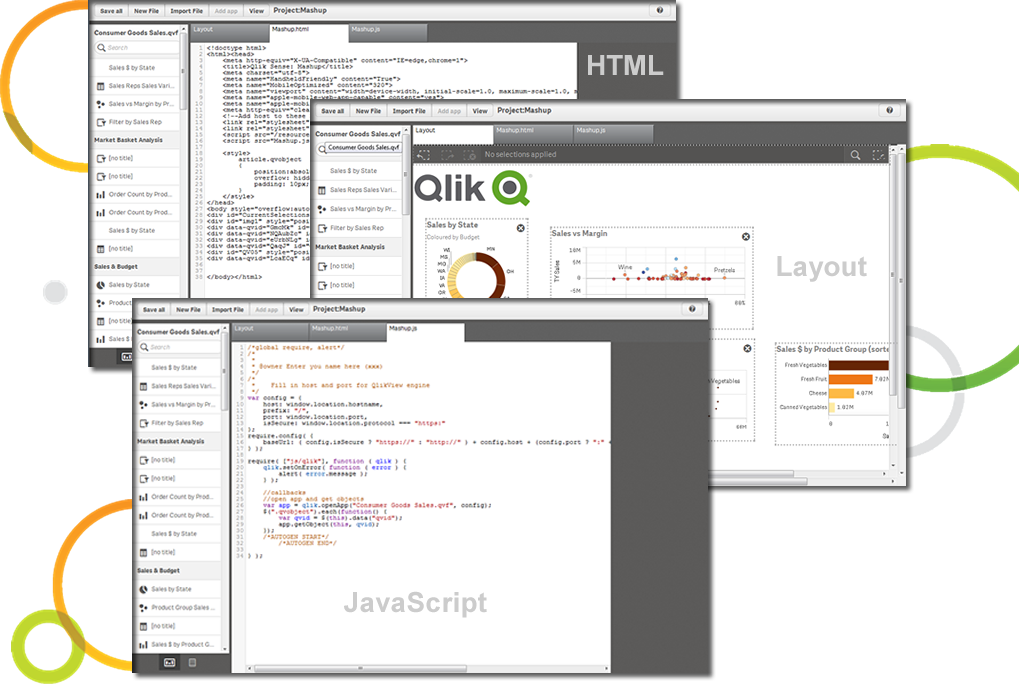
Qlik Sense® is a self-service BI platform for data discovery and visualization. It supports a full range of analytics use cases—data governance, pixel-perfect reporting, and collaboration. Its Associative Engine indexes and connects relationships between data points for creating actionable insights.
$200
per month
Amazon Redshift
Score8.9 out of 10
N/A
Amazon Redshift is a hosted data warehouse solution, from Amazon Web Services.
$0.24
per GB per month
Pricing
Qlik Cloud Analytics (Qlik Sense)
Amazon Redshift
Editions & Modules
Starter
$200
per month
Standard
$825
per month
Premium
$2750
per month
Qlik Sense (On-Premise)
Contact Sales
Redshift Managed Storage
$0.24
per GB per month
Current Generation
$0.25 - $13.04
per hour
Previous Generation
$0.25 - $4.08
per hour
Redshift Spectrum
$5.00
per terabyte of data scanned
Offerings
Pricing Offerings
Qlik Cloud Analytics (Qlik Sense)
Amazon Redshift
Free Trial
No
No
Free/Freemium Version
No
No
Premium Consulting/Integration Services
Yes
No
Entry-level Setup Fee
No setup fee
No setup fee
Additional Details
—
—
More Pricing Information
Community Pulse
Qlik Cloud Analytics (Qlik Sense)
Amazon Redshift
Considered Both Products
Qlik
Verified User
Chose Qlik Cloud Analytics (Qlik Sense)
PowerBI ranks higher in terms of UI capabilities currently and Quicksight is cheaper than Qliksense. For the features Qliksense provided 3 years ago, we found it to be the best tool for the org, as the org had people with relevant experience.
A de minimis incentive was given to thank the reviewer for their time. The incentive was not used to bias or drive a particular response, nor was the incentive contingent on a positive endorsement. More Info
A de minimis incentive was given to thank the reviewer for their time. The incentive was not used to bias or drive a particular response, nor was the incentive contingent on a positive endorsement. More Info
Qlik Sense is a program whose purpose is to greatly improve all your operations and use of all data in an organic way. The mission will always be to increase the economic and commercial processes of the company in a short time. I recommended it for its high technology, which was Created for this area, the results are successful. We have noticed how it has increased relationships with our clients thanks to the credibility and security that we provide.
A de minimis incentive was given to thank the reviewer for their time. The incentive was not used to bias or drive a particular response, nor was the incentive contingent on a positive endorsement. More Info
If the number of connections is expected to be low, but the amounts of data are large or projected to grow it is a good solutions especially if there is previous exposure to PostgreSQL. Speaking of Postgres, Redshift is based on several versions old releases of PostgreSQL so the developers would not be able to take advantage of some of the newer SQL language features. The queries need some fine-tuning still, indexing is not provided, but playing with sorting keys becomes necessary. Lastly, there is no notion of the Primary Key in Redshift so the business must be prepared to explain why duplication occurred (must be vigilant for)
A de minimis incentive was given to thank the reviewer for their time. The incentive was not used to bias or drive a particular response, nor was the incentive contingent on a positive endorsement. More Info
A de minimis incentive was given to thank the reviewer for their time. The incentive was not used to bias or drive a particular response, nor was the incentive contingent on a positive endorsement. More Info
[Amazon] Redshift has Distribution Keys. If you correctly define them on your tables, it improves Query performance. For instance, we can define Mapping/Meta-data tables with Distribution-All Key, so that it gets replicated across all the nodes, for fast joins and fast query results.
[Amazon] Redshift has Sort Keys. If you correctly define them on your tables along with above Distribution Keys, it further improves your Query performance. It also has Composite Sort Keys and Interleaved Sort Keys, to support various use cases
[Amazon] Redshift is forked out of PostgreSQL DB, and then AWS added "MPP" (Massively Parallel Processing) and "Column Oriented" concepts to it, to make it a powerful data store.
[Amazon] Redshift has "Analyze" operation that could be performed on tables, which will update the stats of the table in leader node. This is sort of a ledger about which data is stored in which node and which partition with in a node. Up to date stats improves Query performance.
A de minimis incentive was given to thank the reviewer for their time. The incentive was not used to bias or drive a particular response, nor was the incentive contingent on a positive endorsement. More Info
A de minimis incentive was given to thank the reviewer for their time. The incentive was not used to bias or drive a particular response, nor was the incentive contingent on a positive endorsement. More Info
We've experienced some problems with hanging queries on Redshift Spectrum/external tables. We've had to roll back to and old version of Redshift while we wait for AWS to provide a patch.
Redshift's dialect is most similar to that of PostgreSQL 8. It lacks many modern features and data types.
Constraints are not enforced. We must rely on other means to verify the integrity of transformed tables.
A de minimis incentive was given to thank the reviewer for their time. The incentive was not used to bias or drive a particular response, nor was the incentive contingent on a positive endorsement. More Info
Qlik Sense is a constantly improving it's software and working with its' users to make it better. They are great at keeping their users informed of progress and care about delivering a quality product
A de minimis incentive was given to thank the reviewer for their time. The incentive was not used to bias or drive a particular response, nor was the incentive contingent on a positive endorsement. TR verified that a representative sample of customers was invited. More Info
Qlik Sense has a better and easy to learn user interface compared with other analytics tool which always help us to create regular and adhoc reports within the stipulated time frame and can be easily refreshed at a scheduled time and sent to multiple stakeholders for timely update regarding the Key metrics indicator.
A de minimis incentive was given to thank the reviewer for their time. The incentive was not used to bias or drive a particular response, nor was the incentive contingent on a positive endorsement. More Info
Just very happy with the product, it fits our needs perfectly. Amazon pioneered the cloud and we have had a positive experience using RedShift. Really cool to be able to see your data housed and to be able to query and perform administrative tasks with ease.
A de minimis incentive was given to thank the reviewer for their time. The incentive was not used to bias or drive a particular response, nor was the incentive contingent on a positive endorsement. More Info
Qlik is great for companies with lots of business domains and departments because it scales well, especially if data that is reported is saved in SQL and similar structures. Its ease of use and good UI enables business units to create and manage their own reports. That removes a great burden of creating and managing/modifying these pages from the IT team. Overall, it's a win-win for both IT and business units.
A de minimis incentive was given to thank the reviewer for their time. The incentive was not used to bias or drive a particular response, nor was the incentive contingent on a positive endorsement. More Info
The support was great and helped us in a timely fashion. We did use a lot of online forums as well, but the official documentation was an ongoing one, and it did take more time for us to look through it. We would have probably chosen a competitor product had it not been for the great support
A de minimis incentive was given to thank the reviewer for their time. The incentive was not used to bias or drive a particular response, nor was the incentive contingent on a positive endorsement. More Info
A de minimis incentive was given to thank the reviewer for their time. The incentive was not used to bias or drive a particular response, nor was the incentive contingent on a positive endorsement. More Info
A de minimis incentive was given to thank the reviewer for their time. The incentive was not used to bias or drive a particular response, nor was the incentive contingent on a positive endorsement. More Info
A de minimis incentive was given to thank the reviewer for their time. The incentive was not used to bias or drive a particular response, nor was the incentive contingent on a positive endorsement. More Info
The customization of the platform opens up plenty of other options depending on the use cases. The API layer is incredibly rich and makes integration of Qlik based visualization into web pages a simple and effective pattern. It's been very easy to use with a great community made up of professionals. Qlik Sense has introduces artificial Intelligence into my data visualization and reporting activity.
Than Vertica: Redshift is cheaper and AWS integrated (which was a plus because the whole company was on AWS). Than BigQuery: Redshift has a standard SQL interface, though recently I heard good things about BigQuery and would try it out again. Than Hive: Hive is great if you are in the PB+ range, but latencies tend to be much slower than Redshift and it is not suited for ad-hoc applications.
A de minimis incentive was given to thank the reviewer for their time. The incentive was not used to bias or drive a particular response, nor was the incentive contingent on a positive endorsement. More Info
Redshift is relatively cheaper tool but since the pricing is dynamic, there is always a risk of exceeding the cost. Since most of our team is using it as self serve and there is no continuous tracking by a dedicated team, it really needs time & effort on analyst's side to know how much it is going to cost.
A de minimis incentive was given to thank the reviewer for their time. The incentive was not used to bias or drive a particular response, nor was the incentive contingent on a positive endorsement. More Info
A de minimis incentive was given to thank the reviewer for their time. The incentive was not used to bias or drive a particular response, nor was the incentive contingent on a positive endorsement. TR verified that a representative sample of customers was invited. More Info
Our company is moving to the AWS infrastructure, and in this context moving the warehouse environments to Redshift sounds logical regardless of the cost.
Development organizations have to operate in the Dev/Ops mode where they build and support their apps at the same time.
Hard to estimate the overall ROI of moving to Redshift from my position. However, running Redshift seems to be inexpensive compared to all the licensing and hardware costs we had on our RDBMS platform before Redshift.
A de minimis incentive was given to thank the reviewer for their time. The incentive was not used to bias or drive a particular response, nor was the incentive contingent on a positive endorsement. More Info