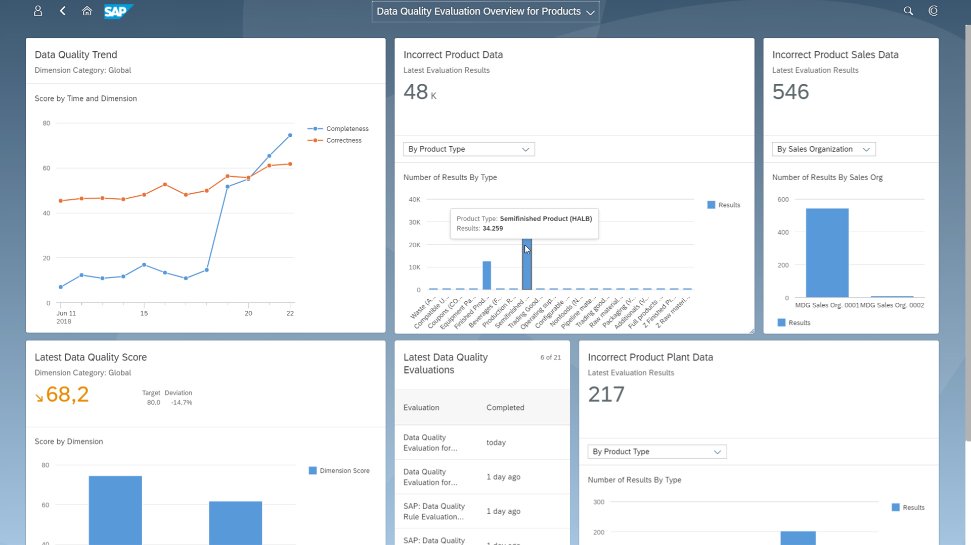
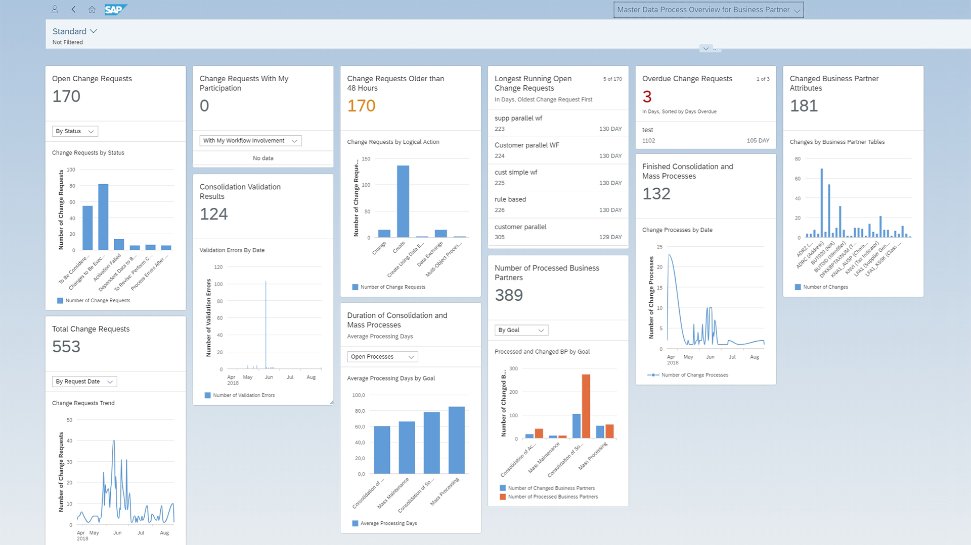
SAP Master Data Governance is a master data management solution that helps users to implement a cohesive and harmonized master data management strategy across all master data domains. It is presented as a solution that simplifies enterprise data management, increases data accuracy, and that facilitates consolidation, central governance and data quality management. The SAP Master Data Governance, cloud edition, a…
N/A
Snowflake
Score8.7 out of 10
N/A
The Snowflake Cloud Data Platform is the eponymous data warehouse with, from the company in San Mateo, a cloud and SQL based DW that aims to allow users to unify, integrate, analyze, and share previously siloed data in secure, governed, and compliant ways. With it, users can securely access the Data Cloud to share live data with customers and business partners, and connect with other organizations doing business as data consumers, data providers, and data service providers.
Director in Information Technology at Kimberly-Clark (Consumer Goods, 10,001+ employees)
Chose SAP Master Data Governance
SAP Master Data Governance was the best choice for us since 50% of our business enterprise software consists of different SAP ERP software modules and SAP Master Data Governance integrates and manages data the best if from predominantly SAP ecosystems like ours.
A de minimis incentive was given to thank the reviewer for their time. The incentive was not used to bias or drive a particular response, nor was the incentive contingent on a positive endorsement. More Info
The best use case of SAP Master Data Governance is centrally consolidating your organizational data so you can make sense of it and make business decisions using that data. We live in a world where data can be all over the place, and making sense of it is a skill of its own.
A de minimis incentive was given to thank the reviewer for their time. The incentive was not used to bias or drive a particular response, nor was the incentive contingent on a positive endorsement. More Info
Snowflake is well suited when you have to store your data and you want easy scalability and increase or decrease the storage per your requirement. You can also control the computing cost, and if your computing cost is less than or equal to 10% of your storage cost, then you don't have to pay for computing, which makes it cost-effective as well.
A de minimis incentive was given to thank the reviewer for their time. The incentive was not used to bias or drive a particular response, nor was the incentive contingent on a positive endorsement. More Info
Data conversation and Data uploading into SAP S/4 HANA system using SAP Master Data Governance during SAP implementation phase.
Centrally Data governance to have visibility of data in different systems with integration to SAP Master Data Governance, including SAP S/4, SAP EWM and SAP Ariba.
Data Management and Data correction using MDM through SAP Master Data Governance for Materials, which is subjected to approval before finally using in the S/4.
A de minimis incentive was given to thank the reviewer for their time. The incentive was not used to bias or drive a particular response, nor was the incentive contingent on a positive endorsement. More Info
Snowflake scales appropriately allowing you to manage expense for peak and off peak times for pulling and data retrieval and data centric processing jobs
Snowflake offers a marketplace solution that allows you to sell and subscribe to different data sources
Snowflake manages concurrency better in our trials than other premium competitors
Snowflake has little to no setup and ramp up time
Snowflake offers online training for various employee types
A de minimis incentive was given to thank the reviewer for their time. The incentive was not used to bias or drive a particular response, nor was the incentive contingent on a positive endorsement. More Info
We've had to design our own unique or alternative solutions to satisfy our business objectives because plugins don't always perform well with the main product.
It can be sluggish at times and lacks functionality offered by rival MDM packages, as well as limited resources and documentation for certain areas such as hierarchy.
A de minimis incentive was given to thank the reviewer for their time. The incentive was not used to bias or drive a particular response, nor was the incentive contingent on a positive endorsement. More Info
Do not force customers to renew for same or higher amount to avoid loosing unused credits. Already paid credits should not expire (at least within a reasonable time frame), independent of renewal deal size.
A de minimis incentive was given to thank the reviewer for their time. The incentive was not used to bias or drive a particular response, nor was the incentive contingent on a positive endorsement. More Info
MDG has proven to work and to bring results once implemented with the right approach, right engagement and sponsorship. Given that it is a very good tool to govern and control master data. Mainly if your company runs SAP systems which there will be a very straight forward integration, not needing any additional middleware or technologies.
A de minimis incentive was given to thank the reviewer for their time. The incentive was not used to bias or drive a particular response, nor was the incentive contingent on a positive endorsement. More Info
SnowFlake is very cost effective and we also like the fact we can stop, start and spin up additional processing engines as we need to. We also like the fact that it's easy to connect our SQL IDEs to Snowflake and write our queries in the environment that we are used to
A de minimis incentive was given to thank the reviewer for their time. The incentive was not used to bias or drive a particular response, nor was the incentive contingent on a positive endorsement. More Info
Upto 8 1. Powerful Features: It offers a wide range of powerful features. 2. Complex Data Management: It helps companies to comply with large and complex regulation and audit processes. Missing 2: 1. Less interactive user interface or less modern look. 2. Limited integration with other tools
A de minimis incentive was given to thank the reviewer for their time. The incentive was not used to bias or drive a particular response, nor was the incentive contingent on a positive endorsement. More Info
Because the fact that you can query tons of data in a few seconds is incredible, it also gives you a lot of functions to format and transform data right in your query, which is ideal when building data models in BI tools like Power BI, it is available as a connector in the most used BI tools worldwide.
A de minimis incentive was given to thank the reviewer for their time. The incentive was not used to bias or drive a particular response, nor was the incentive contingent on a positive endorsement. More Info
SAP provides great support for Master Data Governance (MDG). They work with us when we are faced with issues in standard solutions. SAP has a great set of Fiori tools that can be used for a better user experience. The issue with SAP is their web dynpro UI screens and they need to provide better support for performance issues that customers face.
A de minimis incentive was given to thank the reviewer for their time. The incentive was not used to bias or drive a particular response, nor was the incentive contingent on a positive endorsement. TR verified that a representative sample of customers was invited. More Info
We have had terrific experiences with Snowflake support. They have drilled into queries and given us tremendous detail and helpful answers. In one case they even figured out how a particular product was interacting with Snowflake, via its queries, and gave us detail to go back to that product's vendor because the Snowflake support team identified a fault in its operation. We got it solved without lots of back-and-forth or finger-pointing because the Snowflake team gave such detailed information.
A de minimis incentive was given to thank the reviewer for their time. The incentive was not used to bias or drive a particular response, nor was the incentive contingent on a positive endorsement. More Info
A de minimis incentive was given to thank the reviewer for their time. The incentive was not used to bias or drive a particular response, nor was the incentive contingent on a positive endorsement. TR verified that a representative sample of customers was invited. More Info
An environment provided by SAP Master Data Governance seamless and integration with other SAP products is very good. Also it ensures compatibility and streamlines procedures, this integration is beneficial for businesses who have already invested in SAP products.
A de minimis incentive was given to thank the reviewer for their time. The incentive was not used to bias or drive a particular response, nor was the incentive contingent on a positive endorsement. More Info
I have had the experience of using one more database management system at my previous workplace. What Snowflake provides is better user-friendly consoles, suggestions while writing a query, ease of access to connect to various BI platforms to analyze, [and a] more robust system to store a large amount of data. All these functionalities give the better edge to Snowflake.
A de minimis incentive was given to thank the reviewer for their time. The incentive was not used to bias or drive a particular response, nor was the incentive contingent on a positive endorsement. More Info
MDG is definitely an investment that takes a few years to recuperate. (If you are looking at pure, direct financial benefits.)
However, if you look at all the productivity gains in the business due to not having to stop the business constantly because of data issues, the payback period would be substantially shorter.
In particular, we were able to reduce master data maintenance staffing levels while increasing quality and decreasing workload for business requesters and approvers.
Not having to worry about data integrity issues has shortened the time to realize benefits for several of our major process change related projects and it has also decreased the risk of these projects running into significant delays (often at the last minute) due to master data being misjudged during the process resdesign.
A de minimis incentive was given to thank the reviewer for their time. The incentive was not used to bias or drive a particular response, nor was the incentive contingent on a positive endorsement. More Info
A de minimis incentive was given to thank the reviewer for their time. The incentive was not used to bias or drive a particular response, nor was the incentive contingent on a positive endorsement. More Info