SpecFlow is an open source BDD for .NET. that aims to bridge the communication gap between domain experts and developers by binding readable behavior specifications to the underlying implementation.
N/A
Tricentis Tosca
Score8.8 out of 10
N/A
Tricentis Tosca provides an approach to test
automation that is AI-powered, codeless, and end-to-end so it can test
everything in a complex IT landscape, to ensure business processes
work flawlessly no matter where changes occurs.
Its 160+ technology support helps users test everything at
the UI, API and data layer, including virtually any enterprise, custom,
homegrown and mobile application.
With its model-based approach, Tosca enables business,
QA and IT teams to…
It is best suited for implementing the automated test cases in a human readable form so it's easy for non-technical members of the team and stakeholders to understand the test cases, features and the functionalities of the application. Automation of Integration tests and End to End tests are good use case. It is less appropriate or situations where the focus is only on the writing and maintenance of unit tests.
A de minimis incentive was given to thank the reviewer for their time. The incentive was not used to bias or drive a particular response, nor was the incentive contingent on a positive endorsement. More Info
I still love to test some desktop applications as well as API's with Tosca. For web applications Tosca is OK but there are better alternatives. As a user, Tosca is really great to work with as you can set up a clean project quite fast. It is also quite easy to make a mess as a non-experienced user, using configurations (but in the wrong way), using TCD (but in the wrong way). It would help if there was more focus on generic test automation fundamentals, many more clear examples and instead of just mentioning the best practices, make users really understand the best practices so they know how and when to (not) apply them.
A de minimis incentive was given to thank the reviewer for their time. The incentive was not used to bias or drive a particular response, nor was the incentive contingent on a positive endorsement. More Info
Versatility to be used in combination with different kinds of automated testing like automated performance testing, API testing, UI testing etc. I use JavaScript, Selenium, C#, email testing libraries, database testing libraries in combination with BDD with SpecFlow. I am able to use all these with SpecFlow to make my automation framework to be able to automate any kind of automated testing.
It provides different widely used runner options like NUnit, XUnit etc. Before I started to work on establishing proper test automation in my workplace, the previous automation framework (non-BDD based) as well as unit tests used NUnit runner. The transition to using BDD was smooth because we could use the same runner and there were no compatibility issues.
The auto-complete feature is good. I use it with Visual Studio as well as Rider and I don't have to recall the entire Gherkin statements. I just type a few words and the entire Gherkin statement implemented in framework is auto-suggested by SpecFlow. It saves time and context switching.
A de minimis incentive was given to thank the reviewer for their time. The incentive was not used to bias or drive a particular response, nor was the incentive contingent on a positive endorsement. More Info
Ease of maintenance with the help of Reusable TestStep Blocks (Libraries)
Flexible and scalable execution infrastructure to support organizations to ramp up or ramp down the resources based on the requirement.
Various certification courses available on Tricentis Academy to enable users to learn all the available products based on the role desired by the user.
Creation of Execution packs based on the type of testing cycle
AI enabled test case designing with features like test case generation using plain text prompts.
With the help of co pilot, we can now auto generate complex TQL.
Co pilot will summarize what a given test cases will do when executed.
A de minimis incentive was given to thank the reviewer for their time. The incentive was not used to bias or drive a particular response, nor was the incentive contingent on a positive endorsement. More Info
SpecFlow does not accepts optional input variables in the methods defined during Gherkin statement implementation. Cucumber supports optional input variables in the methods defined during Gherkin statement implementation.
The tests identified while using SpecFlow with NUnit removes all white spaces in the scenario names. It makes the tests less readable. If the white spaces are not auto-removed, it would be much better for readability as well as their actual identification in the repository.
A de minimis incentive was given to thank the reviewer for their time. The incentive was not used to bias or drive a particular response, nor was the incentive contingent on a positive endorsement. More Info
Documentation - struggled multiple times with features not explained very well, or not explained at all
The only support is on Tricentis Forums, where, sometimes, based on 'luck' - you will open a support case, and wait few days until you get the chance to speak with someone from Tricentis and show case your issue
A de minimis incentive was given to thank the reviewer for their time. The incentive was not used to bias or drive a particular response, nor was the incentive contingent on a positive endorsement. More Info
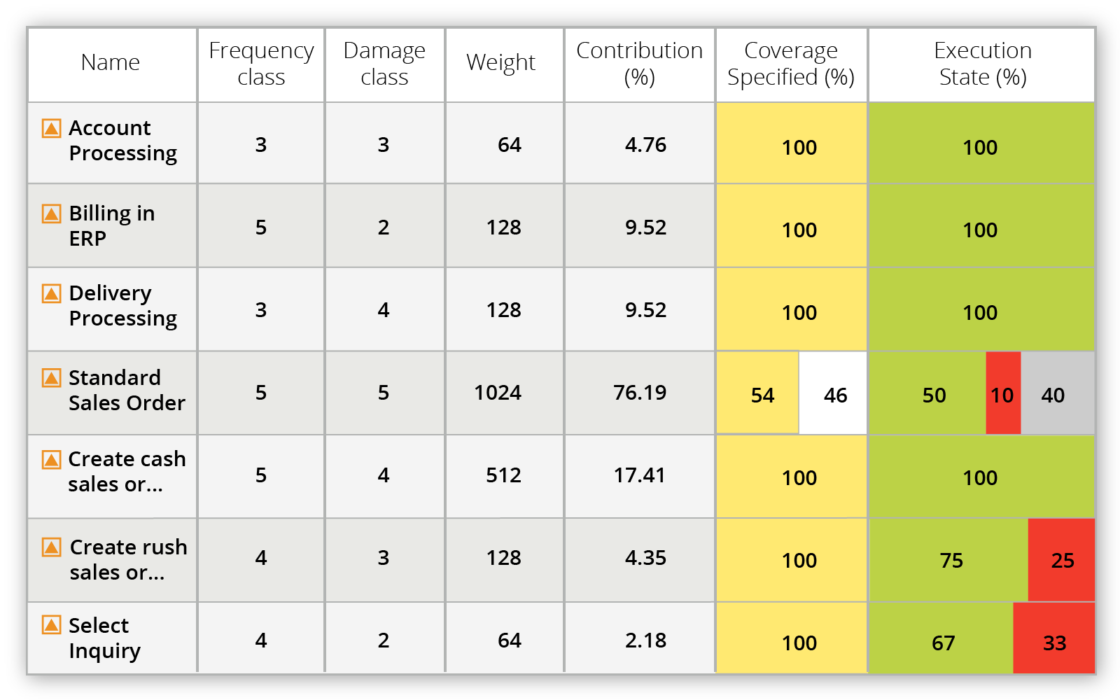
Tricentis Tosca has consistently delivered value through its model‑based, low‑code automation, strong SAP ECC/S/4HANA and Fiori support, and the ability to reuse test assets across regression, upgrades, and transformation projects. Its coverage across SAP, Web, APIs, and desktop within a single platform reduces tool sprawl and maintenance effort, while features like risk‑based testing, CI/CD integration, and business‑readable tests align well with our quality and release goals
A de minimis incentive was given to thank the reviewer for their time. The incentive was not used to bias or drive a particular response, nor was the incentive contingent on a positive endorsement. More Info
Tricentis Tosca supports a large number of technologies and applications. it is easier to start and progress on test automation using Tosca. It is a codeless tool which makes it easier to learn for even a entry level engineer.The modular approach makes it easier to create test cases and maintain them for future enhancements.
A de minimis incentive was given to thank the reviewer for their time. The incentive was not used to bias or drive a particular response, nor was the incentive contingent on a positive endorsement. More Info
Tricentis team was very supportive. Support is expensive but they helped us at many level. Setting up timeline, implementation, precise questions on automation challenges. We had an account manager and technical people we could as to talk to. Support was generally timely and helping. They often proposed to come on site to help us which would cost more but could be helpful
A de minimis incentive was given to thank the reviewer for their time. The incentive was not used to bias or drive a particular response, nor was the incentive contingent on a positive endorsement. More Info
It would be better if the support is betterIt would be better if the support is betterIt would be better if the support is betterIt would be better if the support is betterIt would be better if the support is betterIt would be better if the support is betterIt would be better if the support is betterIt would be better if the support is betterIt would be better if the support is betterif the support is betterIt would be better if the support is betterIt would be better if the support is betterif the support is betterIt would be better if the support is betterIt would be better if the support is betterif the support is betterIt would be better if the support is betterIt would be better if the support is betterif the support is betterIt would be better if the support is betterIt would be better if the support is betterif the support is betterIt would be better if the support is betterIt would be better if the support is betterif the support is betterIt would be better if the support is betterIt would be better if the support is betterif the support is betterIt would be better if the support is betterIt would be better if the support is betterif the support is betterIt would be better if the support is betterIt would be better if the support is betterif the support is betterIt would be better if the support is betterIt would be better if the support is betterif the support is betterIt would be better if the support is betterIt would be better if the support is betterif the support is betterIt would be better if the support is betterIt would be better if the support is betterif the support is betterIt would be better if the support is betterIt would be better if the support is betterif the support is betterIt would be better if the support is betterIt would be better if the support is betterif the support is betterIt would be better if the support is betterIt would be better if the support is betterif the support is betterIt would be better if the support is betterIt would be better if the support is betterif the support is betterIt would be better if the support is betterIt would be better if the support is betterif the support is betterIt would be better if the support is betterIt would be better if the support is betterif the support is betterIt would be better if the support is betterIt would be better if the support is betterif the support is betterIt would be better if the support is betterIt would be better if the support is better
A de minimis incentive was given to thank the reviewer for their time. The incentive was not used to bias or drive a particular response, nor was the incentive contingent on a positive endorsement. TR verified that a representative sample of customers was invited. More Info
okIt would be better if the support is betterIt would be better if the support is betterIt would be better if the support is betterIt would be better if the support is betterIt would be better if the support is betterIt would be better if the support is betterIt would be better if the support is betterIt would be better if the support is betterIt would be better if the support is betterIt would be better if the support is better
A de minimis incentive was given to thank the reviewer for their time. The incentive was not used to bias or drive a particular response, nor was the incentive contingent on a positive endorsement. TR verified that a representative sample of customers was invited. More Info
SpecFlow is .Net based which supports C#. Behave is Python based. Cucumber is Java based. Ghost Inspector is no-code based but provides very limited testing features. We wanted to implement BDD so we rued out using Ghost Inspector. Most of the developers in my team are C# experts so it was decided for everyone's comfort to go for SpecFlow rather than Behave or Cucumber. It's import to have technical experts in the language of the automation framework because there are many situations where the solutions to the test automation needs are not straightforward and implementing those requires expertise in the related programming language.
A de minimis incentive was given to thank the reviewer for their time. The incentive was not used to bias or drive a particular response, nor was the incentive contingent on a positive endorsement. More Info
Tricentis Tosca is codeless and therefore easier to use. It's a great tool for people that would start doing automation and have no coding background. It seems like it has the same capabilities as other test automation suites but I felt it lacked a bit of capabilities on the test management suite such as defects test suites organizations etc
A de minimis incentive was given to thank the reviewer for their time. The incentive was not used to bias or drive a particular response, nor was the incentive contingent on a positive endorsement. TR verified that a representative sample of customers was invited. More Info
Everyone stays on the same page regarding the behavior of existing functionalities whether it be technical or non-technical individuals. So there is less need for multiple people to get involved which saves time and thus money.
Reusing the same code through the implemented Gherkin statement saves test automation time and thus reduces cost.
We combine SpecFlow with other opensource testing technologies to make our automation framework more versatile which further saves costs for us.
A de minimis incentive was given to thank the reviewer for their time. The incentive was not used to bias or drive a particular response, nor was the incentive contingent on a positive endorsement. More Info
It really had a very good impact on our ROI. We were able to automate most of the apps and layers with in it and get a very short execution time which led to increased releases with in short span of time.
Time to market really improved and efficiency of developing scripts was not too bad.
With built in test dashboards, it was easy to pull metrics and share the insights with management.
A de minimis incentive was given to thank the reviewer for their time. The incentive was not used to bias or drive a particular response, nor was the incentive contingent on a positive endorsement. More Info