Splunk is software for searching, monitoring, and analyzing machine-generated big data, via a web-style interface. It captures, indexes and correlates real-time data in a searchable repository from which it can generate graphs, reports, alerts, dashboards and visualizations.
N/A
WhoisXML API IP Geolocation API
Score 8.0 out of 10
N/A
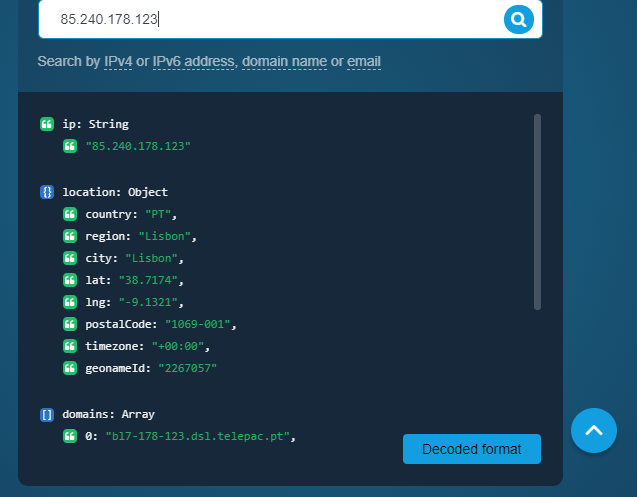
About IP Geolocation API WhoisXML API’s IP Geolocation API is a resource to link an IP address, domain name, or email to its geographical coordinates. For a given input, the API returns various location data points among which the country, city, time zone, postal code, latitude and longitude, ASN type, geoname ID, ISP, as well as associated domains. Marketing Marketers and advertising professionals can use the API to enrich customer profiles with location…
I'm liking the newer products, and I'm looking forward to how they integrate with the overall product when they come together. Just log in and be able to query a large number of systems for similar issues or a unique one. That is a great fit for Splunk Enterprise, looking for a simple case or a simple String or something of that nature across multiple machines. It's a great fit for that to identify issues or particular software, whatever your scenario is, String, to find it across any particular server or group of servers, so that you can update or do a deployment or whatever it is you're looking to do.
On our end, we've mostly used IP Geolocation API for cybersecurity purposes. A particular scenario that comes to mind is when suspicious IP addresses make it to our site from locations we wouldn't expect. In this context, the API integrated into our existing infosec solutions helps us spot those IP addresses so we can decide how to sort them. Also, say that one of our employees receive a phishing email or one that contains a possible malware file. We can use IP Geolocation API to enrich what we know about a sender and add the related IP address to our blocklist if necessary.
Aside from identifying the physical location of an IP address owner, the API also provides users with its Internet service provider and connection type. That is handy information if website owners wish to customize their site loading to match the connection speed of the majority of their visitors.
It doesn’t matter whether website visitors use an IPv4 or IPv6 address in that the API works for both spaces. The records in the API’s database are also updated weekly, so users always get the latest results.
Like most, if not all, IP geolocation services, it does not provide very accurate information down to the street level address. But since we do most of our business transactions online, that doesn’t pose much of a problem for us.
We are using Splunk extensively in our projects and we have recently upgraded to Splunk version 6.0 which is quite efficient and giving expected results. We keep track of updates and new features Splunk introduces periodically and try to introduce those features in our day to day activities for improvement in our reporting system and other tasks.
You can literally throw in a single word into Splunk and it will pull back all instances of that word across all of your logs for the time span you select (provided you have permission to see that data). We have several users who have taken a few of the free courses from Splunk that are able to pull data out of it everyday with little help at all.
Splunk maintains a well resourced support system that has been consistent since we purchased the product. They help out in a timely manner and provide expert level information as needed. We typically open cases online and communicate when possible via e-mail and are able to resolve most issues with that method.
We had a few questions regarding API set up when we started using IP Geolocation API so we reached out to the support team and they promptly helped us out. We have not experienced any glitch with the product and the data sent to us has always been reliable so far.
The online course was simple clear and described the main capabilities of the solution. There is also an initial module that can be done for free so anyone can familiarize themselves with the functionality of this solution. On the other hand, however, there could be more free online courses. Maybe even with a certificate, this would broaden the group of people who are familiar with the platform while increasing familiarity with the solution itself.
A lot of products have natively inside their own dashboards and or their own logging repositories. And each one is difficult to learn or they're too complex or they're not verbose in the sense that they're not easy to mine the data that you're looking for. So that could be anything from the native logging that you find in other Cisco products. It's easier to use Splunk to draw the data that you're looking for as opposed to going to the individual's products themselves to get the logs that you're looking for.
Splunk has allowed developers to diagnose production issues when access of control was taken away from them to be allowed to view items in production environments and I believe that is invaluable.
At times some developers weren't super happy about using it, but it was more of the fact that they were used to having production access and not creating their splunk queries to get information.
Going one place to view logs was very beneficial to have.