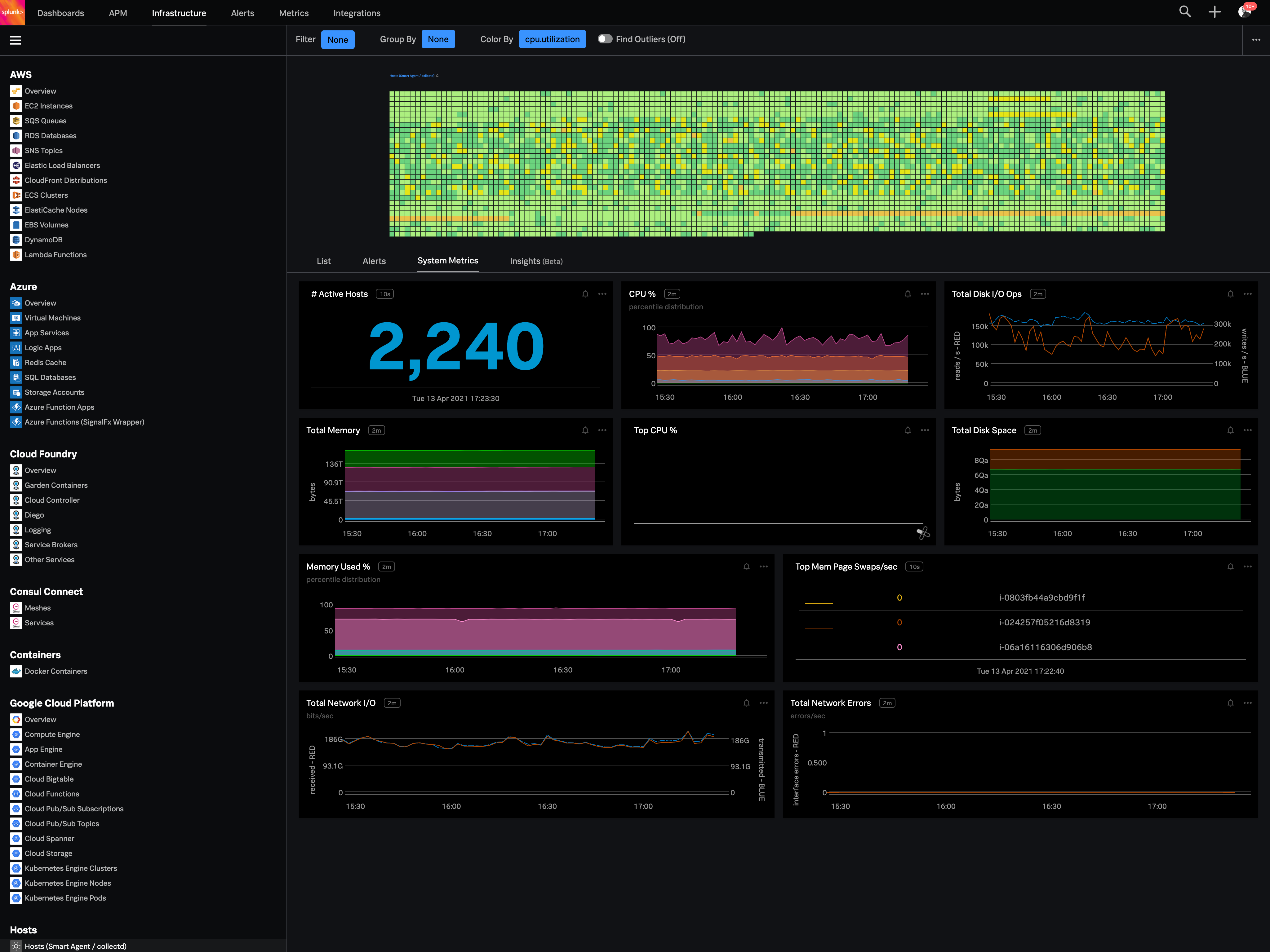
Splunk Observability Cloud aims to enable operational agility and better customer experience through real-time AI-driven streaming analytics allowing accurate alerts in seconds. It is designed to shorten MTTD and MTTR by providing real-time visibility into cloud infrastructure and services.
$180
per year per host
SUSE Rancher
Score9.5 out of 10
N/A
Developed by Rancher Labs and now from SUSE, Rancher is open-source software that enables organizations to deploy and manage Kubernetes at scale, on any infrastructure across the data center, cloud, branch offices, and the network edge. Rancher centrally manages Kubernetes clusters across the organization in order to ensure security and accelerate transformation. Rancher is also available hosted. Hosted Rancher is a fully managed Rancher control plane - presented as the fastest, most cost…
Its great if you need real-time visibility across complex or regulated environments. Also strong for hybrid or multi-cloud setups where uptime, observability and fast IR are required. It’s probably overkill for smaller teams or environments that don’t have constant changes or compliance reporting needs. It's expensive and has a steep learning curve. Also, in my opinion, do not get yourself into a consumption based model. Costs can certainly get out of control quickly.
A de minimis incentive was given to thank the reviewer for their time. The incentive was not used to bias or drive a particular response, nor was the incentive contingent on a positive endorsement. TR verified that a representative sample of customers was invited. More Info
SUSE Rancher as a management tool becomes useful on a larger scale. Small deployments not so much. If someone also requires Kubernetes capacity or storage, Rancher is an excellent choice. Also, without Kubernetes' skills, it is unlikely that Rancher deployment is going to be a success. Then again if someone else is managing your Kubernetes capacity, setting up the software's capacity will yield greater control. Rancher is not a very integrated solution similar to others in the market.
A de minimis incentive was given to thank the reviewer for their time. The incentive was not used to bias or drive a particular response, nor was the incentive contingent on a positive endorsement. More Info
The first one is its Kubernetes container monitoring.
I really like this features because as we know how much K8s is vast and to manually monitor each part of the Kubernetes it takes so much time but Splunk Observability Cloud makes it easier. And even once we integrate K8s with Splunk Observability Cloud it gives us some prebuilt dashboards which gives holistic view of our Cluster and its nodes, pods, etc.
The dashbaord feature of Splunk Observability Cloud, it gives us full flexibility to customize our dashboard with a wide range of predefined chart types.
Now it also supports OTEL, which is a plus point for observability. As now everyone is moving towards Otel and in current market there are only few tools who supports OTEL based integrations, Splunk Observability Cloud is one out of them.
A de minimis incentive was given to thank the reviewer for their time. The incentive was not used to bias or drive a particular response, nor was the incentive contingent on a positive endorsement. TR verified that a representative sample of customers was invited. More Info
You can use table-like functionality to generate dashboards, but these queries are heavy on the system.
It could be easier to give insight into what type of line parsing is used for specific documents in a company-managed environment and/or show ways to gain the insights needed.
I would like to see ways to anonymize specific data for shared reports without pre-formatting this in a dashboard on which reports could be based.
A de minimis incentive was given to thank the reviewer for their time. The incentive was not used to bias or drive a particular response, nor was the incentive contingent on a positive endorsement. More Info
No possibility to snapshot Projects. You can snapshot and restore the whole Kubernetes cluster, but not a Project or Namespace. For this, you have to use external tools.
You cannot detach the Rancher-created Kubernetes clusters from Rancher management.
Good: Stable system with low error rate Easy to use for simple use cases Bad: UI is not very clear for complex usage Mobile view (when logged in from phone) is bad No library for .net
A de minimis incentive was given to thank the reviewer for their time. The incentive was not used to bias or drive a particular response, nor was the incentive contingent on a positive endorsement. More Info
When there is an issue, it’s a win if one can easily identify the root cause. To do the same, it should allow the user to dig deep with multiple data points and compare the data and identify the anomaly. In this use case, it’s good to drive from Splunk 011y.
A de minimis incentive was given to thank the reviewer for their time. The incentive was not used to bias or drive a particular response, nor was the incentive contingent on a positive endorsement. More Info
Overall it deserves an 8 out of 10. The platform is very easy to use as long as the UI is stable. We have had a few buggy versions in the past. However the CLI is excellent and the platform is simple to manage and maintain. It is easy to deploy and offer for company wide use which increases utilization and ROI.
A de minimis incentive was given to thank the reviewer for their time. The incentive was not used to bias or drive a particular response, nor was the incentive contingent on a positive endorsement. More Info
A de minimis incentive was given to thank the reviewer for their time. The incentive was not used to bias or drive a particular response, nor was the incentive contingent on a positive endorsement. More Info
The documentation is quite complete and there is a very active community that is willing to collaborate and answer questions for those who are just starting out.
A de minimis incentive was given to thank the reviewer for their time. The incentive was not used to bias or drive a particular response, nor was the incentive contingent on a positive endorsement. More Info
Splunk Infrastructure Monitoring provides far superior options for anybody using a complex hybrid multi-cloud environment and allows both your SOC and NOC to work together on the same data while driving their own insights. We found other products are still in the old world view of servers and agents residing together within a single data centre, but modern apps are no longer like this.
A de minimis incentive was given to thank the reviewer for their time. The incentive was not used to bias or drive a particular response, nor was the incentive contingent on a positive endorsement. More Info
We started using SUSE Rancher in the early days and spent a large amount of time getting to know and love it. This was before the days of some of the likes of Amazon Web Services who may now provide a cheaper but less feature-rich alternative to SUSE Rancher, however we have yet to explore this.
A de minimis incentive was given to thank the reviewer for their time. The incentive was not used to bias or drive a particular response, nor was the incentive contingent on a positive endorsement. More Info
The investment for small environments is quite significant. There has to be a compelling case to enhance the areas where SUSE Rancher brings in value to make such a financial leap. There is also a free version to test the value propositions, which will help support the user's buying decisions. More clusters, more volume, more tasks and more complexity in the environment equals more value that Rancher can provide.
A de minimis incentive was given to thank the reviewer for their time. The incentive was not used to bias or drive a particular response, nor was the incentive contingent on a positive endorsement. More Info
A de minimis incentive was given to thank the reviewer for their time. The incentive was not used to bias or drive a particular response, nor was the incentive contingent on a positive endorsement. More Info
Shortens "Time-to-Market" factor for new business applications or implementing new functionalities. From 1 to 50 microservices-based business applications in 6 years.
24/7 availability, generates more money. There are many infrastructure components that are regularly powered-off for maintenance or upgrade, bur we rarely are turning off our downstream Kubernetes clusters where our business applications lives.
Single Point of Contact with platform maintenance and development Team, eases implementation of new business applications