TrustRadius: an HG Insights company

Splunk Observability Cloud

Score8.4 out of 10

131 Reviews and Ratings

What is Splunk Observability Cloud?

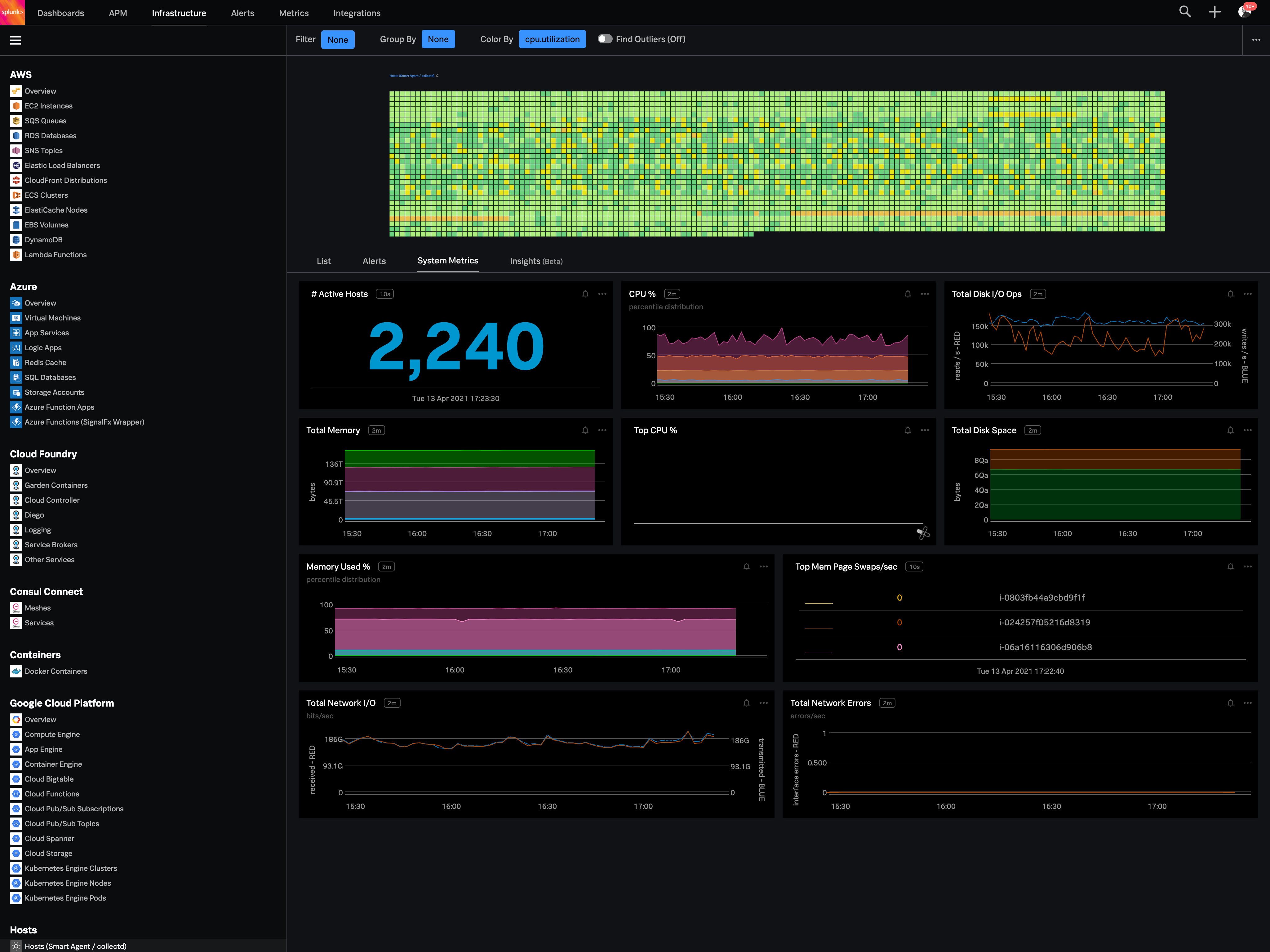
Splunk Observability Cloud aims to enable operational agility and better customer experience through real-time AI-driven streaming analytics allowing accurate alerts in seconds. It is designed to shorten MTTD and MTTR by providing real-time visibility into cloud infrastructure and services.

Media

Screenshot of Real-time monitoring for public, private and hybrid cloud

Screenshot of Real-time monitoring for public, private and hybrid cloud

Splunk Observability Cloud

Use Cases and Deployment Scope

it allows for the full view or the picture to be created on how to analyze the full depth of logs within our environment and furthermore accessing them from cloud allows for the data to always be readily available at all times. In this instance it also provides a more secure manner of storing data and making sure it is readily available

Pros

  • analysis
  • insider threat
  • easy access

Cons

  • Splunk Observability Cloud language
  • user friendly
  • AI assistant

Return on Investment

  • data availability
  • real time analysis
  • threat detection

Usability

Alternatives Considered

Splunk Enterprise Security

The ultimate enterprise visibility tool for complex EKS and serverless architectures.

Use Cases and Deployment Scope

We use Splunk Cloud as primary APM and infrastructure monitoring tool for cloud native AWS environments.Our stack heavily relies on EKS,ECS and serverless lambda functions so by standardizing opentelemetry we ingest metrics , traces and logs directly into Splunk without proprietary agents.The biggest problem solved is Mean Time to Resolution(MTTR) during outages.Before Splunk, investigating 502 error on ALB meant manually checking cloud watch logs and container metrics.Now distributed tracing correlates the infra anomaly directly to failing microservices trace and exact log line.It also helps in end to end monitoring across staging and production servers.

Pros

  • The real time straming metrics ,means infra metrics and alerts update within seconds.
  • Native opentelemetry standardisation
  • Immediate log to trace correlation through log observer connect
  • Unified kubernetes troubleshooting
  • Built in AI Agent & LLM monitoring

Cons

  • Cost predictability and ingestion management
  • Steep learning curve
  • Ui Clutter
  • Heavy queries chokes system sometimes

Return on Investment

  • Reduce MTTR by around 60 percent and also recovered engineering hours . Troubleshooting became easier for teams.
  • Protected revenue and customer experience
  • Cloud infrastructure optimization
  • Efficiency of team has doubled.
  • Delivery time has reduced.

Usability

Alternatives Considered

Datadog, Prometheus and Grafana

Other Software Used

Splunk Enterprise Security, Splunk Cloud Platform, Slack, Atlassian Jira, Medium, Jenkins, Atlassian Bitbucket, Amazon Elastic Kubernetes Service (EKS), Kubernetes, OpenTelemetry, AWS CloudFormation, PagerDuty, Datadog, GitLab, IBM Terraform

Best solution for teams struggling with troubleshooting in production

Use Cases and Deployment Scope

So we use Splunk Observability Cloud for APM, Traces, Logs and Monitoring of our cloud resources and our application performance. So the main problem it solves is troubleshooting our engineers spent a lot time in troubleshooting but after using this everything is easy and automated we got alert of incident and also with same alert we get link of traces and logs so for our engineers it saves a lot time.

Pros

  • Troubleshoot errors
  • Optimize application
  • Monitor cloud resources
  • Centralized Incident Alerting

Cons

  • Advance dashboards are bit learning curve for user
  • Advance monitoring need more add ons means more cost
  • They need to give more out of the box dashboards so even small team can start with

Return on Investment

  • We have optimized our product
  • We have solved error with minimum downtime because of traces and logs
  • The main problem of this is if you go advance then cost is too high to pay

Usability

Alternatives Considered

Grafana and Amazon Elasticsearch Service

Other Software Used

Grafana, Amazon Elasticsearch Service

Solid Product but Overkill for Most Organizations

Use Cases and Deployment Scope

We use it mainly to monitor infrastructure and application performance across multiple environments, but also as part of our broader security and compliance visibility stack. It helps us detect performance issues, and unusual activity before they turn into incidents. It helps with problem of fragmented monitoring and limited visibility across systems that have to meet regulatory requirement especially for HIPAA and PCI data . We use infrastructure monitoring, alerting, and real-time dashboards that support both IT operations and security response teams.

Pros

  • Realtime visibility across infrastrucrte and applicaitons
  • Excellent traceability of data to get us to root cause
  • Dashboard are very flexible and customizable.
  • Easy integrations with the rest of our tech stack

Cons

  • Unnecessarily complicated licensing
  • UI needs and update. It's overly cluttered and difficult to learn
  • Big correlations for logs and traces can be slow and time consuming.

Return on Investment

  • Satisfies observability requirements for the reglatory requirements we have
  • Significantly reduces time to detect and remediate potential threats
  • Expensive to use. Ensure you are not on a consumption model.

Usability

Alternatives Considered

IntSights Cyber Intelligence, from Rapid7, CrowdStrike Falcon and SentinelOne Singularity

Other Software Used

Fortinet FortiGate, Rapid7 InsightIDR

Splunk Observability Cloud all way

Use Cases and Deployment Scope

In our organization, Splunk Observability Cloud is a critical component of our end-to-end monitoring and observability strategy. We use it to gain deep visibility into the health, performance, and reliability of our cloud-native applications and infrastructure in real time.

Pros

  • Data security
  • Custom Dashboards & Alerts
  • Log Management

Cons

  • Having the AI within Splunk Observability Cloud and let the users use human language and retrieve the data from it without the knowledge of SQL Splunk queries.

Return on Investment

  • Made the logging and observability much easier
  • Proactive Incident Detection & Resolution

Usability

Alternatives Considered

Grafana

Other Software Used

Cisco Catalyst Center, Cisco Nexus Dashboard, Cisco Nexus 9000 Series Switches