

Uptimeify
What is Uptimeify?
Uptimeify is a white-label monitoring and incident management platform for agencies, managed service providers (MSPs) and web service providers that maintain websites and infrastructure for multiple clients. It consolidates monitoring for an entire client portfolio into one dashboard, adds an internal incident response layer for the provider's team and presents status pages and reports under the provider's own brand.
Monitoring coverage
Website checks cover uptime, response time, SSL certificate validity, keyword presence, page size and HTTPS redirects. Server and service checks cover DNS, ICMP (ping), SSH, FTP, SMTP and IMAP/POP. Uptimeify also monitors client IP addresses against DNS blacklists (DNSBL) with delisting details and tracks domain expiry via RDAP with configurable thresholds. Multi-step Playwright browser flows verify journeys such as logins or checkouts, and heartbeat (cron) checks confirm that scheduled jobs have run.
Detection and alerting
A failed check is confirmed from multiple monitoring locations before an incident is opened. Probes operate from nine locations in six EU member states: Berlin, Frankfurt, Falkenstein and Nuremberg (Germany), Logroño (Spain), Paris (France), Milan (Italy), Warsaw (Poland) and Helsinki (Finland). Alerts can be routed across 29 notification channels, including Slack, Microsoft Teams, PagerDuty, Opsgenie, Pushover, SMS, voice calls, email and custom webhooks.
Incident management
The incident management module covers the work after the alert. On-call schedules support rotations and overrides, and escalation policies forward an unacknowledged page to the next tier. Alerts can be ingested from Uptimeify checks and from external tools such as Zabbix, Datadog, Grafana, Prometheus, Sentry and Beszel, as well as via webhook, email and an events API, and are grouped into incidents. Routing, roles and an incident timeline structure the response, and status page rules keep client status pages current. Analytics include MTTA and MTTR, postmortems and an organization audit log. For organizations subject to NIS2, report cases track the 24-hour, 72-hour and one-month deadlines, prepare report drafts in German or English and export a management report as PDF; submission to the authority remains with the customer. Incident management is internal to the provider's team and not visible to client logins.
Client-facing features
Uptimeify offers a free plan for status pages that does not require a credit card. Paid plans provide branded status pages, public or password-protected, on a custom domain, with services shown as "in maintenance" during planned work. Automated PDF reports carry the provider's logo for weekly, monthly or quarterly periods or a custom range. Maintenance windows can target a single monitor, several monitors, an entire customer or all monitors with a given tag, including recurring windows.
Administration and automation
Monitoring is organised into separate sub-accounts per client with role-based access (admin, editor, read-only), scopable to specific customers. A REST API covers customers, websites, monitors, status pages, maintenance windows and notification channels, using Bearer-token authentication with organization-wide or customer-scoped tokens and a documented rate limit of 600 requests per minute.
Hosting and subprocessors
Uptimeify is made and hosted in the European Union. According to its public subprocessor list, every subprocessor that handles monitoring or incident data is a European company: hosting at Hetzner, OVH, netcup, UpCloud and IONOS, SMS and calls through German providers with a German failover, and email through a Dutch provider. This may be relevant for providers serving EU or public-sector clients where data residency is a consideration.
Platform resilience
The platform is built without a single point of failure: redundant entry points, an active-active application layer, a PostgreSQL cluster with automatic leader failover and a replicated queue and cache layer. Checks and escalation run active-active across all nine locations, so the failure of one node or site does not stop detection or notification.
Intended users
Agencies, MSPs and freelancers managing anywhere from a small number to several hundred client sites who want branded, consolidated monitoring and incident response rather than separate tools built for a single organisation.
Categories & Use Cases
Screenshots


1 / 3
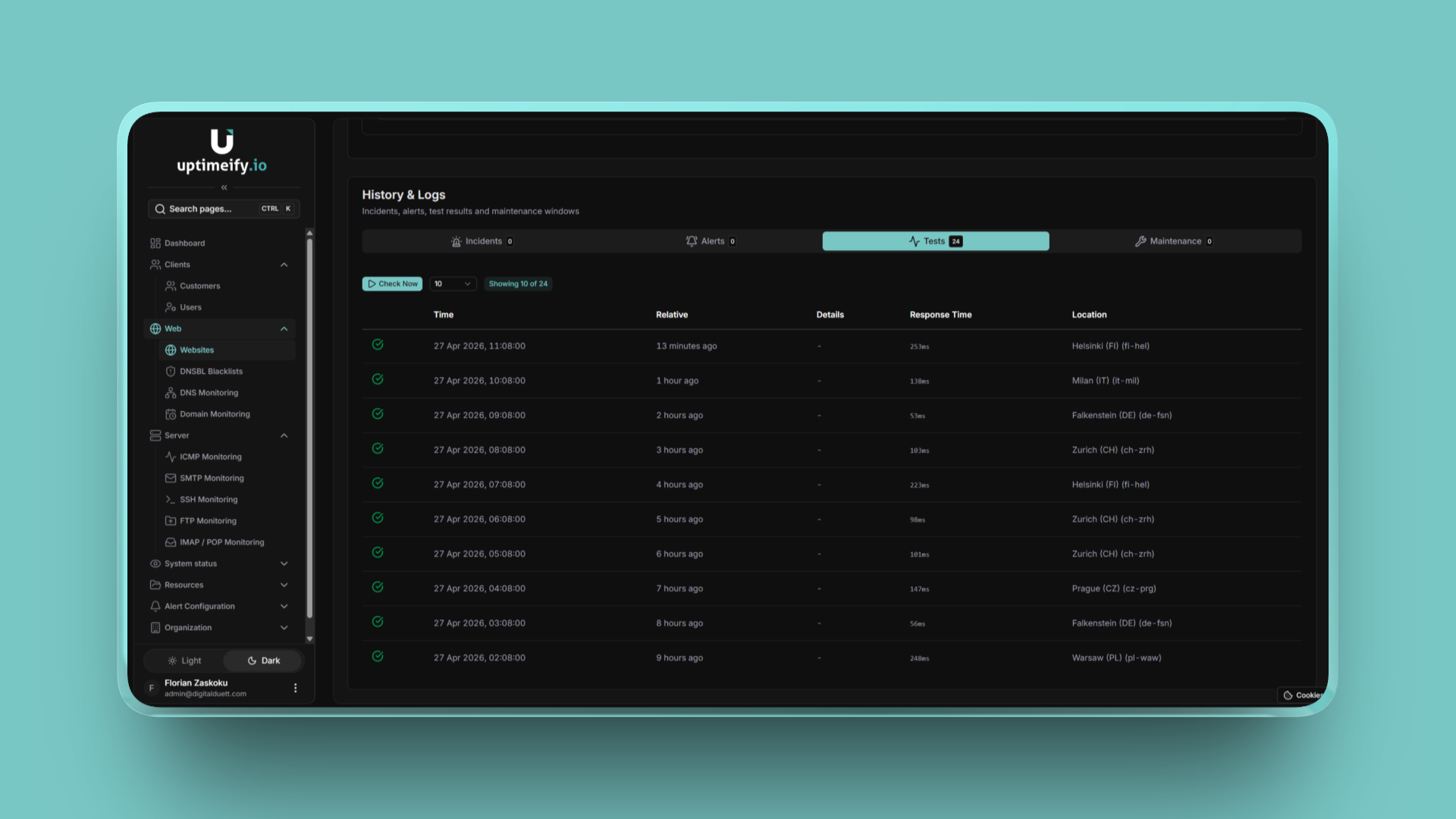
Screenshot of Dashboard
Technical Details
| Deployment Types | SaaS |
|---|---|
| Mobile Application | No |
| Supported Languages | German, English |